Why Your Allstate Car Insurance Costs So Much (And How to Fix It Fast)

If you’re wondering how can I lower my Allstate car insurance, the short answer is: you have more options than you think — and some of them can work within days.
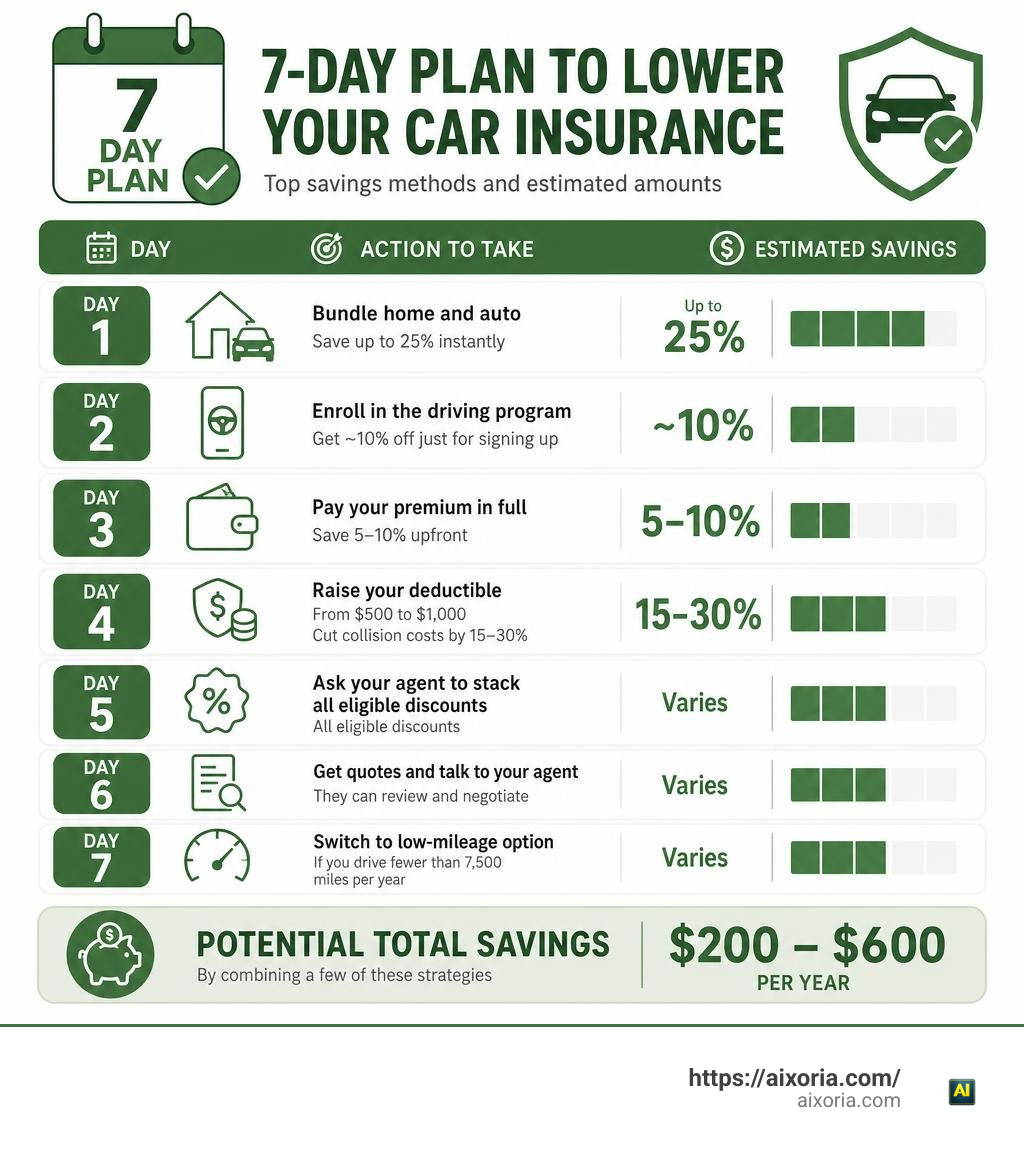
Here are the fastest ways to reduce your Allstate premium right now:
- Bundle home and auto — save up to 25% instantly
- Enroll in Drivewise — get ~10% off just for signing up
- Pay your premium in full — save 5-10% upfront
- Raise your deductible from $500 to $1,000 — cut collision costs by 15-30%
- Ask your agent to stack all eligible discounts — Allstate offers 12 in total
- Get competing quotes and bring them to your agent — exclusive agents have real flexibility to negotiate
- Switch to Milewise if you drive fewer than 7,500 miles per year
Allstate’s average full coverage rate is $243 per month ($2,915 per year) — roughly 30-40% above the national average. That’s a real gap. But it doesn’t mean you’re stuck paying that much.
Allstate actually cut rates in 32 states by an average of 9% in 2025, and its SAVE program reduced premiums for 7.8 million customers by an average of 17%. The savings are there — most people just don’t know to ask for them.
Most Allstate customers can realistically save $200 to $600 per year by combining a few of the strategies in this guide.
How Can I Lower My Allstate Car Insurance? The 3 Quickest Wins
If you want to see a drop in your premium before your next billing cycle, you need to focus on high-impact, immediate changes. Allstate is a premium brand, which means their base rates are higher to support their massive network of local agents and robust coverage options. However, we can use their generous discount structure to bring that premium down to a highly competitive level.

By combining what we call the “Power Stack”—bundling, telematics, and payment discounts—you can dramatically reduce your premium in less than a week. Let us walk you through the three quickest wins you can secure today. You can also read our detailed Allstate Auto Insurance Review 2026: Rates & Coverage – InsureMojo to see how these rates compare across different driver profiles.
Bundling Home and Auto Policies
The absolute heaviest hitter in the Allstate savings playbook is the multi-policy discount. When you bundle your auto insurance with an Allstate homeowners, condo, or renters insurance policy, you can save up to 25% on your auto premiums.
Here is a pro-tip that many drivers overlook: even if you do not own a home, adding a cheap renters insurance policy (which can cost as little as $15 a month) can trigger the multi-policy discount on your car insurance. In many cases, the discount you receive on your auto policy is actually larger than the entire cost of the renters policy itself. This results in net monthly savings while giving you extra protection for your personal belongings. Allstate values customer loyalty, and they view bundled policyholders as more stable, which is why they reward them with some of the steepest discounts in the industry.
Enrolling in the Allstate Drivewise Telematics Program
If you are a safe driver, you are leaving money on the table if you are not using Drivewise. Drivewise is Allstate’s telematics program that monitors your real-world driving habits through the Allstate mobile app. It tracks behaviors such as:
- High speeds (driving over 80 mph)
- Hard braking (sudden, rapid decreases in speed)
- Time of day (avoiding high-risk late-night driving between 11 PM and 4 AM)
- Phone use (avoiding distracted driving)
Just for enrolling in the program, Allstate will hand you an immediate discount of approximately 10% on your premium. While Allstate’s marketing materials advertise potential savings of up to 40% at renewal, customer reviews suggest that realistic ongoing savings for safe drivers average around 20% to 25%.
Best of all, in most states, Drivewise features a “no-downside guarantee,” meaning that even if you have a few hard-braking incidents, your rates will not go up. It is a risk-free way to shave a quarter off your bill. Just keep a car charger handy, as continuous background GPS tracking can drain your phone’s battery.
Stacking the 12 Available Allstate Discounts
Allstate offers 12 distinct discounts, and the secret to getting a rock-bottom rate is to stack as many of them as possible. Many of these discounts are not automatically applied to your account, so you must proactively ask your agent to verify them.
Some of the easiest payment and policy-related discounts to secure within 7 days include:
- The FullPay Discount: Pay your entire 6-month premium upfront instead of monthly to save 5% to 10%.
- EZ Pay: Set up automatic withdrawals from your bank account to save up to 5%.
- eSmart: Go paperless and agree to receive all policy documents online for an instant discount.
- Early Signing Discount: If you are shopping for a new policy, signing your paperwork at least seven days before the policy takes effect will earn you an easy discount.
By stacking paperless billing, automatic payments, paying in full, and Drivewise, you can easily knock 30% or more off your base rate. For a comprehensive breakdown of every single discount opportunity, check out the guide on Every Allstate Car Insurance Discount Explained (2026) | Compare.com.
Optimizing Your Policy Structure and Coverage Limits
Sometimes, the best way to lower your insurance cost is to take a hard look at what you are actually paying for. Many drivers carry coverages, limits, and deductibles that they set years ago and have never updated.

By optimizing your policy structure, you can lower your monthly premium without leaving yourself dangerously exposed to financial ruin.
How Can I Lower My Allstate Car Insurance Through Policy Adjustments?
One of the most effective ways to lower your premium is by adjusting your deductibles. Your deductible is the amount of money you pay out-of-pocket before your insurance coverage kicks in during a claim. Many drivers default to a $500 deductible, but moving from a $500 to a $1,000 deductible can cut your collision and comprehensive premiums by 15% to 30%. This can translate to an annual savings of $100 to $200.
Before you make this change, ensure you have enough liquid savings set aside to comfortably cover that $1,000 out-of-pocket expense if you are involved in an accident.
To make this transition easier, Allstate offers a unique program called Deductible Rewards. When you sign up, you get an immediate $100 off your collision deductible. For every year you drive claim-free, Allstate will knock another $100 off your deductible, up to a maximum of $500. Over time, this can effectively bring your $1,000 deductible back down to $500 at no extra cost to you.
| Deductible Level | Average Premium Impact | Out-of-Pocket Risk | Best For |
|---|---|---|---|
| $500 Deductible | Baseline Rate | Lower ($500 out-of-pocket) | Drivers with limited emergency savings |
| $1,000 Deductible | 15% to 30% savings | Moderate ($1,000 out-of-pocket) | Safe drivers with emergency savings |
| Drop Comprehensive/Collision | Up to 50% savings | High (No payout for vehicle damage) | Drivers with older cars valued under $5,000 |
Another policy adjustment to consider is dropping optional coverages on older vehicles. If you drive a car that is paid off and worth less than $5,000, you may be overpaying by carrying comprehensive and collision coverage. If the annual cost of your physical damage coverage exceeds 10% of your car’s total value, it is often financially smarter to drop those coverages and self-insure.
Additionally, look at minor add-ons like roadside assistance or rental car reimbursement. If you already have roadside coverage through AAA or a premium credit card, removing it from your Allstate policy can save you up to $100 per year.
Switching to the Milewise Pay-Per-Mile Program
Are you a remote worker, a retiree, or someone who primarily uses public transportation? If you drive fewer than 7,500 miles per year (and ideally under 5,000 miles), Allstate’s Milewise program could be your ticket to massive savings.
Milewise is a pay-per-mile insurance program. Instead of paying a flat monthly premium, your bill is split into two parts:
- A low daily base rate (often just a couple of dollars a day to keep the car insured while parked)
- A per-mile fee (usually a few cents per mile driven)
If your car spends most of its time sitting in the garage, switching to Milewise can easily slash your insurance bill by 30% to 50%. Your mileage is tracked using a small device plugged into your car’s OBD-II port or through your vehicle’s built-in telematics.
That Milewise is highly economical for low-mileage drivers, but it has limited state availability. Be sure to ask your local agent if Milewise is offered in your area.
Strategic Negotiation and Managing Renewal Rate Hikes
Many policyholders do not realize that insurance rates are not set in stone. While corporate algorithms generate the initial numbers, you have a powerful ally on your side: your local Allstate exclusive agent.
Unlike other companies that rely strictly on automated call centers, Allstate’s model is built on local, exclusive agents who are highly motivated to retain your business.
How to Negotiate with Your Allstate Agent Using Competing Quotes
Before you call your agent to negotiate, you need to do some homework. Spend an hour gathering competitive quotes from at least three other major insurance carriers. Make sure you are comparing “apples to apples” by matching the exact same coverage limits and deductibles you currently have with Allstate.
Once you have those quotes in hand, call your local Allstate agent directly—do not call the national 1-800 customer service number. The corporate phone representatives have very little wiggle room, but your local agent’s livelihood depends on policy retention.
Use this simple script:
“I’ve been a loyal Allstate customer for years, but I recently received a competing quote that is $400 cheaper per year for the exact same coverage. I really want to stay with Allstate because of your local service, but the price gap is too large to ignore. Is there anything we can do to review my policy, apply new discounts, or adjust my rate to make it competitive?”
Faced with a customer who is ready to walk, agents will often run a comprehensive policy review. They may find affinity discounts (such as discounts for your employer, college alumni association, or professional organizations) that were never applied, or manually adjust your rating tier to close the price gap.
What to Do When Your Premium Increases at Renewal
It is incredibly frustrating to open your renewal bill and see that your premium has increased, especially when you have had a clean driving record and no claims. This is a common industry-wide issue driven by systemic inflation, rising vehicle repair costs, and increased weather-related claims.
If your rate jumps at renewal, do not just accept the “inertia tax” and pay it. Follow this step-by-step response plan:
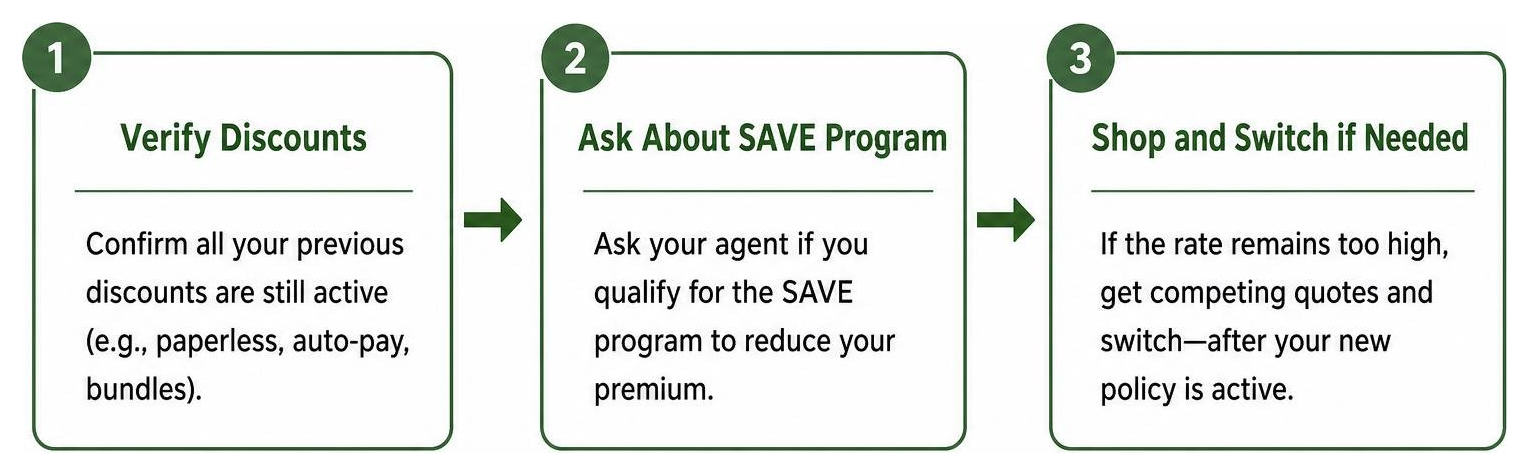
First, verify that all your previous discounts are still active. Sometimes, paperless billing or automatic payment authorizations can lapse, causing your rate to spike.
Second, ask your agent if you qualify for Allstate’s SAVE program. In 2025, this specialized rate-relief initiative reduced premiums for 7.8 million customers by an average of 17% to help offset inflation-driven rate hikes.
Finally, if your agent cannot bring the rate back down to a comfortable level, it is time to shop around. Always ensure your new policy is active before canceling your Allstate coverage to avoid a high-risk coverage lapse.
Improving Personal Risk Factors for Long-Term Savings
While policy adjustments and discount stacking can lower your rates within 7 days, the most sustainable way to keep your Allstate premiums low over the long term is to improve your personal risk profile. Insurance is ultimately a game of risk evaluation, and showing Allstate that you are a low-risk driver will naturally yield the best rates.
Boosting Your Credit Score and Driving Record
In most states, insurance companies use a credit-based insurance score as a primary factor in determining your premium. Statistically, drivers with higher credit scores file fewer claims, which makes them highly attractive to insurers.
If you can improve your credit score by paying bills on time, reducing outstanding revolving debt, and correcting errors on your credit report, you could see a major drop in your premium at your next renewal. A few states (such as California, Hawaii, and Massachusetts) prohibit the use of credit scores for setting auto insurance rates, but for the rest of the country, credit health is directly tied to insurance costs.
Your driving record is equally critical. Traffic violations and at-fault accidents typically impact your premiums for three to five years. To mitigate this risk, you can:
- Take an approved defensive driving course: Completing a state-approved defensive driving class can earn you a 5% to 10% discount on your liability and collision coverages.
- Inquire about Accident Forgiveness: If you have a clean record, adding Accident Forgiveness to your policy can protect your rates from spiking after your first at-fault accident. While this add-on costs a small amount upfront, it can save you thousands of dollars in surcharges down the road.
How Can I Lower My Allstate Car Insurance for Teen Drivers?
Adding a teenager or young driver to your Allstate policy can cause your premium to skyrocket. On average, adding a teen driver can double your rates because young drivers represent the highest risk category on the road. Fortunately, Allstate offers several targeted strategies to soften this financial blow:
- The Smart Student Discount: Allstate has one of the most generous student discounts in the industry. While most competitors require a 3.0 GPA (B average) to qualify, Allstate’s Good Student discount has a lower threshold of just a 2.7 GPA (B- average). If your unmarried student is under 25 and maintains this GPA, you can save 10% to 15% on their coverage.
- The Resident Student Discount: If your college student attends a school at least 100 miles away from where the vehicle is garaged and did not take a car with them, you can secure a massive discount while keeping them fully covered when they return home for holidays and summer breaks.
- The teenSMART Program: If your teen completes the approved teenSMART driver education program, Allstate will reward you with an additional discount on your policy.
Frequently Asked Questions About Allstate Rates
Why is Allstate more expensive than other insurance companies?
Allstate positions itself as a premium insurance brand. Their higher rates reflect their business model, which includes maintaining a massive network of over 8,400 local, exclusive agents who provide personalized, in-person service. Additionally, Allstate offers highly customizable, robust coverage tiers (Basic, Standard, and Enhanced) that include premium features like New Car Replacement and Gap Insurance.
While value-focused carriers may offer lower base rates, Allstate can become highly competitive when you bundle multiple policies and stack their available discounts.
Does Drivewise ever increase your insurance rates?
In the vast majority of states, Allstate’s Drivewise program features a “no-downside guarantee.” This means that your rates will not go up based on poor driving habits tracked by the app; you will simply miss out on the maximum discount.
However, in a small handful of states, extreme high-risk driving behaviors (like consistent speeding over 80 mph or heavy late-night driving) can technically be used to adjust your premium upward. Be sure to ask your local agent about the specific Drivewise rules in your home state before enrolling.
How often should I review my Allstate policy?
We highly recommend reviewing your Allstate policy at least once a year, or immediately following major life milestones such as getting married, buying a home, moving to a new ZIP code, retiring, or changing to a remote work schedule.
Each of these life changes can trigger new discounts or allow you to adjust your annual mileage estimates down, which can result in immediate premium reductions.
Conclusion
Lowering your Allstate car insurance premium does not have to be an exhausting chore. By focusing on immediate, high-impact strategies like bundling your policies, enrolling in the Drivewise telematics program, and raising your deductibles, you can see a noticeable drop in your insurance costs in as little as 7 days.
At Aixoria, we believe in leveraging modern technology, smart optimization, and data-driven strategies to make life more affordable and efficient. Just as you can optimize your insurance policy for maximum savings, you can stay ahead of the curve in all areas of life by keeping up with the latest AI updates and technology trends. Take control of your policy today, call your local agent with competing quotes in hand, and stop overpaying for premium coverage!