Health Insurance for International Students in the USA: What You Need to Know
Scr0ll d0wn to D0VVNL0AD

Health insurance USA international students need is not optional — it is a financial lifeline and, in most cases, a legal requirement.
Here is a quick overview of what you need to know:
| Question | Quick Answer |
|---|---|
| Do I need health insurance? | Yes — required by most universities and many visa types |
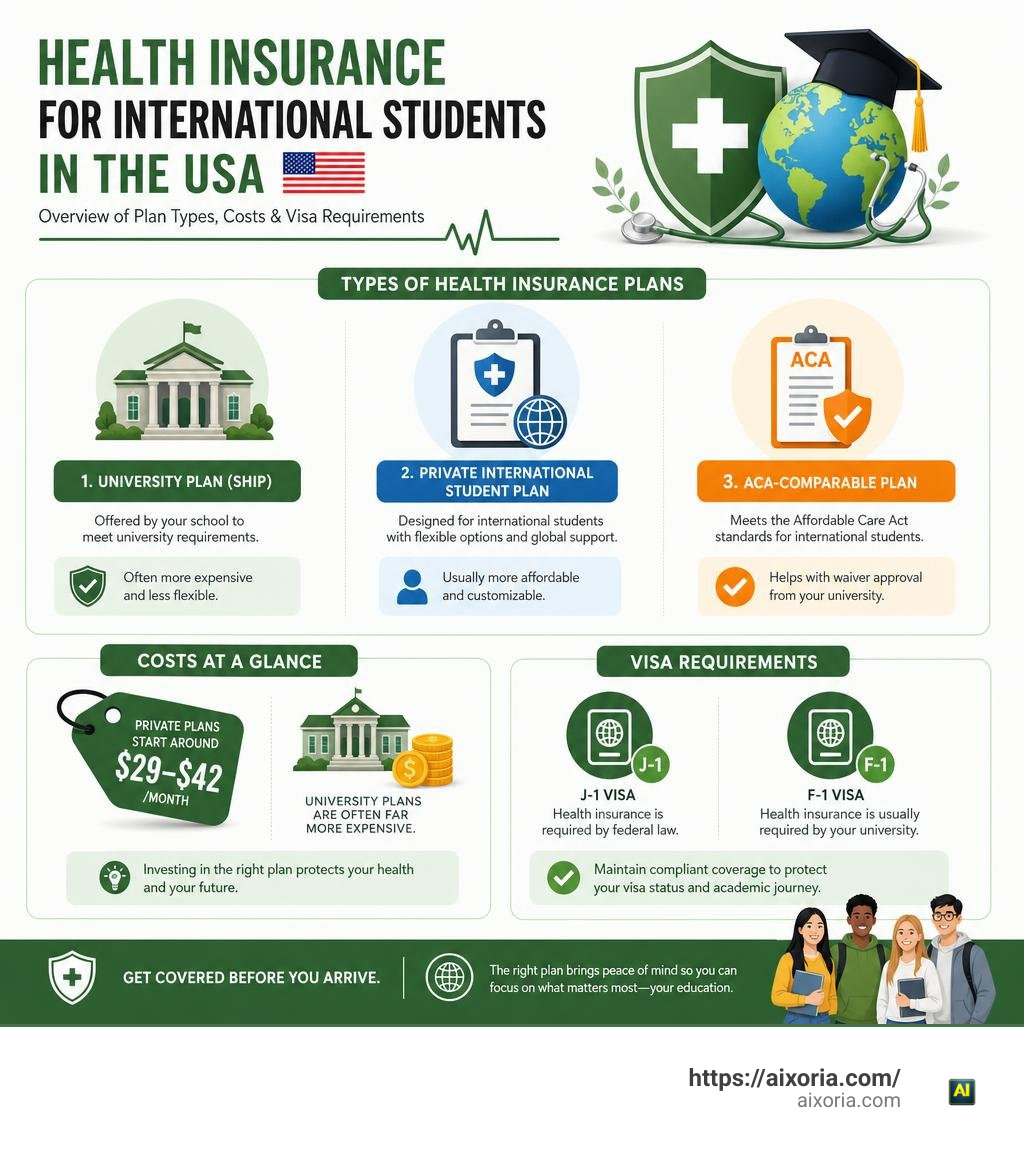
| Which visa types have mandates? | J-1 (federal law), F-1 (usually university policy) |
| What are my main plan options? | University plan (SHIP), private international student plan, ACA-comparable plan |
| How much does it cost? | Private plans start around $29–$42/month; university plans are often far more expensive |
| Can I skip the university plan? | Yes — if you qualify for a waiver with a comparable private plan |
| Can I buy coverage before arriving? | Yes — and you should |
The US healthcare system works very differently from most countries. There is no universal public coverage. A single emergency room visit can cost thousands of dollars — even for something minor. Without insurance, one accident or illness can create serious financial hardship.
That is why choosing the right plan before you arrive matters more than most students realize.
This guide breaks down everything you need to know: visa requirements, plan types, key terms, the school waiver process, and how to find affordable coverage that actually works for your situation.
Why You Need Health Insurance USA International Students
Moving to the United States for your studies is a thrilling milestone. However, navigating the highly privatized US healthcare system can feel like entering an administrative jungle. Unlike countries with nationalized healthcare or universal coverage, the US operates on a pay-as-you-go model driven by private insurance networks.
Having comprehensive coverage is not just about avoiding eye-watering medical bills; it is also a fundamental requirement to maintain your legal status and enrollment. If you are also planning to travel extensively before classes start or during breaks, you might want to look into the Best Travel Medical Insurance International to ensure you are covered during your transitional journeys.
Mandatory Visa Requirements for F-1 and J-1 Holders
For international students, visa regulations dictate your health insurance requirements. The rules differ significantly depending on whether you are traveling on an F-1 or a J-1 visa:
- J-1 Exchange Visitors and Scholars: The U.S. Department of State strictly mandates specific minimum insurance coverage levels for all J-1 visa holders and their J-2 dependents. As of July 2026, these federal mandates require:
- Medical benefits of at least $100,000 per accident or illness.
- Repatriation of remains in the amount of $25,000.
- Medical evacuation coverage to return the student to their home country in a crisis, valued at least at $50,000.
- A deductible that does not exceed $500 per accident or illness.
- The policy must be underwritten by an insurance corporation meeting specific financial rating standards.
- F-1 Visa Students: The US government does not enforce a federal minimum insurance requirement for F-1 students. Instead, the responsibility falls on individual universities. Almost all reputable US institutions require F-1 students to maintain continuous coverage and will automatically enroll them in their own expensive School Health Insurance Plan (SHIP) unless the student successfully completes a waiver process using a comparable private plan.
The Reality of US Medical Costs
Without proper coverage, seeking medical care in the US can lead to rapid financial ruin. A routine visit to a primary care doctor for a cold can easily cost $150 to $300 out of pocket. If you require diagnostic services like an MRI, you can expect bills running up to $10,000.
The most staggering costs are associated with the Emergency Room (ER). An ER visit for a minor issue like a sprained ankle or food poisoning can easily surpass $3,000 to $5,000. For severe accidents or acute conditions requiring inpatient hospitalization, bills can quickly reach tens or hundreds of thousands of dollars, making medical expenses the leading cause of personal bankruptcy in the United States.
Maintaining continuous health insurance protects your physical well-being and secures your financial stability, allowing you to focus entirely on your academic success.
Key Terms and Coverage in US Health Insurance Plans
Before shopping for a plan, it is essential to understand standard US health insurance terminology. Knowing these terms helps you accurately compare policies and avoid unexpected out-of-pocket expenses when seeking care. To understand how these rules compare to general travel policies, check out our comprehensive Travel Insurance Comparison 2026: Compare Plans & Save Money guide.

Deductibles, Copays, and Coinsurance Explained
When you use healthcare services, you and your insurance provider share the costs. Here is how that cost-sharing works step-by-step:
- Premium: The fixed amount you pay (usually monthly or per semester) to keep your insurance policy active.
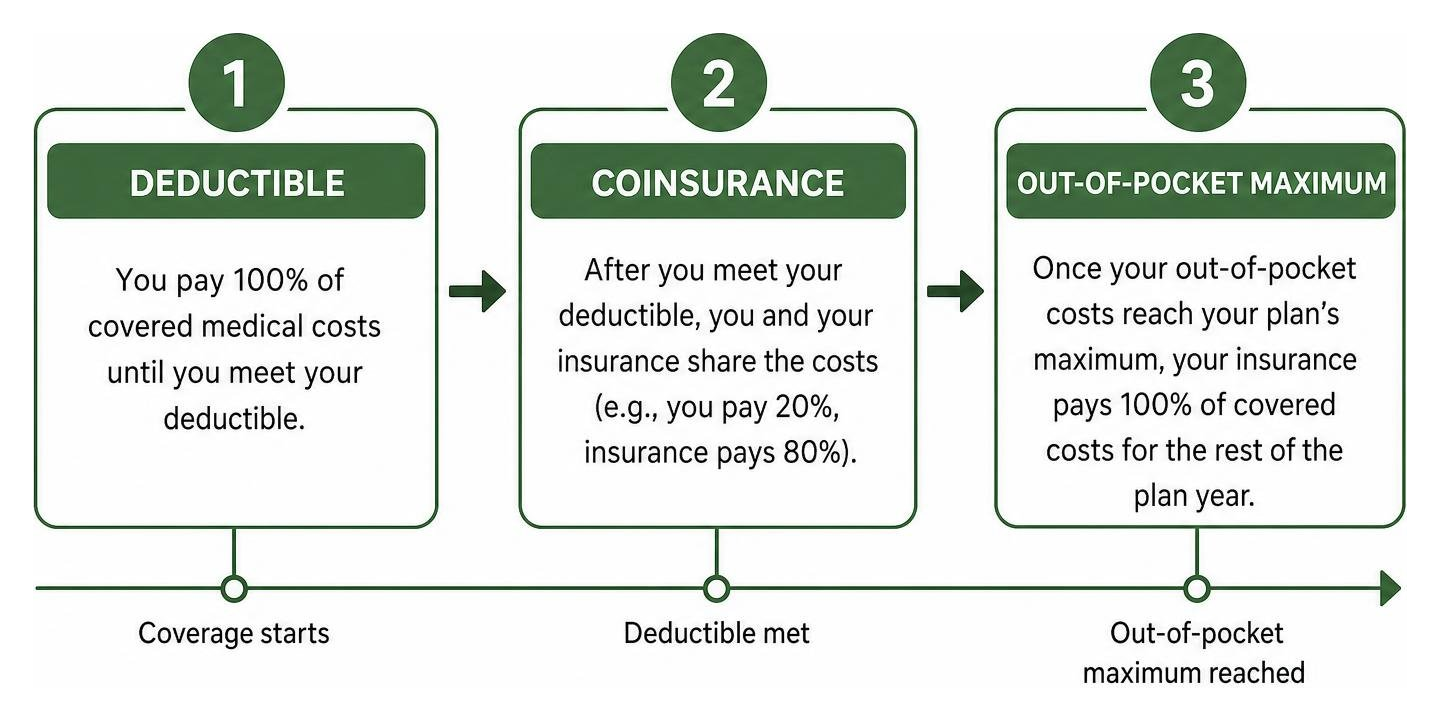
- Deductible: The amount of money you must pay out of pocket for medical services before your insurance starts paying. For example, if your plan has a $500 deductible, you must pay the first $500 of your medical bills yourself. Some premium plans, such as the BLUE 100 plan, offer a $0 in-network deductible to minimize your upfront costs.
- Copay (Copayment): A flat, fixed fee you pay at the time of service for a specific type of care. For example, you might pay a $20 copay for a doctor’s visit or a $150 copay for an emergency room visit.
- Coinsurance: Your share of the costs of a covered healthcare service, calculated as a percentage. If your coinsurance is 20%, your insurance pays 80% of the bill, and you pay the remaining 20% after you have met your deductible.
- Out-of-Pocket Maximum: The absolute limit on what you will pay for covered services in a single policy year. Once your deductibles, copays, and coinsurance payments reach this limit, the insurance company pays 100% of all covered medical expenses for the rest of the policy year.
Essential Medical Benefits and Common Exclusions
A typical, high-quality health insurance USA international students plan covers a wide array of medical needs, but you must read the policy brochure carefully to identify exclusions.
- What is typically covered:
- Inpatient hospitalization and outpatient surgeries.
- Doctor visits and specialist consultations.
- Prescription medications (often through designated pharmacy networks).
- Mental health services, including outpatient therapy and counseling.
- Emergency medical evacuation and repatriation of remains.
- Telemedicine services for 24/7 virtual doctor visits.
- What is typically excluded or limited:
- Dental and Vision Care: Standard health insurance plans rarely cover routine dental cleanings or eye exams. You must purchase separate add-on plans or pay out of pocket.
- Pre-Existing Conditions: These are health conditions you had before your policy started. Many student plans cover pre-existing conditions immediately, while others may impose a waiting period (especially for dependents).
- High-Risk Sports: Injuries sustained while participating in professional, intercollegiate varsity, or extreme sports are often excluded, though informal intramural sports are usually covered.
Choosing the Right Plan: University SHIP vs. Private Options
When you arrive at your university, you will likely find that you have been automatically billed for the university’s default School Health Insurance Plan (SHIP). While convenient, these plans are notoriously expensive, often costing between $2,000 and $4,000 per year. Fortunately, most universities allow you to “waive out” of their plan if you can prove you have purchased a comparable private policy. To understand how to vet these private companies, read our review of the Most Reputable Travel Insurance Companies.
University SHIP vs. Private Health Insurance USA International Students
To help you decide whether to stick with your university’s default plan or purchase an independent policy, we have compiled a comparison of the two pathways:
| Feature | University SHIP Plan | Private International Student Plan |
|---|---|---|
| Average Cost | High ($2,000 – $4,000+ per year) | Low to Moderate ($400 – $1,500 per year) |
| Convenience | Automatic enrollment; billed directly to tuition | Requires manual purchase and waiver submission |
| Coverage Limits | Often unlimited (fully ACA-compliant) | Tiered options ranging from basic to unlimited |
| Waiver Process | Not required | Requires school approval of comparable coverage |
| Dependents | Often expensive or unavailable for families | Highly customizable options for spouses and children |
Many students realize they can save thousands of dollars by opting for private alternatives. Highly reputable providers offer tailored plans designed specifically to meet university waiver requirements. You can explore these options through International Student, Scholar & OPT Health Insurance Plans, which provides flexible, budget-friendly coverage.
How to Select the Right Health Insurance USA International Students Plan
When searching for a private plan, you should not simply buy the cheapest policy available. You must ensure it aligns with your specific visa rules and university guidelines.
If you are on an F-1 visa, check your university’s international student office website for their specific “waiver criteria.” Some schools require plans to be fully ACA-comparable, while others simply look for specific minimum benefit levels. For example, if you are attending the University of Chicago, you can look at the ISO Care plan, which is custom-designed to match that institution’s strict waiver standards.
If you are looking for highly customizable options, you can explore the Student Secure | International Student Health Insurance plans, which offer tiered coverage levels (Smart, Budget, Select, and Elite) to match both your budget and your visa requirements. For those seeking plans that are fully comparable to the Affordable Care Act (ACA) standards, ACA Compliant Health Insurance for International Students | VISIT Health Plans offers highly competitive rates that are widely accepted by US universities. You can also view affordable options from ISO Student Health Insurance – Affordable Plans for International Students in the USA, a provider that has served over one million international students since 1958.
Navigating the School Waiver Process and Filing Claims
If you decide to purchase a private plan, you must successfully navigate your university’s waiver process to avoid being double-billed.

Step-by-Step Guide to Waiving Your School Plan
The waiver process is straightforward if you follow these steps:
- Download Your School’s Waiver Criteria: Obtain the exact list of insurance requirements from your university’s student portal.
- Purchase a Compliant Plan: Select a private plan that matches or exceeds these requirements. Many top providers offer a “waiver guarantee,” meaning they will issue a full refund (minus a small processing fee) if your school rejects the plan.
- Submit the Waiver Form: Fill out your school’s online waiver form. You will need to upload your Certification of Coverage (a document provided instantly by your private insurer upon purchase).
- Await Approval: The school will review your policy. Once approved, the university SHIP charge will be removed from your student tuition bill.
Finding In-Network Doctors and Filing Claims
Once insured, using your plan efficiently requires staying “in-network.” US insurance companies partner with specific networks of doctors, hospitals, and pharmacies (such as the Aetna PPO or UnitedHealthcare networks).
- In-Network vs. Out-of-Network: In-network providers have agreed to discounted rates with your insurer. If you visit an in-network doctor, your insurance will cover a much higher percentage of the bill. If you go out-of-network, you will pay significantly more, and some plans may not cover the visit at all.
- Use Telemedicine First: For non-emergency issues like a sore throat, mild fever, or skin rash, utilize your plan’s virtual care or telemedicine service. It is often completely free, available 24/7, and saves you a trip to a clinic.
- Filing a Claim: If you visit an in-network provider, they will usually bill your insurance company directly. However, if you are asked to pay upfront, or if you receive a bill afterward, you must submit a completed claim form along with all itemized bills and payment receipts to your insurer within the required timeframe (usually 90 days).
Frequently Asked Questions about Student Health Insurance
Can I purchase health insurance before arriving in the USA?
Yes, you can—and you absolutely should. Most private providers allow you to purchase your plan online from your home country. You can select your policy’s start date to align perfectly with your travel plans, ensuring you are covered from the very moment you land in the United States. You will receive your digital insurance card and policy documents instantly via email.
What are the best health insurance options for students on OPT?
Graduating students transitioning to Optional Practical Training (OPT) or STEM OPT often face a coverage gap. They are no longer eligible for university SHIP plans, and their new employer’s benefits may not kick in immediately. Fortunately, private providers offer dedicated OPT health insurance plans starting as low as $29 to $42 per month, providing an affordable, flexible bridge to keep you protected during your job search.
Do I need a Social Security Number (SSN) to register for my insurance portal?
No. International students do not need a Social Security Number to purchase private health insurance, download their digital ID cards, or register for their insurance provider’s online member portal. You can easily register and track your claims using your university-issued Student ID number and your date of birth.”https://www.mediafire.com/file/ln2bkzpoil1d6hu/Dinosaurs_2.1_BY_MCMPDL.mcaddon/file“;
Conclusion
Securing affordable and reliable health insurance is one of the most critical steps in preparing for your academic journey in the United States. By taking the time to understand key insurance terms, comparing private plans against your university’s SHIP, and utilizing the waiver process, you can save thousands of dollars while maintaining top-tier coverage.
At Aixoria, we are dedicated to helping you navigate the complexities of international travel, technology, and global living. For more expert guides, insurance tips, and updates on navigating life abroad, explore our Aixoria AI Updates & Resources hub today. Protect your health, secure your financial peace of mind, and enjoy your American study experience to the fullest!