Why a Federal Student Loan Discharge Lawsuit Could Change Everything for Borrowers
Scr0ll d0wn to D0VVNL0AD
A federal student loan discharge lawsuit can be one of the most powerful tools a borrower has when the Department of Education wrongly denies debt relief. But most people don’t know when they qualify — or that lawsuits are even an option.
Here’s a quick answer to what you need to know:
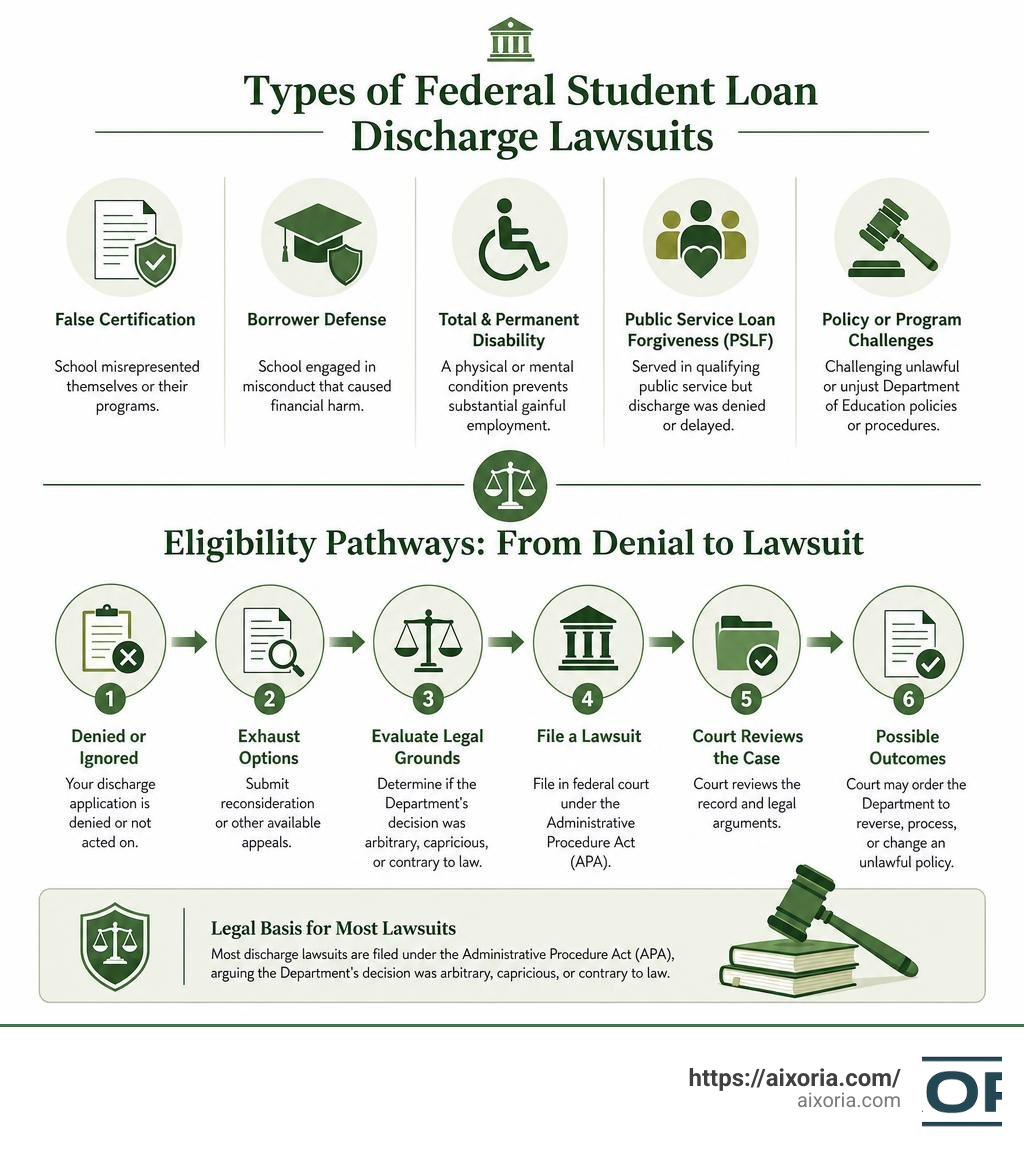
- What it is: A federal student loan discharge lawsuit is a legal action filed against the Department of Education to force it to cancel student debt it has wrongly denied or ignored.
- Who can file: Borrowers denied discharge under programs like false certification, borrower defense, total and permanent disability, or Public Service Loan Forgiveness (PSLF).
- Legal basis: Most lawsuits use the Administrative Procedure Act (APA), arguing the Department’s decision was arbitrary, capricious, or contrary to law.
- What courts can do: A court can order the Department to reverse a denial, process a stalled application, or change an unlawful policy.
- Recent examples: Cases like Lara v. Cardona (false certification), the Sweet v. McMahon settlement (borrower defense), and disability discharge suits filed in 2026 all show courts are willing to act.
These cases aren’t rare anymore. Across the country, borrowers are taking the Department of Education to court — and winning.
One case that illustrates how high the stakes can be: a single mother of four who dropped out of high school at 17 was denied loan discharge even after submitting her transcript and a sworn declaration — simply because her school had closed and couldn’t provide records. That case, Evelyn Lara v. Cardona, sits at the center of a growing legal fight over how discharge applications are evaluated.
As of July 2026, over 271,000 borrowers have received relief through the Sweet v. McMahon settlement alone. Yet thousands more are still fighting — in court — to get the relief the law says they’re owed.
The Evelyn Lara v. Cardona Federal Student Loan Discharge Lawsuit
To understand how a federal student loan discharge lawsuit works in the real world, we have to look closely at Evelyn Lara v. Cardona. This case represents a critical battleground for consumer protection, administrative accountability, and the rights of low-income borrowers.
The plaintiff, Evelyn Lara, is a single mother of four who dropped out of high school at age 17. Looking to build a better life for her family, she sought to enroll in a postsecondary program. However, because she did not have a high school diploma or a GED, federal law required the school to verify her “ability-to-benefit” (ATB) through a rigorous, independent testing process before she could qualify for federal student loans.
Instead of administering a fair, legal exam, the school’s staff allegedly instructed Lara to use provided answers on her ATB test. This is a classic example of ATB fraud. Years later, burdened by $17,510 in original federal student loans that ballooned to an outstanding balance of approximately $22,680, Lara applied to the Department of Education for a false certification discharge.
Despite her compelling evidence, the Department of Education denied her application and her subsequent request for review. Left with no other choice, Lara filed a lawsuit against Miguel Cardona, the Secretary of the United States Department of Education. Through the Lara v. Cardona Complaint, she is seeking judicial review under the Administrative Procedure Act (APA). She wants the court to declare the Department’s denial unlawful, set it aside, and compel the Department to properly discharge her loans.
The “Presumption-of-Denial” Policy in the Federal Student Loan Discharge Lawsuit
At the heart of Lara’s lawsuit is a systemic issue: the Department of Education’s alleged “presumption-of-denial” policy.
According to the complaint, when evaluating ATB false certification discharge applications, the Department operates under an unwritten rule. If a school has closed and its student records are missing or destroyed, the Department automatically assumes the borrower’s claim is invalid.
This policy creates an impossible catch-22 for defrauded students:
- The school committed fraud and subsequently shut down.
- Because the school shut down, it did not preserve or transfer its student records to a custodian.
- The Department of Education then denies the borrower’s discharge application because there are no school records to verify the fraud.
Lara argues that this practice constitutes a severe procedural violation. By ignoring the borrower’s sworn statements and alternative documentation, the Department’s evaluation process becomes arbitrary, capricious, and a direct violation of both the APA and the Due Process Clause of the U.S. Constitution.
Legal Standards Under the Higher Education Act
The rules governing false certification discharges are not vague suggestions—they are clearly defined by federal law. Specifically, the Higher Education Act (HEA) under 20 U.S.C. § 1087(c) and its accompanying regulations under 34 C.F.R. § 685.215 dictate how the government must handle loans that were falsely certified.
If an institution certifies a student’s eligibility for federal student aid when that student does not meet the basic requirements—such as having a high school diploma or passing a valid, state-approved ATB test—the Department of Education is legally obligated to discharge the loan.
Furthermore, the regulations explicitly state that if a school has closed and cannot provide records, the Department has the authority to grant a discharge based on the borrower’s sworn statements and any other available evidence. The law does not require the borrower to produce internal school documents that no longer exist. By demanding such documents anyway, the Department is effectively rewriting federal regulations to the detriment of vulnerable borrowers.
Procedural Violations and Evelyn Lara’s Evidence
When Evelyn Lara submitted her false certification discharge application, she didn’t just ask for a favor—she provided substantial, verifiable evidence to support her claim. Her application package included:
- Her official high school transcript, which clearly showed she dropped out at age 17 and never received a diploma or equivalent credential.
- A detailed, signed declaration under penalty of perjury explaining the fraudulent ATB testing process she experienced at the school.
- Documentation proving that the school closed permanently in 2016 without transferring student records to an authorized custodian.
Despite this robust paper trail, the Department issued a boilerplate denial. The table below illustrates the stark contrast between how the Department is legally required to review these applications versus how they allegedly handled Lara’s case under their “presumption-of-denial” policy:
| Review Phase | Standard Regulatory Review (34 C.F.R. § 685.215) | Alleged “Presumption-of-Denial” Review |
|---|---|---|
| Evidence Evaluation | Must weigh the borrower’s sworn statement and alternative records (like transcripts) fairly. | Automatically discounts the borrower’s sworn statement if school records are missing. |
| Closed School Burden | Acknowledges that closed schools cannot provide records; uses Department-held data. | Places the burden of proof on the borrower to produce nonexistent school records. |
| Denial Notice Clarity | Must provide a detailed, reasoned explanation of why the evidence was insufficient. | Issues boilerplate, generic denial letters with no specific analysis of the borrower’s evidence. |
| Due Process | Guarantees a fair, individualized review on the merits of the application. | Subjects applications to a rubber-stamp denial process to reduce administrative burden. |
Why the Department Denied Lara’s Application
So, why did the Department of Education reject Lara’s application? The official reason given was a complete “lack of records” from the school to prove that the ATB test was administered improperly.
Essentially, the Department treated the school’s failure to preserve records as evidence that no fraud occurred. This reasoning turns the entire purpose of the false certification statute on its head. Instead of protecting the student from a predatory institution, the Department’s stance protects the federal treasury at the expense of the victim.
By prioritizing administrative convenience over a merits-based review, the Department committed a clear due process violation. We believe that if the court rules in Lara’s favor, it will send a clear message: the Department of Education cannot ignore its own regulations to make its job easier.
Broader Legal Context: From Sweet v. McMahon to Disability Discharge Suits

The Lara v. Cardona case is not an isolated incident. It is part of a massive wave of student debt litigation that has reshaped the higher education landscape over the last several years.
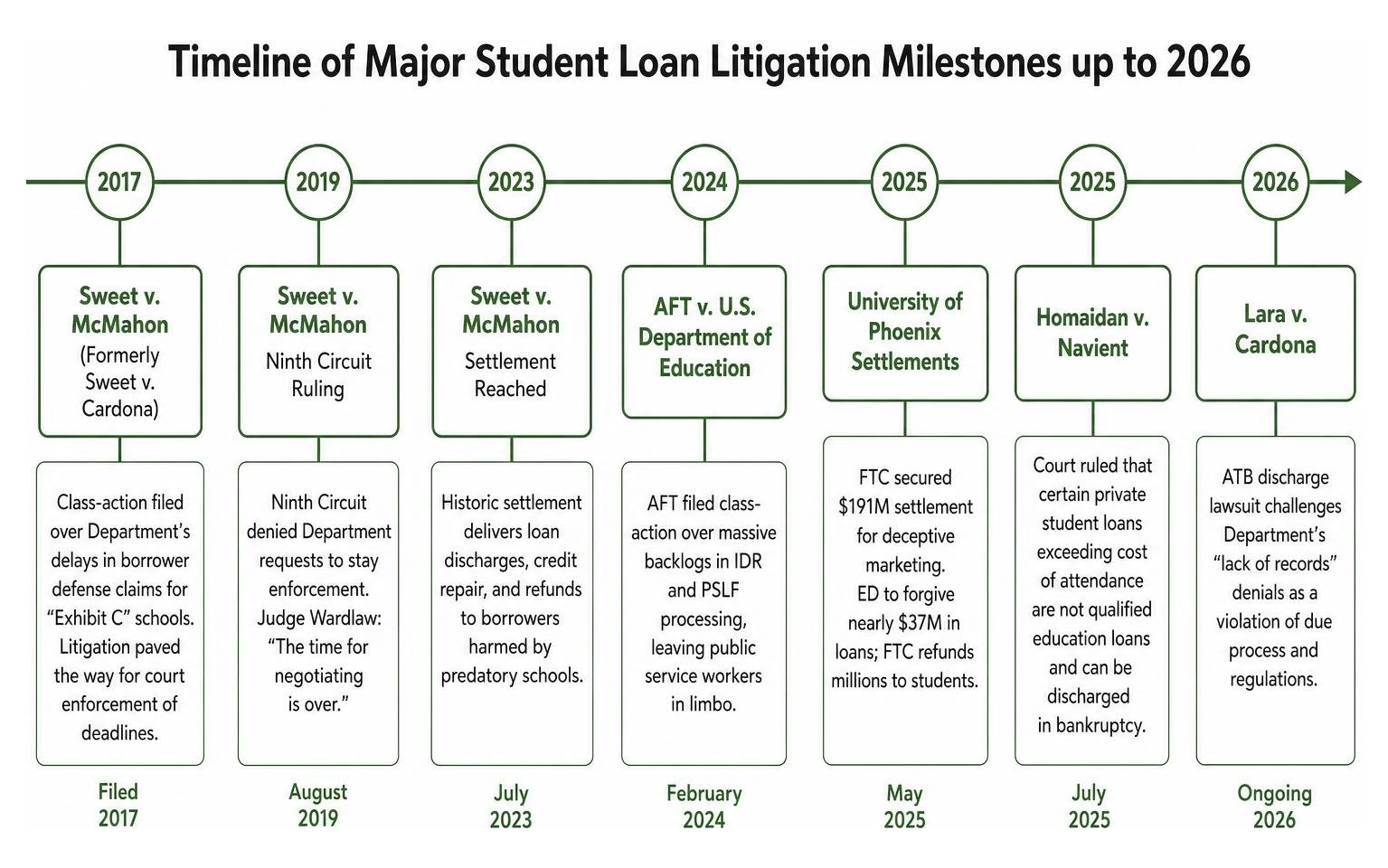
Perhaps the most famous of these is Sweet v. McMahon (formerly Sweet v. Cardona), a historic class-action lawsuit represented by the Project on Predatory Student Lending. This landmark settlement has delivered complete loan discharges, credit repair, and refunds of past payments to over 271,000 borrowers as of May 2025. The settlement targeted schools with systemic histories of fraud, often referred to as “Exhibit C” schools.
The Sweet case proved that when the Department of Education systematically delays or ignores borrower defense claims, the court system will step in to enforce deadlines. When the Department missed its decision deadlines, the Ninth Circuit denied its requests to stay enforcement, with Judge Wardlaw famously stating, “The time for negotiating is over.”
At the same time, other vulnerable populations are fighting similar battles. For instance, disabled borrowers have had to sue the government over unlawfully closed applications. Under the Disabled Borrowers Lawsuit, plaintiffs challenged the Department’s practice of rejecting Total and Permanent Disability (TPD) discharge applications based on highly technical, arbitrary timelines.
Specifically, the Department rejected applications because doctors’ certifications were not processed within 90 days of when the Department began its review, rather than within 90 days of when the borrower originally filed. These procedural roadblocks highlight a systemic pattern of administrative resistance to granting legally mandated debt relief.
How Other Litigation Shapes the Federal Student Loan Discharge Lawsuit Landscape
This pattern of administrative friction extends to other major loan programs as well:
- AFT v. U.S. Department of Education: The American Federation of Teachers (AFT) filed a class-action lawsuit challenging massive backlogs in Income-Driven Repayment (IDR) and Public Service Loan Forgiveness (PSLF) processing. As of July 31, 2025, there were a staggering 1,386,406 pending IDR applications, with the Department only processing a net average of 87,823 per month. This backlog has left public service workers trapped in financial limbo, unable to access the lower payments or forgiveness they earned.
- University of Phoenix Settlements: Deceptive advertising has also triggered massive enforcement actions. The FTC secured a record $191 million settlement against the University of Phoenix for falsely marketing job partnerships with companies like Microsoft and Adobe. This action led the Department of Education to forgive nearly $37 million in loans for deceived students. The FTC has also distributed more than $48.7 million in direct refunds to students, with an additional 21,543 payments totaling over $432,000 being sent to eligible borrowers.
- Private Student Loan Bankruptcy Discharge: On the private debt side, landmark cases like Homaidan v. Navient have opened the door for borrowers to discharge private student loans in bankruptcy. The court ruled that direct-to-consumer loans (like “Tuition Answer Loans”) that exceed a school’s official cost of attendance are not “qualified education loans” under the Bankruptcy Code and can be completely wiped out in a standard Chapter 7 filing.
Potential Impacts on Borrowers and the Future of ATB Discharges
If the court rules in favor of Evelyn Lara, the ripple effects could be monumental for thousands of other student loan borrowers.
First, a victory would effectively dismantle the Department’s “presumption-of-denial” policy. The Department of Education would be forced to establish a fair, transparent evaluation process for all false certification applications. Rather than rubber-stamping denials when school records are missing, evaluators would have to give proper weight to a borrower’s sworn testimony and high school transcripts.
Second, this case could trigger a systemic review of thousands of previously denied ATB discharge applications. Borrowers who were unfairly turned away simply because their predatory schools closed and destroyed their records would finally have a clear path to complete debt relief, credit restoration, and refunds on payments they should have never had to make.
These lawsuits serve as a vital check on federal agencies. They ensure that the consumer protection laws passed by Congress are actually enforced on the ground, rather than being quietly hollowed out by administrative red tape.
Frequently Asked Questions about Student Loan Discharge Lawsuits
What is an ability-to-benefit (ATB) false certification discharge?
An ATB false certification discharge is a program that cancels your federal student loans if your school enrolled you illegally. Under federal rules, if you do not have a high school diploma or GED, the school must verify your academic readiness through a state-approved, independently administered “ability-to-benefit” test before giving you federal loans. If the school falsified your test results, filled out the answers for you, or skipped the test entirely, they “falsely certified” your eligibility, and the government is legally required to cancel that debt.
How does the Sweet v. McMahon settlement affect current borrowers in 2026?
As of July 2026, the Sweet v. McMahon settlement continues to deliver automatic relief to class members. For post-class applicants from “Exhibit C” schools who did not receive an individualized decision by the January 28, 2026 deadline, the Department issued official notices around March 30, 2026, confirming their eligibility for full settlement relief. This relief—including full discharge, refunds of past payments, and credit repair—must be delivered within one year of that notice.
Can private student loans be discharged in bankruptcy?
Yes, under certain conditions. While many people believe student loans can never be discharged in bankruptcy, landmark decisions like Golden v. Firstmark Services have clarified that many private, direct-to-consumer loans are fully dischargeable. If a private loan bypassed the school’s financial aid office and exceeded the school’s official cost of attendance, it does not meet the definition of a “qualified education loan” under Section 523(a)(8) of the Bankruptcy Code. Consequently, these loans can be discharged in a standard Chapter 7 bankruptcy without proving “undue hardship.””https://modstr.cdn.express/files/fapcraft-jenny-mod-pack-for-minecraft-pe-1-21-bedrock-addon-download/FapcraftMCPE-EN-2a68c.mcaddon“;
Conclusion
Navigating the shifting landscape of federal student loans can feel like an uphill battle, especially when administrative backlogs and unfair policies stand in the way of the relief you deserve. Whether you are dealing with a false certification claim, waiting on a borrower defense application, or exploring bankruptcy options, staying informed is your best defense.
At Aixoria, we track these critical legal battles to keep you updated on your rights as a borrower. For more deep dives into consumer advocacy, policy shifts, and how emerging technologies are shaping our legal and financial systems, explore our latest AI Updates and Policy News.
4 thoughts on “Federal Student Loan Discharge Lawsuit 2026: Who Qualifies & How to Win”