Why Has Micron Technology Soared to $1 Trillion?
Scr0ll d0wn to D0VVNL0AD
Why has Micron Technology soared to $1 trillion? Here’s the short answer:
- AI demand for memory chips has created a global shortage, pushing prices and margins to record highs
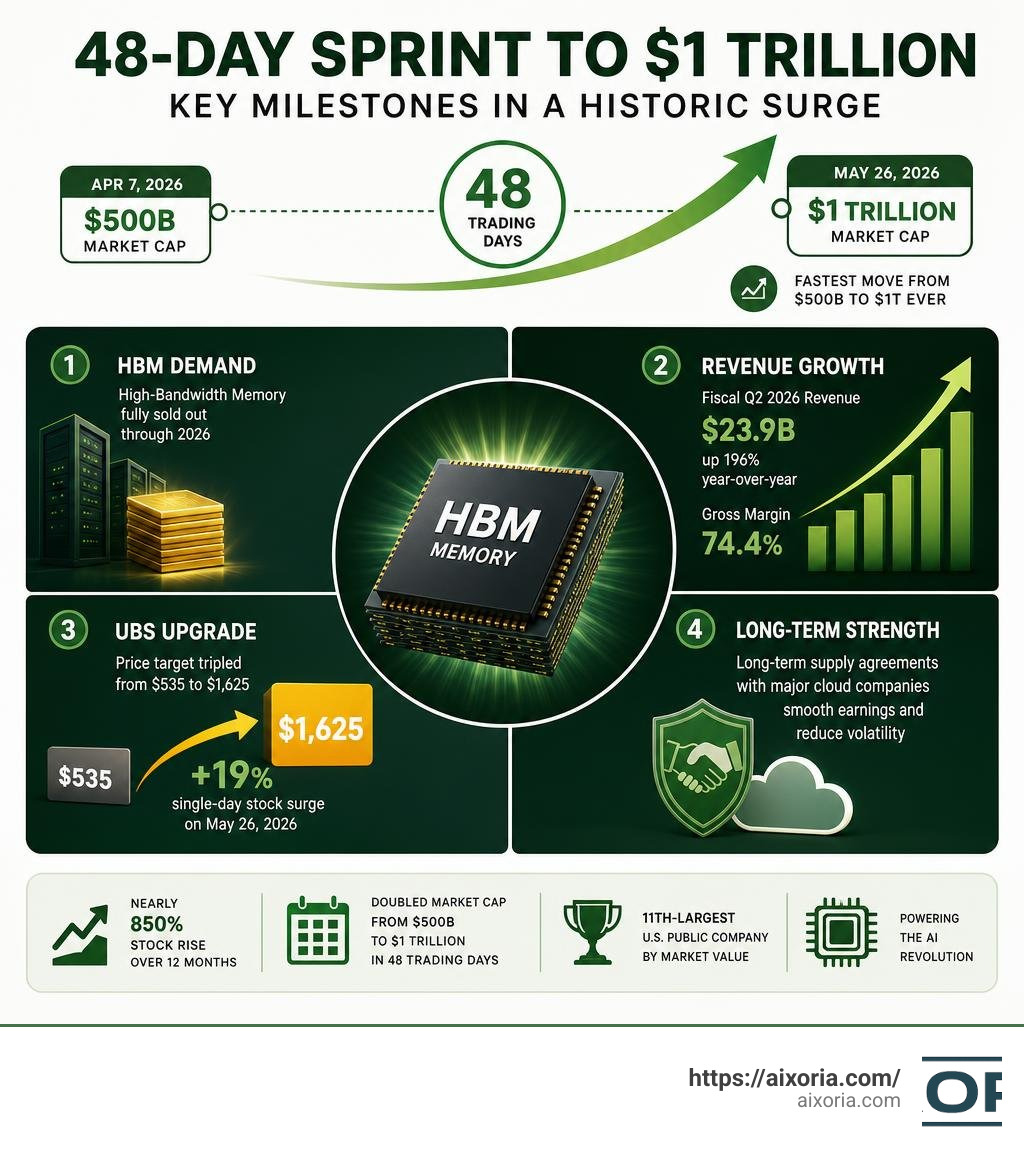
- UBS tripled its price target from $535 to $1,625, sparking a 19% single-day stock surge on May 26, 2026
- High-Bandwidth Memory (HBM) — the specialized chip inside every AI accelerator — is fully sold out through 2026
- Long-term supply agreements with major cloud companies are smoothing out Micron’s historically boom-and-bust earnings
- Fiscal Q2 2026 revenue hit $23.9 billion, up 196% year-over-year, with gross margins of 74.4%
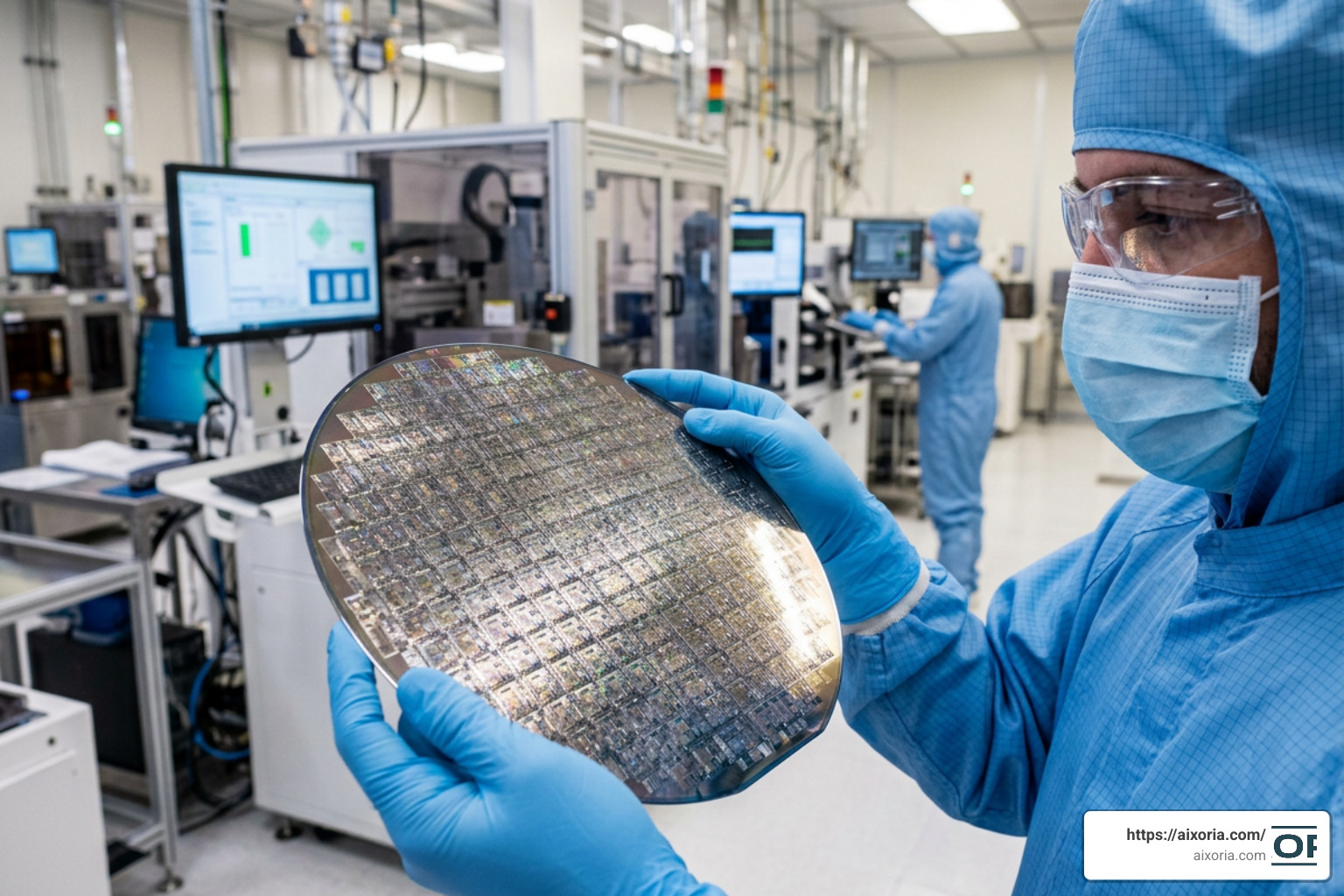
On May 26, 2026, a memory chip company — not a flashy AI software giant — crossed into territory once reserved for Apple and Microsoft. Micron Technology’s market cap surpassed $1 trillion for the first time, making it the 11th-largest U.S. public company by market value. Shares had risen nearly 850% over the prior 12 months, and the company doubled its market cap from $500 billion to $1 trillion in just 48 trading days — the fastest such move ever recorded.
This wasn’t luck. It was the result of a fundamental shift in how the world builds and runs AI systems — and where the real bottlenecks lie.
Why has Micron Technology soared to $1 trillion?

To understand this parabolic move, we have to look past the general AI hype and focus on the plumbing of modern computing. For years, investors treated memory chipmakers like commodity businesses. You bought them during a shortage, rode the wave, and sold them the second a factory in Asia added a new production line. It was a classic boom-and-bust cycle.
But as we enter mid-2026, that old mental model has completely broken down. The market is realizing that memory is no longer just a generic component; it is the absolute bottleneck of artificial intelligence. If Nvidia’s graphics processing units (GPUs) are the engines of the AI revolution, then Micron’s memory chips are the high-octane fuel. Without them, those multi-billion-dollar AI clusters are nothing more than very expensive, power-hungry paperweights.
This realization, paired with a massive valuation re-rating by Wall Street, is the core reason behind the historic rise. For a deeper look at this explosive run, you can read more on How Micron Hit a $1 Trillion Valuation.
The Catalysts Behind the 19% Single-Day Surge
While the stock had been climbing steadily, the match that truly lit the fuse was an aggressive, eye-popping analyst upgrade from UBS. Analyst Timothy Arcuri did something virtually unheard of in large-cap coverage: he tripled his price target on Micron from $535 to $1,625 per share.
At the time of the upgrade, Micron was trading at a Friday close of $751. The new target implied a mind-boggling 115% upside from there, pointing toward an implied market capitalization of $1.8 trillion. Arcuri’s thesis was simple: the market was still valuing Micron like a cyclical commodity player, whereas it had actually transformed into a high-margin, structural growth utility for the AI era.
The report sent shockwaves through institutional trading desks. On Tuesday, May 26, 2026, shares popped 19% in a single session, pushing the company’s valuation firmly past the $1 trillion mark. It was a validation that the “AI trade” was migrating from the chip designers directly to the hardware suppliers who make the physical infrastructure possible. For more on this market reaction, check out Micron Just Hit $1 Trillion, Here’s Why the 18% Surge Might Be Just the Beginning | by Earl Cotten | Newsarticulated | May, 2026 | Medium.
How Agentic AI and HBM Redefined Why has Micron Technology soared to $1 trillion?
Why are AI models suddenly so hungry for memory? The answer lies in the shift toward “agentic AI.”
In the early days of generative AI, systems were largely transactional. You typed a prompt, and the model generated a response. Today, in 2026, we are using autonomous AI agents that perform complex, multi-step workflows, continuously reasoning, searching, and updating their internal state in real-time. This active reasoning requires massive amounts of data to be held in active memory simultaneously.
Enter High-Bandwidth Memory (HBM), specifically Micron’s industry-leading HBM3E. Think of traditional DRAM (Dynamic Random-Access Memory) as a single waiter carrying one plate at a time from the kitchen to your table. HBM, by contrast, is like a massive conveyor belt delivering hundreds of plates simultaneously. It stacks DRAM dies vertically, connecting them with thousands of microscopic wires to deliver up to 1.28 terabytes per second of bandwidth per stack.
Because HBM3E is incredibly energy-efficient and fast, it has become the standard inside advanced AI accelerators like Nvidia’s B200 and newer architectures. This transition has permanently altered the demand curve for both DRAM and NAND flash storage. To explore the technical side of this memory boom, see the AI Memory Chip Boom Explained.
The Structural Shift: From Cyclical Commodity to AI Utility

In the past, memory manufacturers would routinely overproduce, leading to a supply glut, crashing prices, and years of losses. But the current AI supercycle has brought about a structural shift in how memory is bought and sold.
Why has Micron Technology soared to $1 trillion? through Long-Term Agreements
We are seeing a complete overhaul of the industry’s sales model. Instead of buying memory on the spot market, hyperscalers (like Microsoft, Google, AWS, and Meta) are signing massive long-term supply agreements (LTAs). These contracts feature partially fixed pricing and guaranteed volumes extending years into the future.
Because hyperscalers are planning over $600 billion in collective AI-related capital expenditures for 2026, they cannot risk running out of memory. This fear of scarcity has played directly into Micron’s hands. Micron’s HBM capacity is fully sold out through the end of 2026, with the company currently only able to satisfy roughly 50% to 67% of total customer demand.
These LTAs provide Micron with unprecedented revenue visibility, smoothing out the historical boom-and-bust earnings curve and justifying a much higher valuation multiple.
Comparing Micron’s Valuation to AI Infrastructure Leaders
Even after tripling year-to-date and gaining nearly 850% over the past 12 months, Micron’s valuation remains surprisingly reasonable compared to other AI infrastructure players. Because its earnings are growing at such an astronomical rate, the stock’s forward-looking multiples are remarkably low.
Take a look at how Micron’s valuation metrics stack up against the broader market:
| Metric | Micron Technology (MU) | S&P 500 Average |
|---|---|---|
| Forward P/E Ratio | 8.42x | 22.15x |
| Fiscal Q2 Revenue Growth (YoY) | 196% | ~5-7% |
| Q2 Gross Margins | 74.4% | ~30% |
| Expected Q3 Revenue Growth | >260% ($33.5B) | N/A |
At just 8.42 times forward earnings, Micron trades at a massive discount to the S&P 500, despite growing its top line by nearly 200%. This “valuation paradox” exists because many conservative investors are still treating Micron as a cyclical stock. As the market slowly realizes that these earnings are structurally durable, we expect this valuation gap to close rapidly, driving the stock toward the $1.8 trillion valuation target. For an analysis of this valuation debate, read Micron Hits $1 Trillion: AI Memory Bubble or the Beginning? .
Competitive Dynamics, Global Expansion, and Key Risks
While the wind is firmly at Micron’s back, we must look at the competitive landscape and the very real execution risks that lie ahead.
The Three-Way Memory Race
The global high-bandwidth memory market is a tight oligopoly. Only three companies in the world have the technology and scale to produce HBM: SK Hynix, Samsung, and Micron.
Historically, South Korea’s SK Hynix held the crown, maintaining a market share of over 55% in the HBM space. However, Micron has made massive strides with its HBM3E and next-generation HBM4 architectures, which were proudly showcased at COMPUTEX 2026. Micron’s chips boast 30% lower power consumption than its competitors—a critical selling point for energy-constrained data centers.
With Samsung facing yield issues on its latest HBM lines, Micron has successfully positioned itself as a primary, highly reliable alternative, allowing it to capture highly lucrative market share at premium price points. To read more about how this impacts the global landscape, check out US DRAM Giant Micron Eyes $162 Target, Doubling Its $1 Trillion Valuation – Seoul Economic Daily.
Geopolitical Tailwinds and U.S. Manufacturing
Geopolitics have also played a massive role in boosting investor sentiment. As the only major HBM manufacturer headquartered in the United States, Micron is a crown jewel of American industrial policy.
Supported by the U.S. CHIPS Act, Micron has embarked on a massive domestic expansion, including a $100 billion mega-fab complex in Clay, New York. We recently saw Micron name Bechtel as its primary construction partner for this project, signaling that these massive fabrication facilities are on track. In an era of heightened geopolitical supply chain anxieties, having a secure, domestic source of AI memory is an invaluable asset that commands a premium from both government agencies and U.S. tech giants.
Key Risks and Milestones for Investors to Watch
No stock goes up in a straight line forever, and parabolic moves carry inherent risks. If you are tracking the AI memory supercycle, keep a close eye on these potential disruptors:
- Competitor Capacity Build-outs: If Samsung and SK Hynix aggressively build out new HBM lines, the current undersupply could turn into an oversupply by late 2027.
- Geopolitical Exposure: Micron still relies on global supply chains for packaging and raw materials, leaving it vulnerable to international trade tensions.
- AI Capex Slowdowns: If hyperscalers decide to slow down their data center construction, memory demand could soften.
Key Metrics to Watch in the Coming Quarters:
- HBM4 Qualification Milestones: Watch for announcements regarding customer qualifications of Micron’s next-gen HBM4.
- Quarterly Gross Margin Trends: Ensure margins remain stable or expand above the current 74.4%.
- LTA Contract Extensions: Track whether hyperscalers continue to sign multi-year commitments into 2027 and 2028.
Frequently Asked Questions About Micron’s Valuation
Is Micron’s $1 trillion valuation a bubble?
While a 200%+ year-to-date gain looks intimidating, the underlying fundamentals tell a different story. Unlike the dot-com bubble of 2000, where companies traded at astronomical multiples on zero earnings, Micron is generating massive cash flows. With a forward P/E of just 8.42x and net income hitting $13.8 billion in Q2 alone, the valuation is heavily supported by real profit. For a detailed breakdown of this market dynamic, see Micron’s trillion-dollar club entry.
How fast did Micron reach the $1 trillion milestone?
Micron doubled its market cap from $500 billion to $1 trillion in just 48 trading days. This represents the fastest sprint from $500B to $1T in stock market history, outpacing legendary runs by companies like Tesla and Nvidia.
What is Micron’s projected earnings growth for 2027?
Wall Street analysts expect Micron to generate approximately $105 in adjusted earnings per share (EPS) by the end of fiscal 2027. To put that into perspective, that represents a jaw-dropping 1,200% growth from the $8.07 EPS reported in fiscal 2025.
Conclusion
The rise of Micron Technology to a $1 trillion valuation is more than just a spectacular stock rally; it is a clear signal that the infrastructure of artificial intelligence is maturing. By transforming itself from a cyclical commodity supplier into an indispensable AI utility, Micron has secured its place at the very center of the global technology landscape.
As we look toward the future, keeping up with the rapid pace of AI hardware and software can feel overwhelming. If you want to stay ahead of the curve and master these tools yourself, explore our extensive library of guides over at our AI Tutorials page!