The Best AI Content Detectors for Arabic Text (Quick Answer)
Scr0ll d0wn to D0VVNL0AD
If you need to know which are the best AI content detectors for Arabic text right now, here is a fast overview based on available benchmarks and independent research:
| Tool | Arabic Accuracy | False Positive Rate | Key Strength |
|---|---|---|---|
| Originality.ai | ~100% on academic abstracts | As low as 1.09% | Highest benchmark accuracy on Arabic academic content |
| Pangram | 99.95% | 0.10% | 20+ languages, active learning, low false positives |
| Isgen | 96.4% (multilingual benchmark) | Near-zero claimed | 80+ languages, phrase-level highlighting |
| It’s AI | 98.7% on Algerian academic dataset | <0.5% | Sentence-level deep scan, strong Arabic support |
| Decopy AI | Up to 99% claimed | Not disclosed | Free, no login required |
| GPTCleanup | Not independently verified | Not disclosed | Arabic-specific focus, RTL support |
Arabic is now one of the fastest-growing languages online. AI writing tools like ChatGPT, Gemini, and Claude are being used to generate Arabic content at scale — in universities, newsrooms, and businesses across the Middle East and North Africa.
That creates a real problem.
How do you know if what you’re reading — or grading, or publishing — was actually written by a human?
For English text, AI detection is already well-developed. But Arabic is different. It has a complex root system, right-to-left script, and huge variation between formal Modern Standard Arabic and everyday dialects. Most AI detectors were built with English first. That means many of them struggle — or fail entirely — when faced with Arabic content.
The good news: research is catching up fast. A landmark study from KFUPM tested detection of AI-generated Arabic text across multiple large language models, including ALLaM, Jais, Llama 3.1, and GPT-4. Binary detection reached F1-scores as high as 99.9% on academic abstracts. Several commercial tools are now matching or beating those numbers.
This guide breaks down which tools actually work, what the benchmarks show, and what to watch out for before you make any high-stakes decisions based on a detection score.
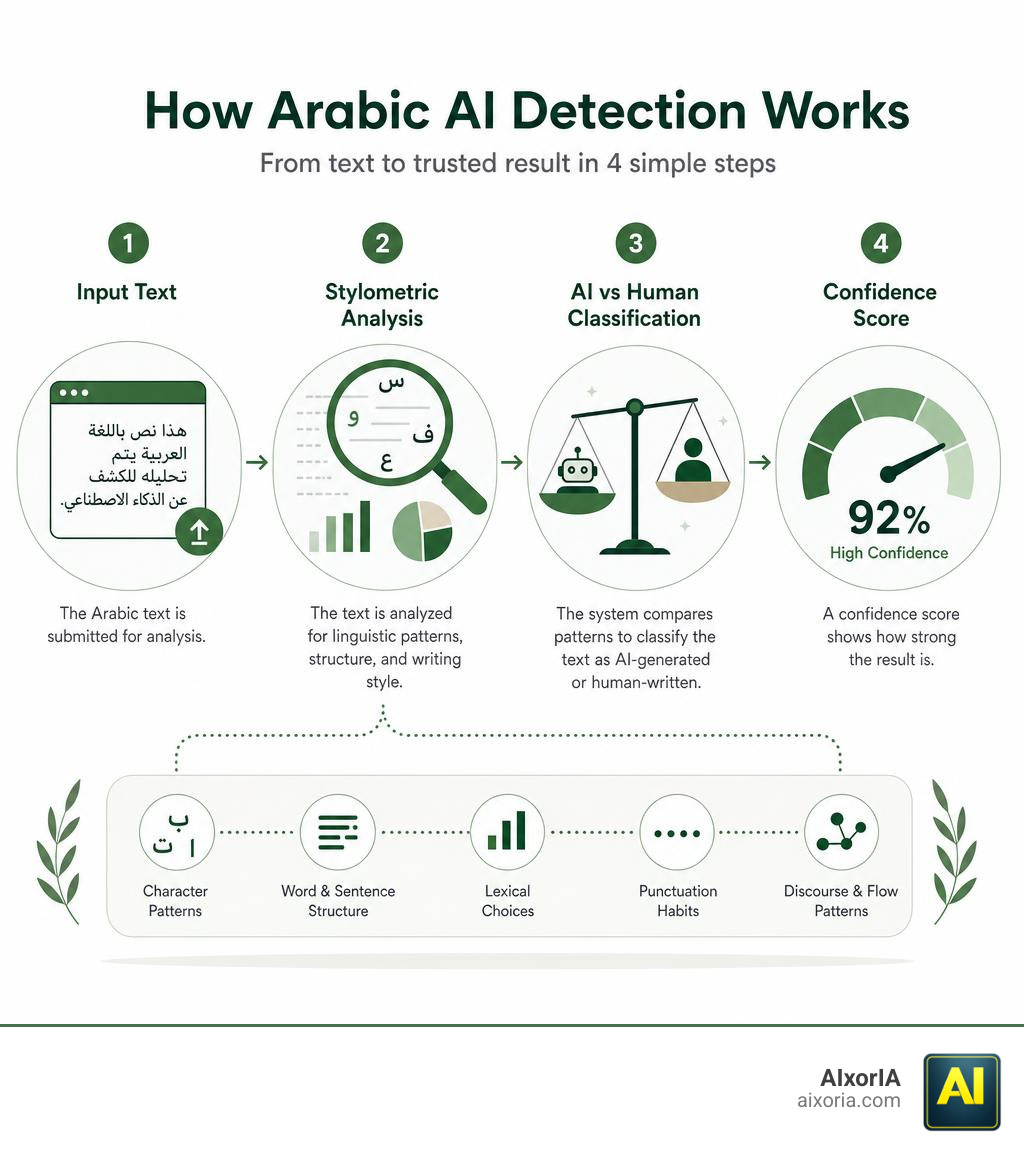
How Stylometric Features Power the Best AI Content Detectors for Arabic Text
To understand how detectors spot machine-generated Arabic, we have to look under the hood. AI tools do not read text the way humans do; instead, they analyze mathematical patterns. Specifically, they look for “stylometric features”—the unique linguistic fingerprints left behind by both humans and machines.
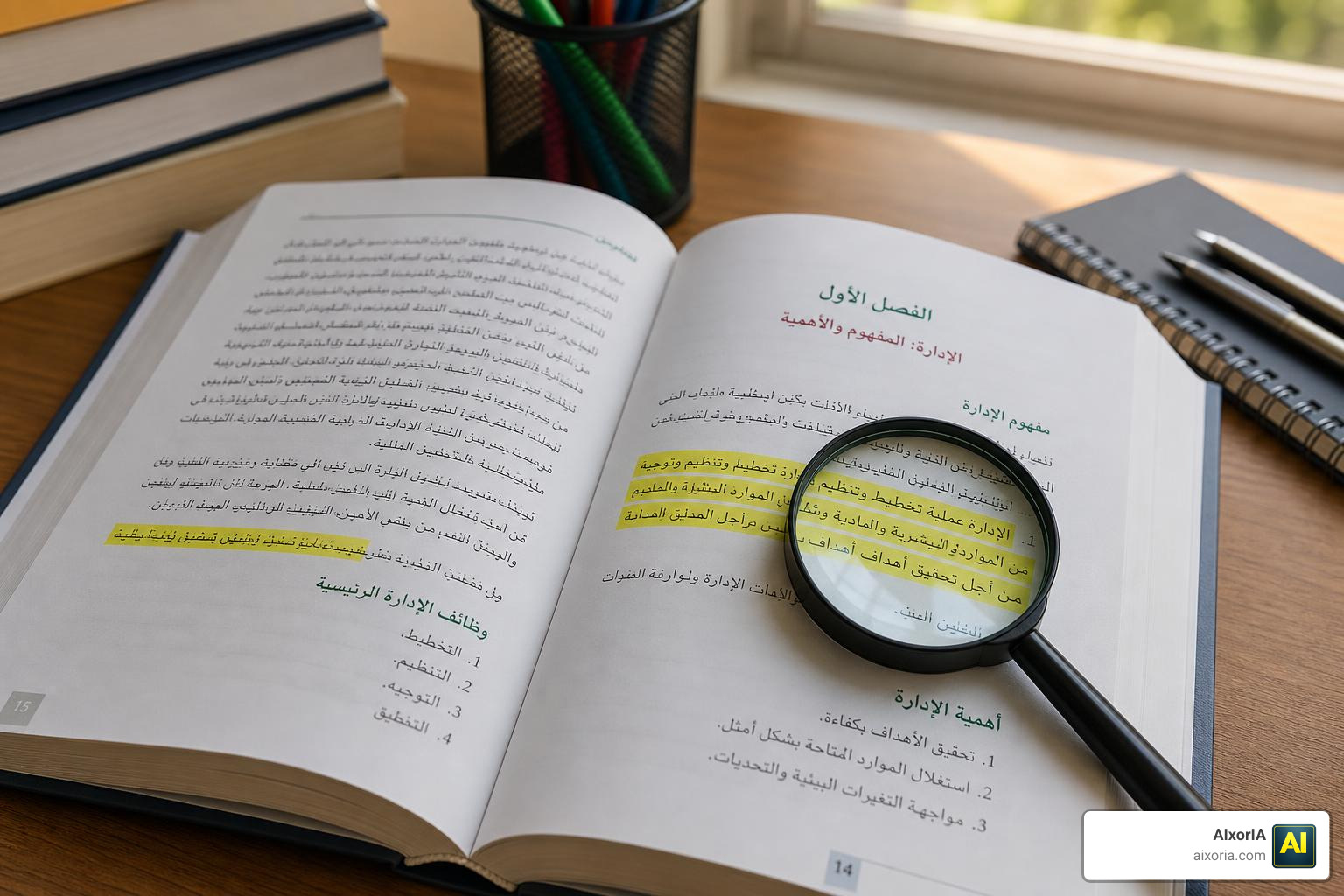
Analyzing Linguistic Signatures in Modern Standard Arabic
Modern Standard Arabic (MSA) is highly structured and morphologically rich. Words are built from three- or four-letter roots using complex templates. This morphological complexity is a double-edged sword for AI models.
When large language models (LLMs) generate Arabic, they tend to make very specific “stylistic” choices. The best AI content detectors for Arabic text analyze these key indicators:
- Vocabulary Diversity: Human writers use a rich, diverse vocabulary with rare words and creative phrasing. AI models tend to stick to a highly predictable, mathematically “safe” vocabulary.
- Sentence Patterns and Transitions: AI-generated Arabic often suffers from unnatural transitions between paragraphs. While a human might naturally vary sentence lengths, an LLM often produces highly uniform sentence structures.
- Formal Tone Consistency: AI models have an almost obsessive commitment to a perfectly formal, textbook-like tone. They rarely use the subtle, idiomatic expressions or regional nuances that a native Arabic speaker would weave into their writing.
How Detectors Handle Advanced Arabic LLMs
Today’s detectors are no longer just fighting basic translation tools. They have to square off against cutting-edge, Arabic-centric LLMs like ALLaM and Jais (70B), alongside global giants like Llama 3.1 (70B) and GPT-4.
These models use different generation strategies, which detectors must learn to identify:
- Title-only generation: Creating an entire piece from a single prompt. This is usually the easiest to detect because the AI has to generate all the stylistic transitions itself.
- Content-aware generation: Writing based on detailed background context provided by the user.
- Abstract or Post Polishing: Taking human-written text and “cleaning it up.” This is the hardest to detect because the core ideas and some vocabulary remain human, but the stylistic polish is done by a machine.
Academic Benchmarks and the Arabic AI Fingerprint Study
For a long time, commercial AI detectors made bold claims about their accuracy without any independent proof. That changed with the release of the KFUPM Arabic AI Fingerprint study (also known as the Arabic AI Fingerprint study).
This research analyzed a massive dataset of 8,388 academic abstracts and 3,318 social media samples across multiple models. The findings were eye-opening:
- Binary detection (simply deciding if a text is human or AI) achieved an incredible F1-score of 99.5% to 99.9% on academic abstracts.
- Cross-model generalization (the ability of a detector trained on one model, like GPT-4, to spot text written by another, like Jais) ranged from 86.4% to 99.9%. This proves that AI models share a fundamental “machine fingerprint” across different architectures.
Performance on Academic Abstracts vs. Social Media
The study highlighted a major performance gap depending on the type of content being analyzed.
- Academic Abstracts: Datasets pulled from platforms like the Algerian Scientific Journals Platform (ASJP) are highly formal and structured. Because academic writing follows strict rules, detectors like Originality.ai achieved a 100% accuracy and F1-score on AI-generated Arabic abstracts, with a false positive rate on human-written abstracts of just 1.09%.
- Social Media Content: Social media Arabic (such as book and hotel reviews) is much harder to analyze. It contains informal dialects, slang, spelling mistakes, and mixed languages. On OpenAI-generated social media content, Originality.ai still managed F1-scores over 99%, but the false positive rate on human-written social media text rose to 4.37%.
Open-Source Models and Fine-Tuned AraBERT Detectors
For developers and researchers who want to run detection locally, open-source models offer a powerful alternative to paid APIs.
A prime example is the AraBERT Arabic AI Text Detector model. This tool is built by fine-tuning AraBERT-v2 (bert-base-arabertv2), a highly respected Arabic NLP model containing 110 million parameters.
- Accuracy: It achieves a 95.0% accuracy on a balanced validation set.
- Precision & Recall: Balanced at 95.0% and 94.0% respectively.
- Inference Speed: Incredibly fast, taking only about 50ms per text on a GPU and 200ms on a standard CPU.
- Limitation: It is capped at a 512-token input limit and works best on formal Modern Standard Arabic.
Key Features to Look For in Arabic AI Detection Tools
If you are shopping for a tool to integrate into your school, publishing house, or business, you need more than just a raw accuracy percentage. You need usability.
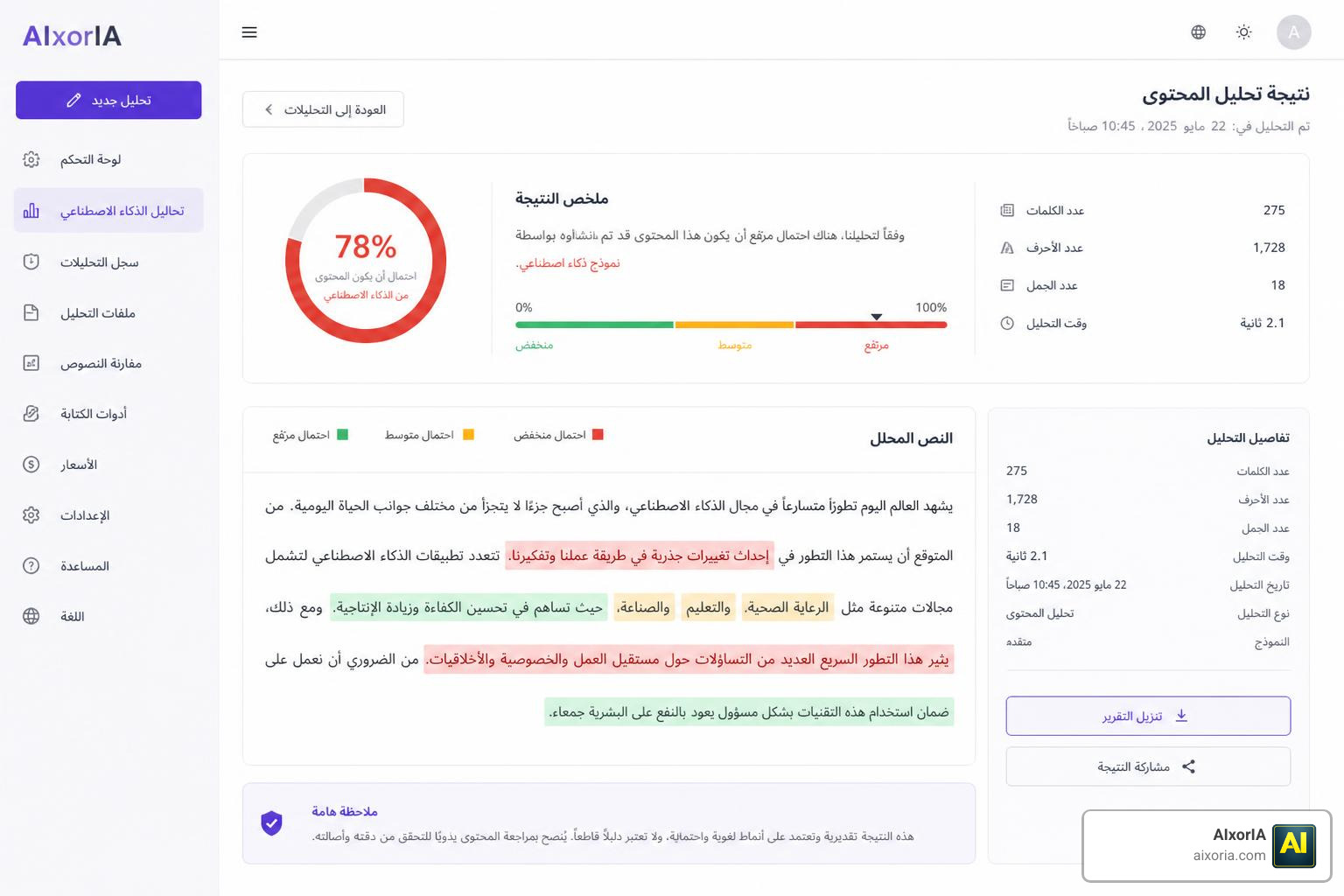
Core Capabilities of the Best AI Content Detectors for Arabic Text
The most effective tools on the market share several advanced features:
- Sentence and Phrase-Level Highlighting: Instead of just giving you a single percentage score (e.g., “85% AI”), tools like أداة الكشف عن الذكاء الاصطناعي باللغة العربية الأكثر دقة لـ ChatGPT والمزيد provide color-coded highlights. This shows you exactly which sentences are driving up the AI score.
- Multilingual Support with Active Learning: Tools like Pangram support over 20 languages (including Arabic, Spanish, French, and Persian) while maintaining near-99% accuracy. Pangram uses an active learning approach to recognize when writers use translation tools to bypass detectors.
- Right-to-Left (RTL) Formatting: Arabic text is written right-to-left. If a detector’s dashboard does not natively support RTL formatting, the text becomes a scrambled mess of punctuation and broken words, making manual review impossible.
Evaluating the Best AI Content Detectors for Arabic Text for Academic Integrity
In education, the stakes are incredibly high. A false accusation of using AI can destroy a student’s academic career.
When evaluating these tools for schools, we recommend looking for detectors that default to classifying unclear text as human-written. This conservative approach helps minimize false positives. Furthermore, look for tools that offer downloadable PDF reports and API access so you can run bulk scans of student submissions through platforms like Canvas or Moodle.
Limitations and Best Practices for High-Stakes Decisions
No AI detector is 100% accurate. We cannot stress this enough: never use AI detection alone to make decisions that could impact a person’s career or academic standing.
| Content Type | Detection Reliability | Primary Challenge | Best Practice |
|---|---|---|---|
| Academic & Scientific Papers | Extremely High (~99%) | Highly formal human writing can look like AI | Look for a pattern of flagged sentences rather than a single high score. |
| Social Media & Blog Posts | Moderate to High (~90-95%) | Dialects, slang, and mixed-language text | Use detectors trained specifically on informal Arabic datasets. |
| Translated & Paraphrased Text | Moderate (~85-90%) | Machine translation patterns mimic AI writing | Use tools with active learning that spot translation-paraphrased text. |
Another fascinating use case for these tools is online safety. In the Middle East, scammers frequently use AI to write highly convincing, automated messages. By pasting suspicious texts from job listings or known Dubai scam lists into a free tool like the Arabic AI Detector, users can quickly check the probability score to see if a message was auto-generated, helping them avoid UAE job scams.
Frequently Asked Questions about Arabic AI Detection
Can AI detectors accurately distinguish between human-written and AI-generated Arabic?
Yes. Thanks to advanced stylometric analysis, the top tools can identify unique machine signatures with over 95% to 99% accuracy on formal Modern Standard Arabic. However, accuracy drops slightly when analyzing informal regional dialects.
Why is Arabic AI detection more challenging than English?
Arabic is a morphologically rich language with complex root systems and a right-to-left script. Additionally, there is a massive difference between formal written Arabic (MSA) and the dozens of spoken dialects used across the Arab world. Most AI models were designed for English first, meaning detectors have had to play catch-up to understand Arabic linguistic patterns.
How can I avoid false positives in human-written Arabic text?
If you are a human writer being flagged by an AI detector, try to vary your sentence structures, use active voice, write with a personal perspective, and include unique regional idioms. Highly formal, uniform, and passive writing is much more likely to trigger a false positive.
Conclusion
The landscape of Arabic AI content generation is moving at a breakneck pace. As models like Jais and ALLaM become more sophisticated, the tools we use to verify content authenticity must evolve alongside them.
At AIxorIA, we believe in making complex technology simple. We provide custom AI solutions, tool training workshops, tutorials, and performance audits to help businesses and institutions navigate this fast-changing landscape. Whether you are trying to protect academic integrity, verify marketing content, or audit your organization’s AI usage, we are here to help with affordable services and fast customer support.
Want to dive deeper into artificial intelligence? Learn more with AIxorIA AI Tutorials and stay ahead of the curve!
1 thought on “Best AI Content Detectors for Arabic Text”