Why Self-Hosting Your Email Newsletter Could Save You Thousands
Scr0ll d0wn to D0VVNL0AD
Open source email newsletter software gives you full control over your subscriber data, your sending infrastructure, and your costs — without paying a SaaS platform forever.
Here are the best options available right now:
| Platform | Best For | Tech Stack | Hosting |
|---|---|---|---|
| listmonk | High-volume campaigns | Go + PostgreSQL | Self-hosted |
| Keila | Privacy-first newsletters | Elixir + PostgreSQL | Self-hosted or EU cloud |
| Mautic | Marketing automation | PHP + MySQL | Self-hosted |
| phpList | Large subscriber lists | PHP + MySQL | Self-hosted or hosted |
| SendPortal | Team-based campaigns | Laravel + MySQL | Self-hosted |
| CadenceRelay | Bulk outreach | Node.js + PostgreSQL | Self-hosted |
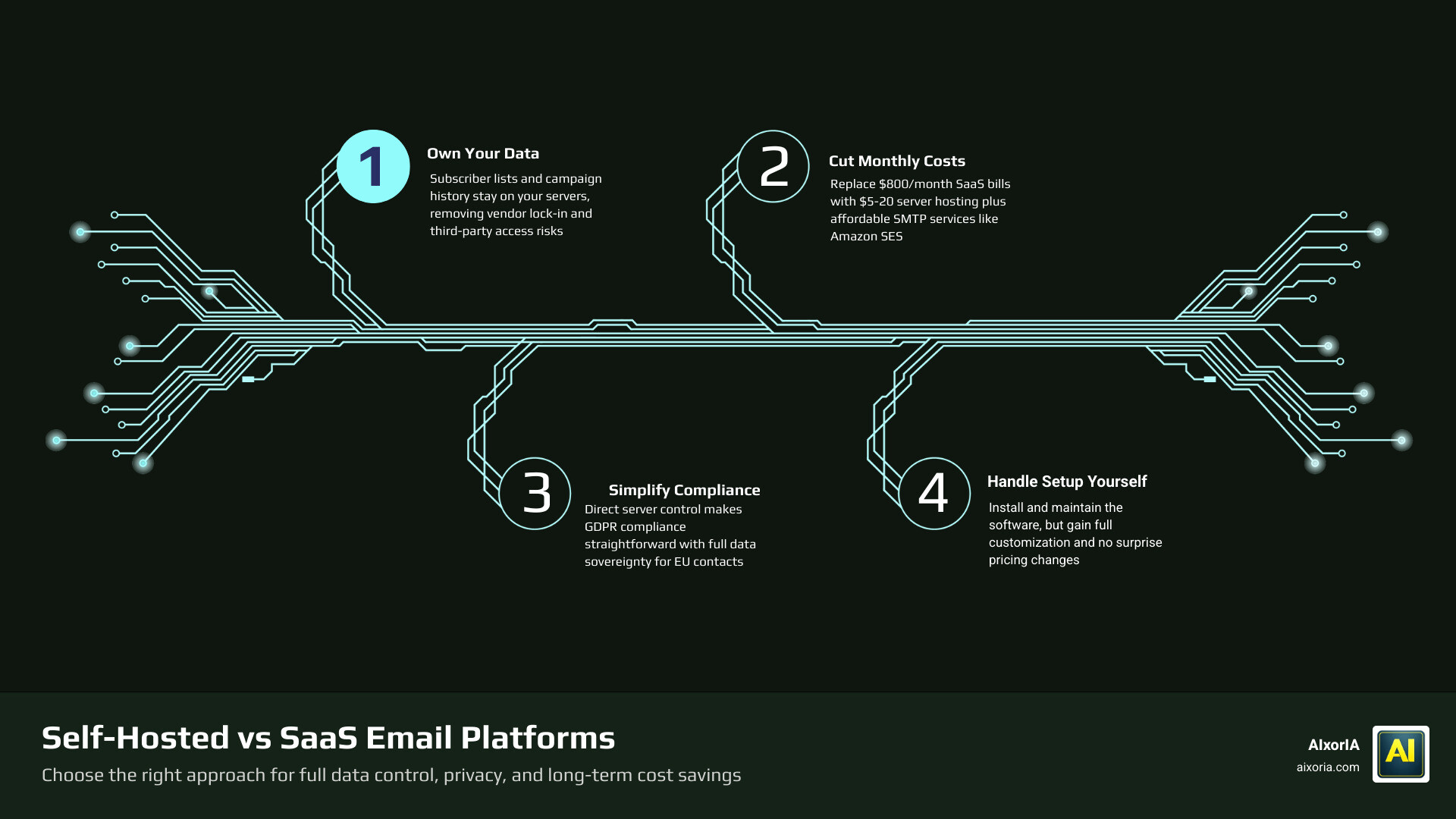
Most small business owners start with a tool like Mailchimp — and that’s fine. But as your list grows, the monthly bill grows with it. At 100,000 contacts, some platforms charge close to $800 per month.
Open source tools flip that model entirely.
You pay for your own server (often $5–$20/month), connect a service like Amazon SES, and send at a fraction of the cost. One popular tool, listmonk, has run campaigns of over 7 million emails using just 57 MB of RAM. That’s not a typo.
But cost is only part of the story.
When you self-host, you own the data. No third-party company is storing your subscriber list. No surprise policy changes. No vendor lock-in. For businesses with European customers, this also makes GDPR compliance much simpler to manage.
The trade-off? You handle installation, maintenance, and deliverability yourself. Some tools make this easier than others — and that’s exactly what this guide covers.
Why Choose Open Source Email Newsletter Software in 2026?
As we move through 2026, the digital landscape has become increasingly protective of user data. Relying on proprietary platforms often means your most valuable asset—your subscriber list—is sitting on someone else’s server. Choosing Open Source Email Newsletter Software isn’t just a technical decision; it’s a strategic one for data sovereignty.
One of the biggest headaches with “big tech” email tools is vendor lock-in. If a provider decides to double their prices or change their terms of service, moving 50,000 subscribers and all your historical campaign data can be a nightmare. Open source tools, often licensed under the AGPL (GNU Affero General Public License), ensure that you have the right to modify the software and move it wherever you like.
Furthermore, for those of us concerned with GDPR and privacy, self-hosting is a game-changer. You can ensure that data never leaves your jurisdiction. Many 9 Best Free Email Newsletter Platforms in 2026 now offer features like “no-tracking” modes to respect subscriber privacy while still delivering high-quality content. If you are just starting out, exploring 9 Best Email Newsletter Software for Small Business in 2026 can help you find a tool that scales with your growth without the “subscriber tax” found in SaaS models.
Top Open Source Platforms for High-Performance Campaigns
When we talk about performance in 2026, we aren’t just talking about how many emails you can send per hour. We are looking at how efficiently the software uses your server resources. If a tool requires a massive, expensive server to send a simple newsletter, the cost savings of open source vanish.
| Feature | listmonk | Keila | Mautic | phpList |
|---|---|---|---|---|
| Primary Language | Go | Elixir | PHP | PHP |
| Database | PostgreSQL | PostgreSQL | MySQL/MariaDB | MySQL |
| Performance | Extremely High | High | Moderate | High |
| UI Complexity | Minimalist | Modern/Clean | Comprehensive | Traditional |
For a deeper dive into the variety of tools available, check out our list of 9 Open Source Email Newsletter Software in 2026 or see how they stack up against the Top Email Newsletter Platforms in 2026.
listmonk: High-Performance Open Source Email Newsletter Software
If performance is your North Star, listmonk is arguably the king of the hill. Written in Go, it is distributed as a single, lightweight binary. This means it doesn’t need a complex web server setup to run—you just execute the file and connect it to a PostgreSQL database.
The efficiency of listmonk is legendary. In production tests, it has handled campaigns of over 7 million emails while consuming a fraction of a single CPU core and peaking at just 57 MB of RAM. It uses Go’s templating engine for dynamic content and offers powerful SQL-based segmentation. This allows you to query your subscriber database with precision, creating highly targeted lists without the lag found in bulkier systems. Beyond email, listmonk also supports multi-channel messaging, including SMS and WhatsApp, making it a versatile hub for all your outreach.
Keila: Privacy-First Open Source Email Newsletter Software
For those who want a modern user experience without the technical overhead of raw SQL, Keila is a fantastic choice. Built with Elixir, Keila is designed to be “easy and reliable.” It strikes a perfect balance between the flexibility of open source and the user-friendliness of a SaaS.
Keila features a visual block editor that makes designing newsletters a breeze for non-developers, but it also supports MJML and Markdown for those who want more control. One of its standout features is the “no-tracking” mode, which allows you to send newsletters without collecting intrusive data on your subscribers. This is particularly useful for 9 Best Internal Email Newsletter Software in 2026 where privacy within an organization is paramount. While it is fully self-hostable via Docker, they also offer managed EU hosting for those who want the benefits of open source without the server maintenance.
Mautic and phpList: Enterprise-Grade Automation
If you need more than just a newsletter tool—if you need a full marketing engine—Mautic is the answer. Trusted by over 200,000 organizations, Mautic is the world’s largest open-source marketing automation project. It includes a drag-and-drop campaign builder, landing page creators, and deep integration capabilities. It’s the “heavy lifter” of the group, designed for complex workflows and hyper-personalized automated emails.
On the other hand, phpList is the reliable veteran. It has been around for years and was used to send over 25 billion campaign messages in 2018 alone. It is available in 20 languages and used in 95 countries. While its interface might feel more “traditional” compared to Keila, its feature set is exhaustive, covering everything from bounce processing to advanced plugin architectures.
Technical Implementation and Scalability at Scale
Deploying Open Source Email Newsletter Software has become significantly easier thanks to containerization. Most modern tools provide a docker-compose.yml file, allowing you to spin up the application and its database with a single command.

When scaling for large volumes, the bottleneck is rarely the software itself—it’s the delivery. This is where SMTP relays and transactional providers like Amazon SES come in. By connecting your self-hosted software to SES, you can send 10,000 emails for about $1.00, maintaining high deliverability while keeping costs low.
For those managing massive lists, tools like CadenceRelay have been tested to handle over 280,000 contacts and 100,000 personalized emails. CadenceRelay is particularly interesting because it was designed with large-scale CSV imports in mind, using stream-based processing to prevent server crashes during data ingestion. To learn more about the broader ecosystem, see our guide on The Best Email Newsletter Platforms and Software in 2026.
Advanced Extensibility: APIs, Webhooks, and RSS
One of the greatest strengths of open source software is that it doesn’t live in a vacuum. Most of these platforms offer robust REST APIs and webhooks, allowing you to trigger emails based on actions in your own app or CRM.

Automation is another area where open source shines. For example, rss2newsletter is a minimalist tool that can automatically turn your blog’s RSS feed into a newsletter sent via listmonk. This eliminates the manual work of “copy-pasting” your latest posts into an email editor.
Similarly, Hyvor Post is a privacy-first platform built on top of an open-source email API. It focuses on a clean writing experience and “no-tracking” by default. If your goal is to set it and forget it, exploring the 9 Best Automated Email Newsletter Software in 2026 will show you how these open-source tools can handle the heavy lifting for you.
Frequently Asked Questions about Open Source Email Tools
How do open source tools handle GDPR and privacy?
Most open-source platforms are built with privacy in mind. Because you host the data, you have absolute control over where it is stored. Tools like Keila and Hyvor Post offer specific “no-tracking” modes, and most include built-in features for double opt-in, data export, and easy unsubscription to keep you compliant with global privacy laws.
What are the hosting requirements for self-hosted newsletters?
Requirements vary, but they are generally modest. A tool like listmonk can run on a tiny VPS with 1 GB of RAM. Heavier tools like Mautic or CadenceRelay might recommend 2-4 GB of RAM and a couple of CPU cores for a smooth experience. Using Docker is the standard way to manage these requirements easily.
Can I use open source software for transactional emails?
Yes! Many of these platforms, especially listmonk and Mautic, are designed to handle both bulk newsletters and transactional emails (like password resets or order confirmations) via their APIs. This allows you to centralize all your outgoing mail in one system.
Conclusion
Switching to Open Source Email Newsletter Software is a powerful way to reclaim your data and slash your marketing costs. Whether you choose the raw speed of listmonk, the privacy-first approach of Keila, or the automation power of Mautic, you are making an investment in the long-term sovereignty of your business.
At AIxorIA, we believe in empowering businesses through technology. We provide custom AI solutions, performance audits, and tool training workshops to help you navigate these transitions smoothly. Our goal is to provide simple language help and fast support so you can focus on what you do best—growing your organization.
If you are looking to streamline your data even further, don’t miss our guide on the Best No-Code ETL Tools in 2026 to help you move information between your new newsletter tool and the rest of your tech stack. Taking control of your tools is the first step toward a more efficient, privacy-conscious future.
1 thought on “9 Open Source Email Newsletter Software in 2026”