Why Classifying Software Application Components Matters in 2026

Understanding
Scr0ll d0wn to D0VVNL0AD
how to classify software applications components is one of the most practical skills a developer, architect, or IT team can have right now.
Here is a quick answer before we dive deeper:
How to classify software application components — quick overview:
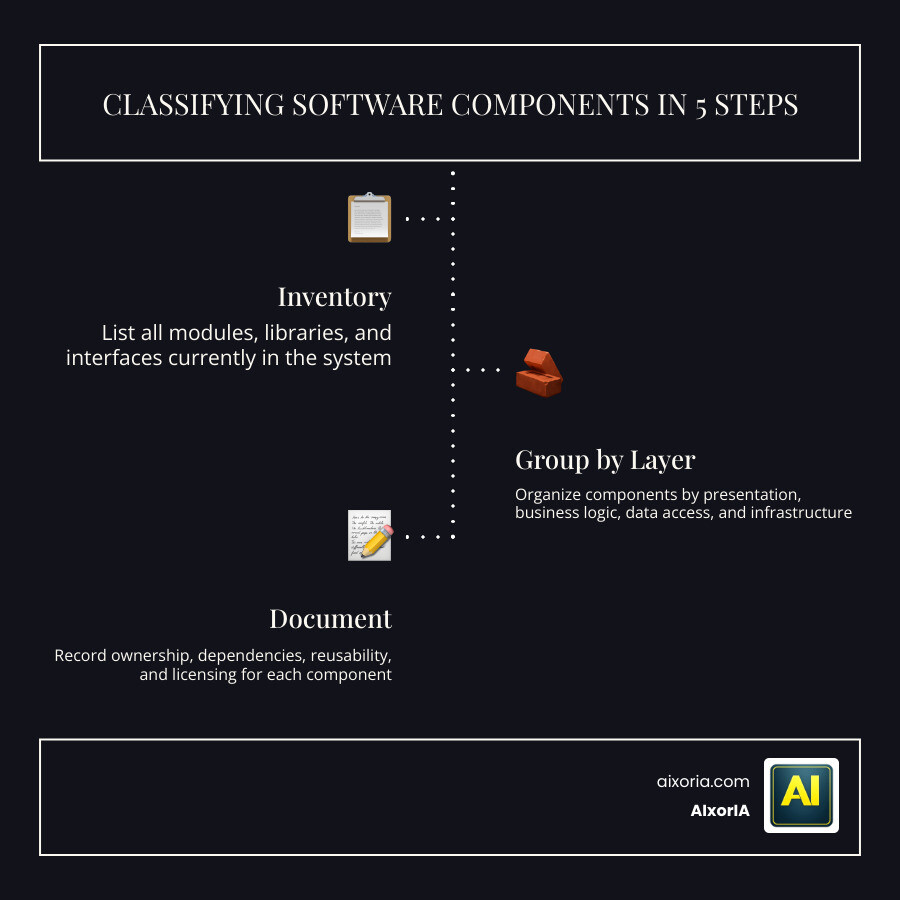
- Inventory all modules, libraries, and interfaces in your system
- Group by architectural layer — presentation, business logic, data access, infrastructure
- Identify function — UI, backend, integration, security, or utility
- Assign ownership and licensing — proprietary, open-source, or third-party
- Label by reusability — core, shared, or standalone
- Document each component with its role, dependencies, and owner
Modern software grows fast. A clean system with a handful of modules can quickly turn into a tangled mix of frontend code, backend services, APIs, and database logic — with no clear structure in sight.
That is where component classification comes in.
It is not just a technical exercise. It is a strategic decision that affects how fast your team ships features, how well your system scales, and how much it costs to maintain over time.
The numbers back this up. Proper classification can cut software maintenance costs by up to 40%, improve scalability by 35%, and help teams get new features to market 50% faster.
Whether you are building an enterprise app, a SaaS product, or an embedded system, the same core question applies: do you know what each part of your software actually does — and how it relates to everything else?
This guide gives you a clear, practical framework to answer that question.
Why You Need to Classify Software Applications Components
We have all seen it: a “small” project that grows into a “Big Ball of Mud.” Without a clear way to classify software applications components correctly, your code becomes a house of cards. One small change in the database might accidentally break the user interface because the boundaries are blurred.
Classification is the antidote to this chaos. By organizing software into logical units based on their roles, we gain several critical advantages:
- Maintenance Savings: When components are properly isolated, we can fix bugs in one area without triggering a domino effect of errors elsewhere. Research shows this can reduce long-term maintenance costs by 40%.
- Scalability: If you know which components are resource-heavy (like a pricing engine) and which are lightweight (like a static UI), you can scale them independently in the cloud.
- Fault Isolation: Microservices architectures that maintain clear component boundaries achieve 60% better fault isolation. If the payment gateway fails, the product catalog keeps running.
- Reduced Technical Debt: Teams following structured classification and Domain-Driven Design (DDD) principles reduce technical debt by 45% over three years.
To manage these complex structures, many teams are turning to the best AI tools for workflow automation in 2026 to ensure that classification rules are followed during every code commit.
The Impact on Development Velocity
Speed is everything in 2026. If your team has to spend three days figuring out how a single module works before they can add a feature, you have a velocity problem. Modular design allows for “feature isolation,” where different teams can work on different components simultaneously without stepping on each other’s toes. This autonomy is the secret sauce behind the 50% faster time-to-market reported by high-performing organizations.
Strategic Benefits for IT Architects
For architects, classification is about governance and risk reduction. Following standards like ISO/IEC 42010 ensures that the system architecture is documented and defensible. It allows us to allocate resources effectively—investing our best talent into “Core” components while using off-the-shelf solutions for “Supporting” logic.
Core Categories of Software Components
When we talk about how to classify software applications components, we usually look at three primary lenses: functional, structural, and interface-based.
- Functional Components: These are defined by what they do (e.g., a “Payment Processor” or “User Authenticator”).
- Structural Units: These are defined by how they are built (e.g., a JAR file, a Docker container, or a DLL).
- Interface Modules: These manage how the system talks to the outside world (e.g., an API Gateway or a Message Broker).
Comparison: Core vs. Supporting Components
| Feature | Core Components | Supporting Components |
|---|---|---|
| Business Value | High (Unique IP) | Low (Generic functionality) |
| Change Frequency | High (Evolves with business) | Low (Stable/Utility) |
| Example | Proprietary AI algorithm | Logging, Emailing, Auth |
| Strategy | Build in-house | Buy or use Open Source |
How to Classify Software Applications Components by Architectural Layer
The most common way to organize a system is by its “altitude” or layer. This prevents “leaky abstractions” where database logic accidentally ends up in your mobile app’s “Submit” button.
- Presentation Layer: The “face” of the app. This includes UI components, React views, or CLI tools.
- Business Logic Layer: The “brain.” This is where the rules live—like calculating interest rates or validating a shipping address.
- Data Access Layer: The “librarian.” These components handle the CRUD (Create, Read, Update, Delete) operations and talk to your databases. To streamline this, architects often use the best AI tools for data integration in 2026 to map complex data sources to clean components.
- Infrastructure Layer: The “plumbing.” This includes logging, security, and external API integrations (like AWS or Azure services).
Classification by Licensing and Ownership
In 2026, your software is rarely 100% yours. You must classify components by their legal and financial status:
- Proprietary: Components we build and own.
- Open-Source: Components like React or Linux. We must track these for security and compliance.
- Third-Party/SaaS: APIs we pay for, like Stripe or OpenAI.
- Public Domain: Software with no copyright restrictions.
Keeping an eye on these is easier with the best AI tools for data analysis and visualization in 2026, which can help track license usage and security vulnerabilities across your entire inventory.
A Step-by-Step Framework for Effective Classification
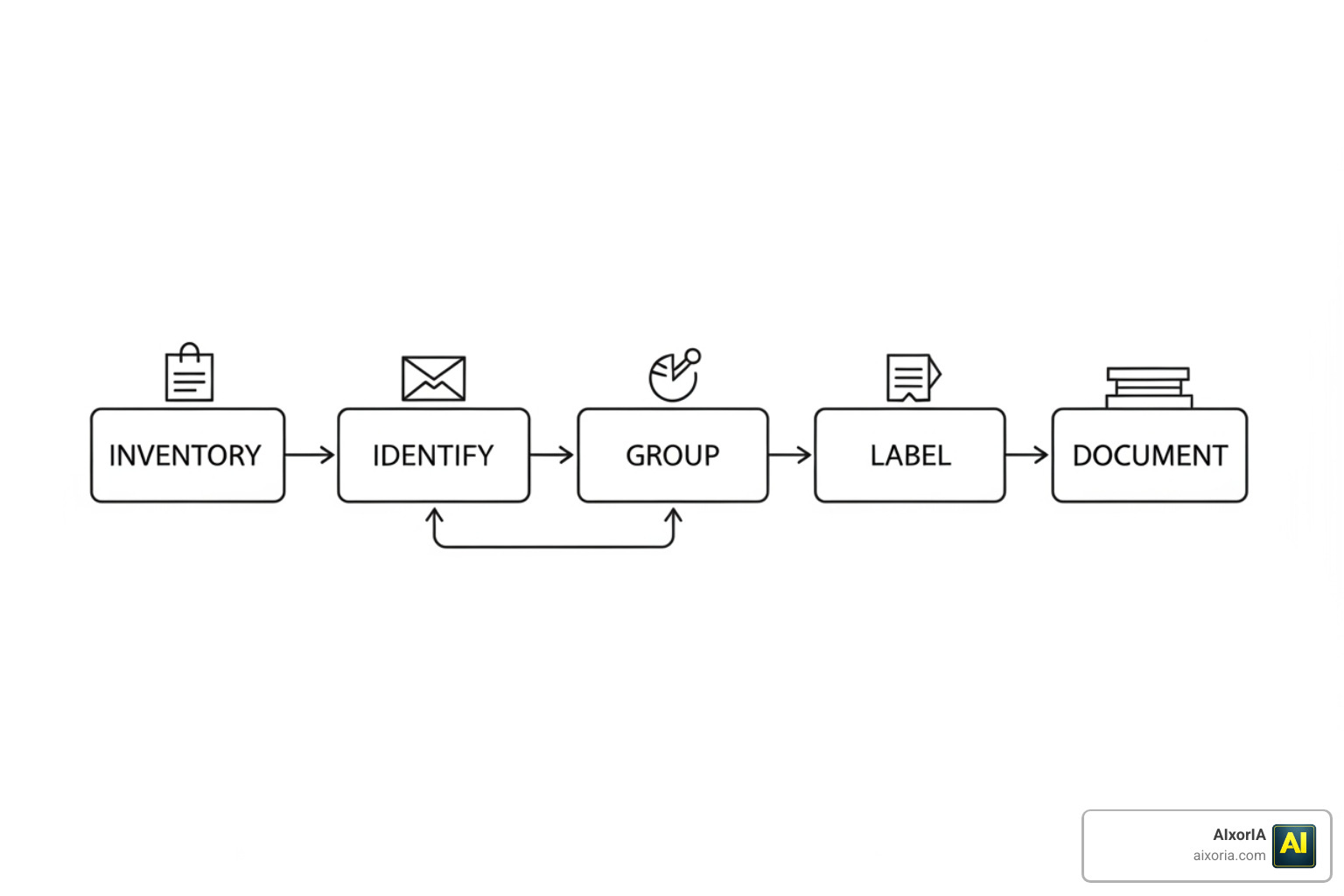
If you are starting with a messy codebase, don’t panic. Follow this complete 2026 guide to classification:
- Inventory All Components: List every module, library, and external service.
- Identify Purpose: What is the “Single Responsibility” of this component?
- Group by Dependency: Does this component depend on the database? (Data Access). Does it talk to the user? (Presentation).
- Assign Reusability Labels: Is this a “one-off” or a “shared library”?
- Document Everything: Use Architecture Decision Records (ADRs) to explain why a component belongs where it does.
Identifying Purpose and Functionality
We recommend asking: “What business action does this serve?” If a component handles both “sending emails” and “calculating taxes,” it is a candidate for splitting. Isolate the boundaries so that your “Workflow” components only orchestrate, and your “Domain” components only calculate.
Tools to Help You Classify Software Applications Components
You don’t have to do this manually. Modern tools can “see” your architecture:
- Static Analysis: Tools like SonarQube detect when a UI component is illegally talking to a database.
- Dependency Managers: Tools like Maven, npm, or NuGet track what depends on what.
- Architecture Visualization: Tools that generate diagrams from your code.
- AI Orchestration: For enterprise systems, the top AI orchestration tools for enterprises in 2026 can automatically categorize microservices based on their traffic patterns and data flows.
Domain-Specific Classification Strategies
How to classify software applications components varies depending on what you are building.
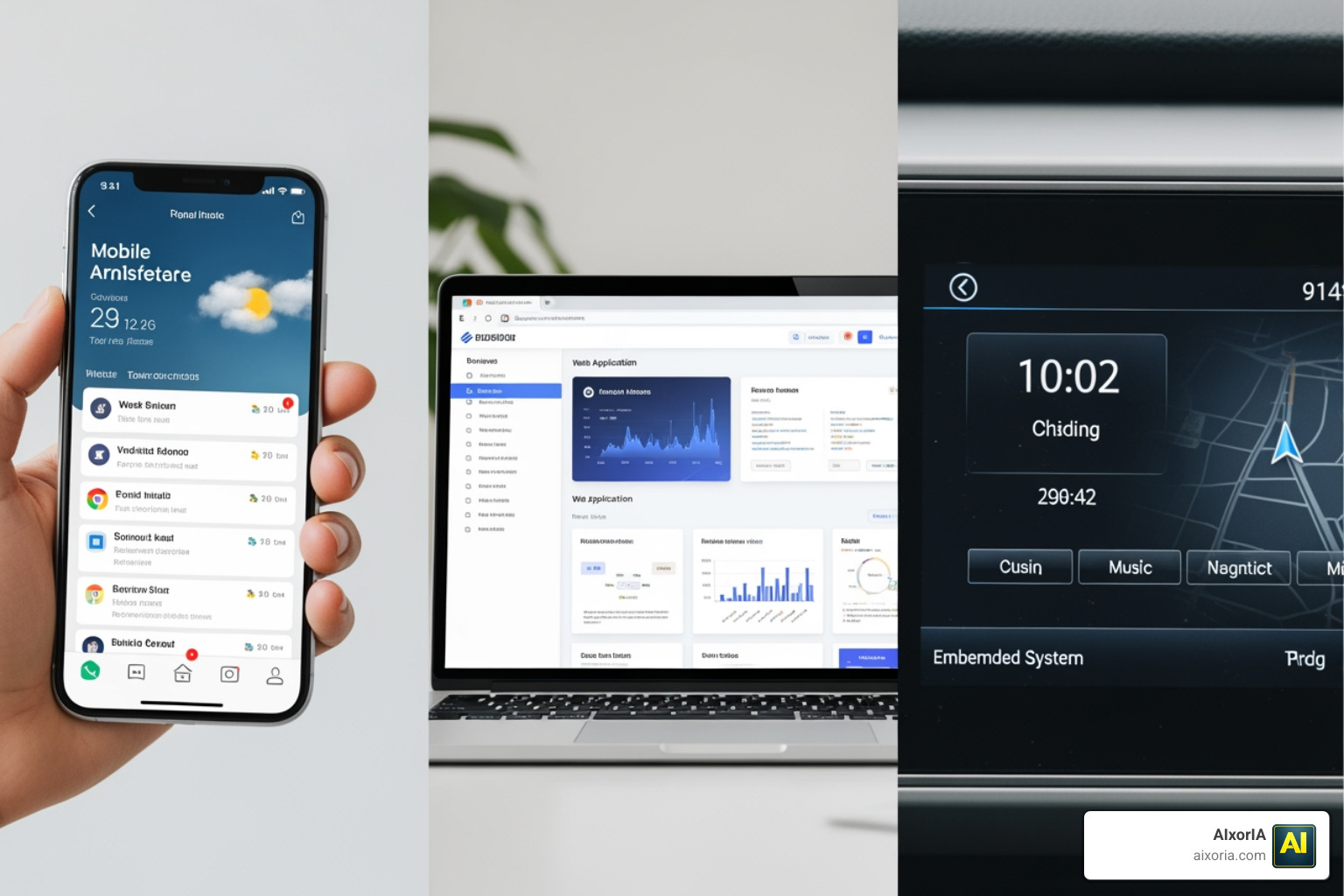
- Enterprise ERP: Focuses on “Modular Monoliths” and clear business domain boundaries.
- Mobile Apps: Focuses on resource management. We classify components by whether they run on the foreground (UI) or background (Data sync).
- Web Microservices: Focuses on deployment boundaries and API contracts.
- Embedded Systems: Focuses on separating hardware-dependent code (drivers) from business logic (the “smart” part of the microwave).
Enterprise and SaaS Perspectives
In the SaaS world, we have to worry about “multi-tenancy.” A single component might need to handle data for 1,000 different companies. Here, classification focuses on “Cloud-native” attributes—how easily can this component be updated without taking the whole system down?
Scientific and Embedded Systems
In domains like engineering (using MATLAB or AutoCAD), components are classified by their “Mathematical Modeling” capabilities. In embedded systems, “Implementation Autonomy” is key—the component that controls the satellite’s thrusters shouldn’t be affected if the telemetry logging component runs out of memory.
Frequently Asked Questions about Software Classification
What is the difference between a module and a component?
A module is a physical grouping of code (like a folder or a file). A component is a logical unit defined by its responsibility. Think of a module as the “box” and the component as the “role” it plays in the system.
Can a single component belong to multiple categories?
Ideally, no. A well-designed component should have one primary responsibility. However, “Cross-cutting concerns” like logging or authentication often touch every layer. We classify these as “Utility” or “Infrastructure” components that are shared across the whole system.
How often should component classification be updated?
We recommend reviewing your classification every release cycle. “Architectural drift” happens when developers take shortcuts. Regular audits ensure that your “Business Logic” hasn’t accidentally migrated into your “Presentation Layer.”
Conclusion
At AIxorIA, we believe that technology should empower your business, not confuse it. Mastering how to classify software applications components is the first step toward building a system that can grow as fast as your ambitions. By creating clear boundaries, you reduce costs, speed up development, and make your team’s life a whole lot easier.
As we look toward the future, the best AI tools for building AI agents in 2026 will likely take over much of the manual work of architecture mapping. But the strategic decisions—the “why” behind the structure—will always require a human touch.
Ready to future-proof your tech stack? Learn more about AIxorIA’s Enterprise Guide to see how we help businesses navigate the complex world of AI and modern software architecture.
Well explained and practical. I’ve had good results with Luna Lisa Alpha () for product photos and posters.. Luna Lisa Alpha