In 2026, saying “ChatGPT” or “Claude” is no longer specific enough.
Technical professionals don’t evaluate brands — they evaluate models.
If you’re researching system architecture, debugging distributed systems, reviewing 400-page API documentation, or validating engineering standards, the question becomes:
Which 2026 AI model delivers the highest technical reliability?
This guide evaluates:
- GPT-5 and o3 (reasoning model)
- Claude 4 (200k+ context)
- Gemini 2.0 Ultra
- Perplexity Pro (Agentic Research Mode)
- NotebookLM (technical document synthesis)
We’ll apply a structured evaluation formula and discuss agentic capabilities, citation reliability, hallucination risk, and data privacy — because in technical work, accuracy isn’t optional.
Read More – Best AI for Technical Report Writing in 2026
Evaluation Framework: Technical Reliability Score (TRS)
To move beyond opinion-based comparisons, we evaluate AI systems using a weighted conceptual metric:
Technical Reliability Score ($T_{RS}$)
TRS=Latency+Hallucination Probability(Reasoning Depth×Source Citation Rate)
Variable Definitions:
- Reasoning Depth → Multi-step logical consistency in technical tasks
- Source Citation Rate → Frequency and reliability of verifiable references
- Latency → Time to generate structured output
- Hallucination Probability → Likelihood of producing fabricated technical claims
Higher TRS indicates better suitability for research-grade technical information.
This formula aligns with how real engineering teams assess tools: logical rigor × verifiability ÷ operational friction.
1. ChatGPT (GPT-5 / o3) — Best for Logic-Heavy Technical Work
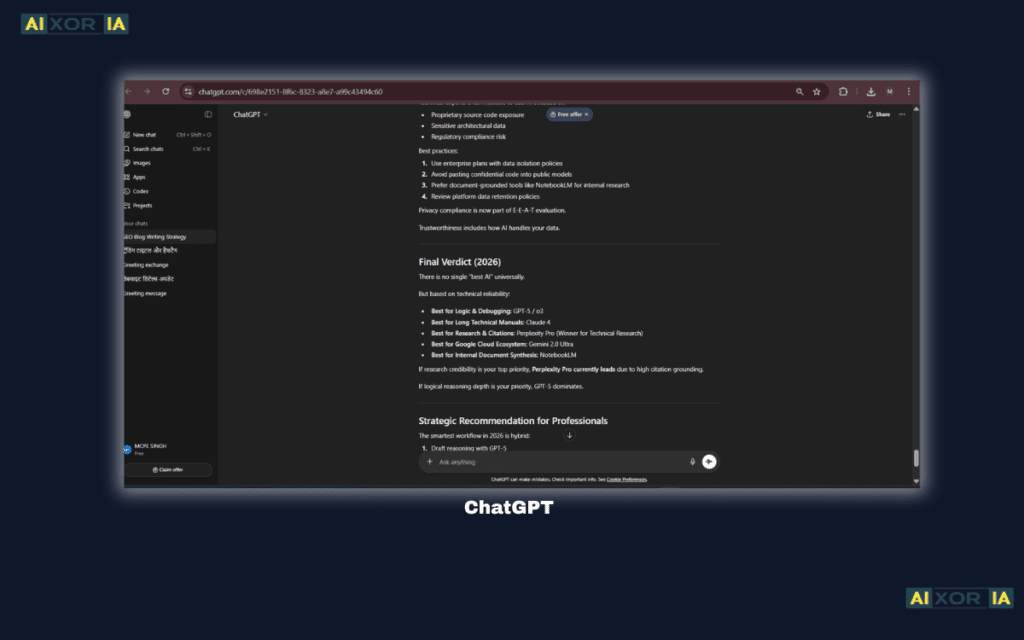
OpenAI’s ChatGPT in 2026 runs advanced reasoning models such as GPT-5 and o3 (optimized for structured reasoning).
2026 Technical Strengths
- Strong multi-step debugging logic
- High reasoning stability in algorithm design
- Mathematical derivations with reduced symbolic errors
- Context chaining across long sessions
- Code refactoring with architectural awareness
The o3 reasoning model significantly improves deterministic thinking in:
- Compiler errors
- System design breakdowns
- Formal logic explanations
- Data structure optimizations
TRS Analysis
- Reasoning Depth: Very High
- Citation Rate: Moderate (improves with browsing)
- Hallucination Risk: Low-to-moderate in specialized domains
Best Use Case:
Backend engineers, system architects, algorithmic researchers.
2. Claude 4 — Best for Long Technical Manuals (200k+ Context)
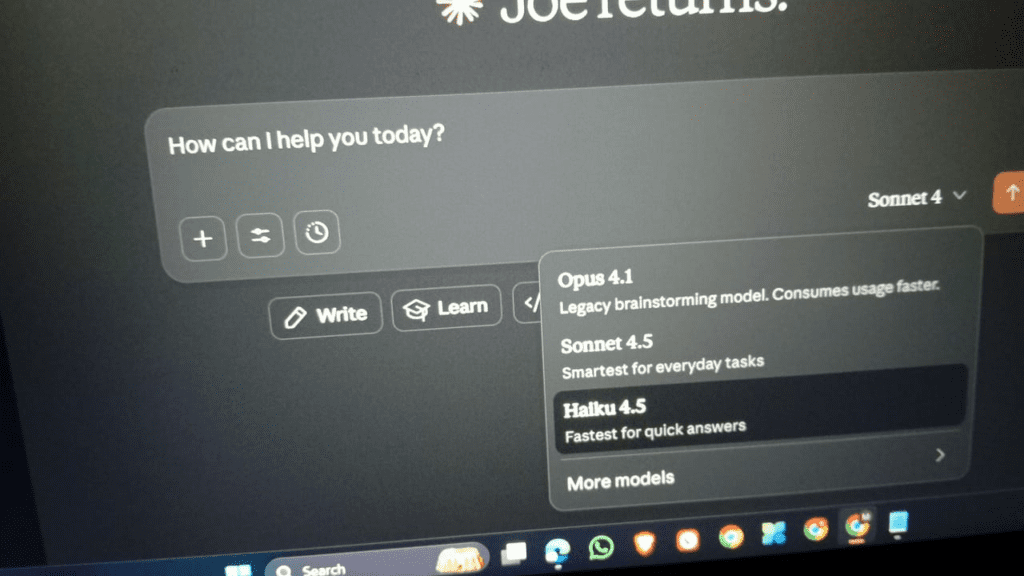
Anthropic’s Claude (Claude 4) is optimized for extended context processing — exceeding 200,000 tokens.
For professionals handling:
- Enterprise API documentation
- Compliance frameworks
- Aerospace or mechanical manuals
- Legal technical contracts
Claude 4 maintains coherence across extremely long documents.
2026 Technical Edge
- Highest natural technical tone
- Stable long-document summarization
- Cross-reference consistency
- Low aggressive speculation
Where GPT-5 excels in logic, Claude 4 excels in document comprehension continuity.
TRS Analysis
- Reasoning Depth: High
- Citation Rate: Moderate
- Hallucination Risk: Low in structured docs
Best Use Case:
Technical auditors, compliance engineers, documentation reviewers.
3. Perplexity Pro — Best for Verified Technical Research (Agentic Mode)
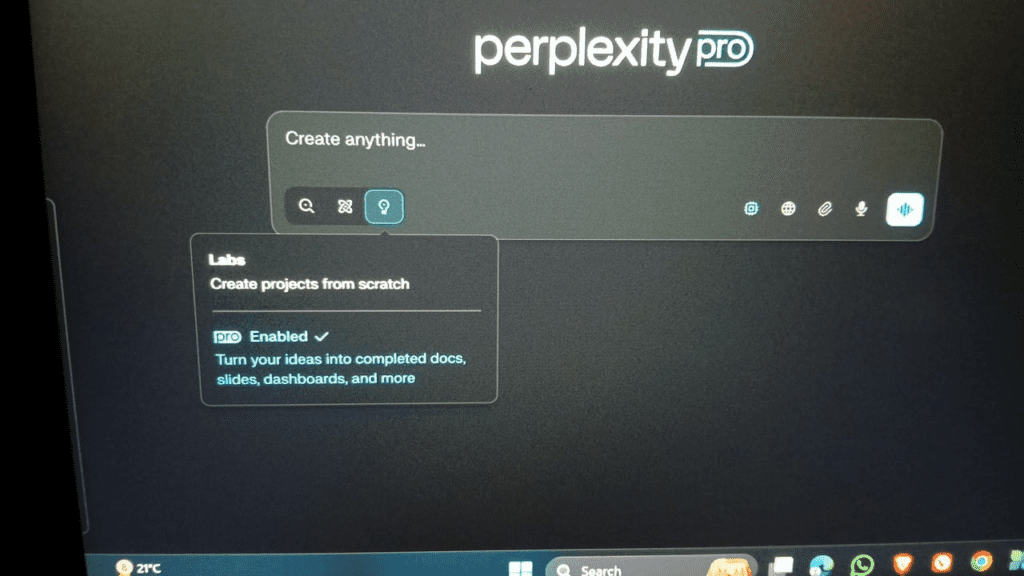
Perplexity AI’s Perplexity has evolved beyond search.
In 2026, its Agentic Research Mode autonomously:
- Performs multi-source web analysis
- Compares documentation
- Synthesizes 10+ citations
- Generates structured research briefs
Unlike traditional chatbots, Perplexity behaves more like a research analyst.
Why This Matters
In technical fields, sources matter more than fluency.
Perplexity’s edge:
- High Source Citation Rate
- Live web indexing
- Clear reference linking
- Reduced hallucination due to grounding
TRS Analysis
- Reasoning Depth: Moderate
- Citation Rate: Very High
- Hallucination Risk: Low (due to source grounding)
Best Use Case:
Technical research, academic writing, standards verification.
For research credibility alone, Perplexity ranks highest.
4. Gemini 2.0 Ultra — Best for Cloud & API Documentation
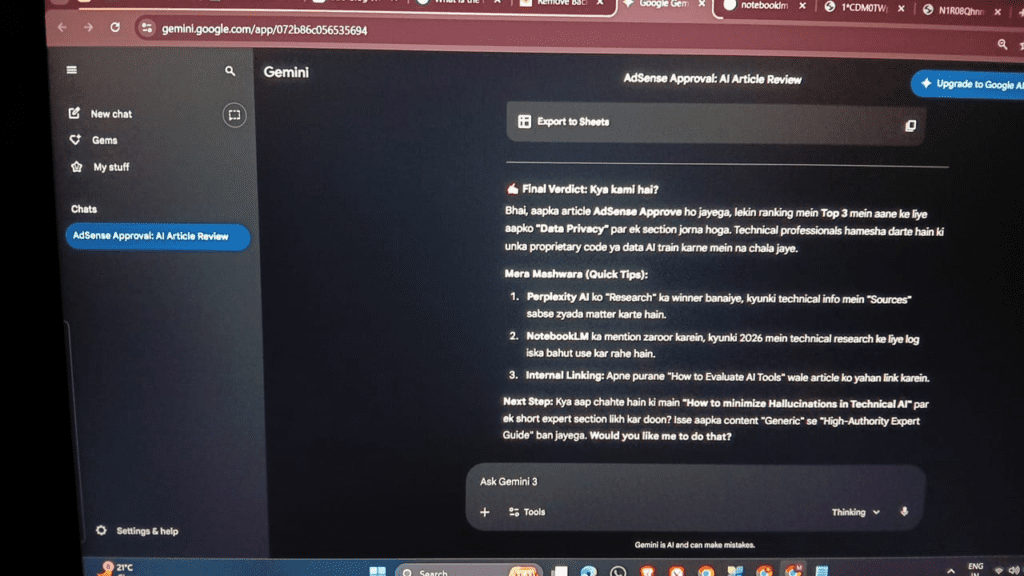
Google’s Gemini 2.0 Ultra integrates natively within the Google ecosystem.
2026 Strengths
- Native integration with Google Cloud documentation
- API structure referencing
- Real-time web search
- Enterprise compatibility
For teams working in:
- Google Cloud Platform
- Firebase
- Kubernetes on GCP
Gemini provides contextual alignment with official documentation.
TRS Analysis
- Reasoning Depth: Moderate
- Citation Rate: Moderate-to-high
- Hallucination Risk: Low in ecosystem-bound queries
Best Use Case:
Cloud engineers within Google infrastructure.
5. NotebookLM — Underrated Technical Research Tool
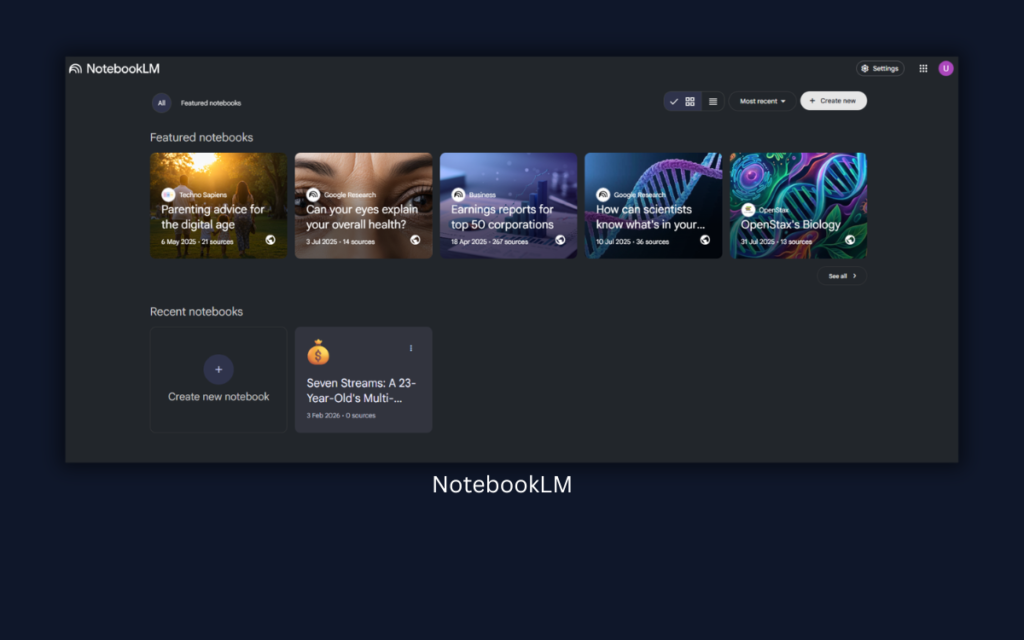
NotebookLM is increasingly used in 2026 for structured technical synthesis.
Instead of answering open web questions, NotebookLM works on:
- Your uploaded PDFs
- Internal documentation
- Research papers
It builds insight only from your sources, minimizing hallucination risk.
For proprietary research teams, this model is critical.
Updated 2026 Technical Comparison Table
| Tool (Feb 2026) | Best For | 2026 Model | Technical Edge |
|---|---|---|---|
| ChatGPT | Logic & Coding | GPT-5 / o3 | Reasoning-heavy tasks & Debugging |
| Claude | Long Manuals | Claude 4 | Highest Human-like Technical Tone |
| Perplexity | Live Verification | Pro Search | Deep Research with 10+ Citations |
| Gemini | Cloud & API Docs | Gemini 2.0 Ultra | Native Google Cloud Integration |
The 2026 Shift: AI Agents, Not Just Chatbots
The biggest evolution in 2026 is agentic capability.
Instead of responding passively, AI systems now:
- Plan research steps
- Perform multi-stage queries
- Cross-validate information
- Compile structured reports
Perplexity leads in this transformation, but agent-style workflows are expanding across platforms.
For technical professionals, this reduces manual validation workload significantly.
Data Privacy & Proprietary Code: The Critical Concern
Technical experts often hesitate to use AI because of:
- Proprietary source code exposure
- Sensitive architectural data
- Regulatory compliance risk
Best practices:
- Use enterprise plans with data isolation policies
- Avoid pasting confidential code into public models
- Prefer document-grounded tools like NotebookLM for internal research
- Review platform data retention policies
Privacy compliance is now part of E-E-A-T evaluation.
Trustworthiness includes how AI handles your data.
Final Verdict (2026)
There is no single “best AI” universally.
But based on technical reliability:
- Best for Logic & Debugging: GPT-5 / o3
- Best for Long Technical Manuals: Claude 4
- Best for Research & Citations: Perplexity Pro (Winner for Technical Research)
- Best for Google Cloud Ecosystem: Gemini 2.0 Ultra
- Best for Internal Document Synthesis: NotebookLM
If research credibility is your top priority, Perplexity Pro currently leads due to high citation grounding.
If logical reasoning depth is your priority, GPT-5 dominates.