Artificial intelligence has rapidly transformed email marketing. Tools powered by AI can now generate subject lines, predict optimal send times, segment audiences, and even write entire campaigns automatically.
Platforms like Mailchimp, HubSpot, and ActiveCampaign integrate AI to help marketers automate workflows and improve engagement.
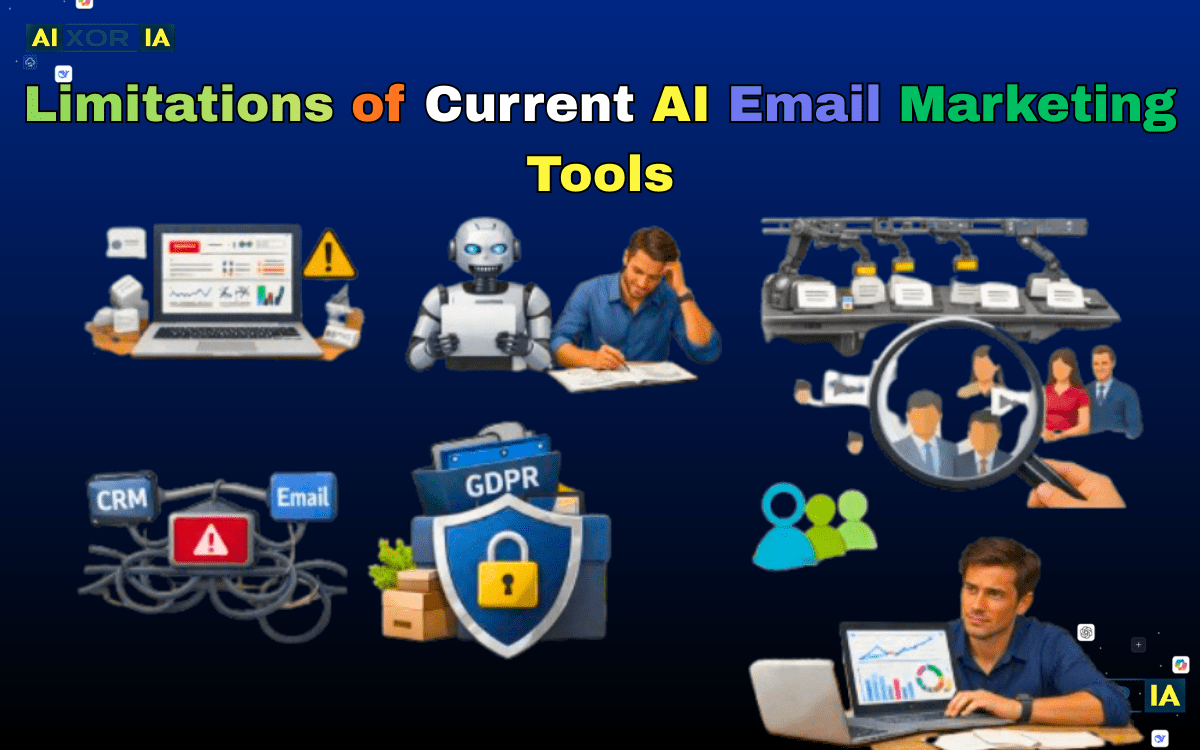
However, despite the speed and efficiency of these tools, current AI email marketing systems still have critical limitations that affect campaign performance, personalization quality, and long-term brand trust.
These limitations are not just technical—they are also psychological, strategic, and data-related.
The 3 Biggest Limitations of Current AI Email Marketing Tools
The three biggest limitations of current AI email marketing tools are:
- Context Blindness – AI cannot truly understand user intent or emotional context.
- Algorithmic Bias – AI often produces repetitive, formula-based messaging.
- Data Fragility – AI predictions collapse when marketing data becomes noisy or outdated.
While AI excels at speed and automation, it still lacks the human empathy and contextual reasoning required for persuasive email marketing.
READ MORE – Best Brand Design Agencies With AI-Powered Workflows
Why AI Email Marketing Tools Struggle With Human Context
AI models are excellent at identifying patterns in data, but marketing is not just pattern recognition.
Successful email campaigns often depend on subtle human factors such as:
- emotional timing
- cultural references
- audience mood
- brand trust history
- purchase hesitation psychology
For example, a subscriber might open an email not because of the subject line but because:
- they recently experienced a problem
- they trust the brand
- they feel emotionally connected to the story
AI tools cannot fully interpret these complex human signals.
Instead, they rely on historical patterns, which often fail when user behavior suddenly changes.
This limitation is known as context blindness.
The Emotional Intelligence Gap in AI Email Marketing
Human marketers rely heavily on emotional intelligence (EQ) when crafting campaigns.
EQ allows marketers to sense:
- when customers are overwhelmed with promotions
- when humor is appropriate
- when empathy is more effective than persuasion
AI models cannot truly feel or interpret emotions.
They analyze words statistically.
For example, if thousands of past emails used phrases like:
- “limited time offer”
- “exclusive deal”
- “don’t miss out”
the AI will assume these phrases are effective and repeat them frequently.
However, modern email audiences are extremely sensitive to sales pressure and automation patterns.
As a result, campaigns generated purely by AI can feel:
- robotic
- repetitive
- overly promotional
This reduces trust and engagement.
The Mathematical Limitation Behind AI Predictions
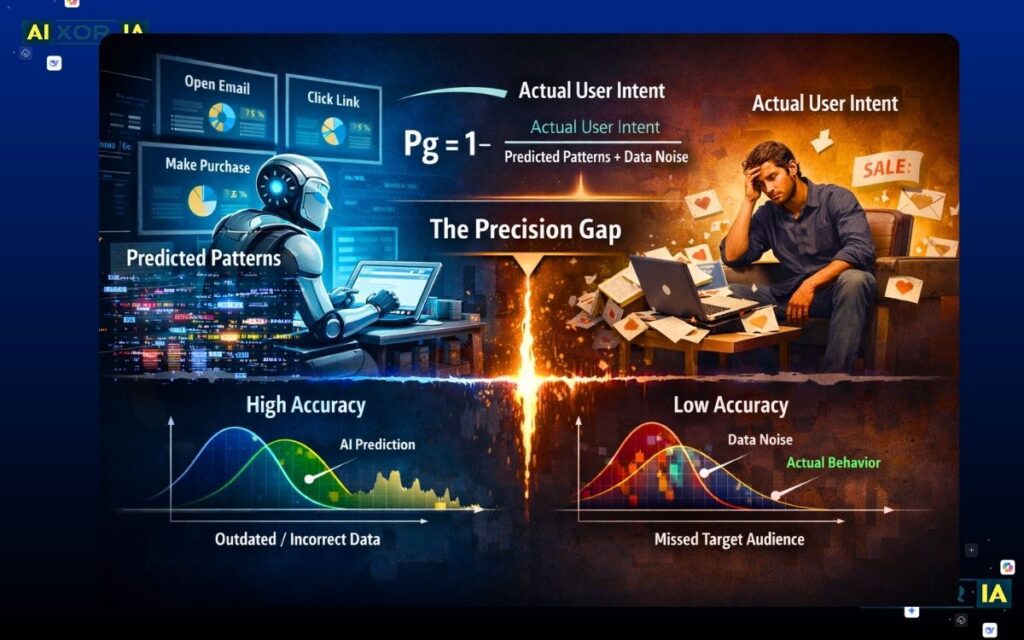
Most AI email marketing tools rely on probabilistic prediction models.
These models attempt to estimate the likelihood that a subscriber will:
- open an email
- click a link
- make a purchase
However, real human behavior rarely follows perfect mathematical predictions.
A useful way to understand this limitation is through the concept of the Precision Gap.
The Precision Gap ($P_g$)
AI email systems estimate performance based on predicted user behavior patterns.
But when predictions rely on incomplete or noisy data, the accuracy drops.
This relationship can be expressed as:Pg=1−(Predicted Pattern Match+Data NoiseActual User Intent)
Where:
- Actual User Intent represents real human motivation
- Predicted Pattern Match represents AI prediction models
- Data Noise represents outdated or incorrect subscriber data
As data noise increases, prediction accuracy decreases.
This creates a widening precision gap, which leads to poorly targeted campaigns.
In practice, this means an AI system may confidently send a promotional email to a subscriber who has already lost interest in the product.
The AI model sees historical engagement.
But it cannot detect the current psychological state of the user.
Human vs AI Performance in Email Marketing
AI and humans each perform better in different areas of email marketing.
| Task | AI Capability | Human Expert | Winning Edge |
|---|---|---|---|
| Subject Line Creation | High speed testing and automation | Creative storytelling and humor | AI for speed |
| Campaign Strategy | Pattern analysis | Market understanding and empathy | Human |
| Deliverability | Basic automation | Reputation management and list hygiene | Human |
| Personalization | Name, location, and past behavior | Emotional context and user intent | Human |
| Optimization | Continuous A/B testing | Strategic campaign planning | AI + Human |
The most successful campaigns today combine AI efficiency with human insight.
Real-World Limitations Observed in Popular AI Email Tools
Many marketers rely on AI features integrated into major marketing platforms.
However, real-world usage often reveals practical limitations.
Below are short experiences using some of the most popular tools.
READ MORE – Benefits of AI-Powered RFP Tools for Small Business Proposal Writing
Mailchimp AI Subject Lines
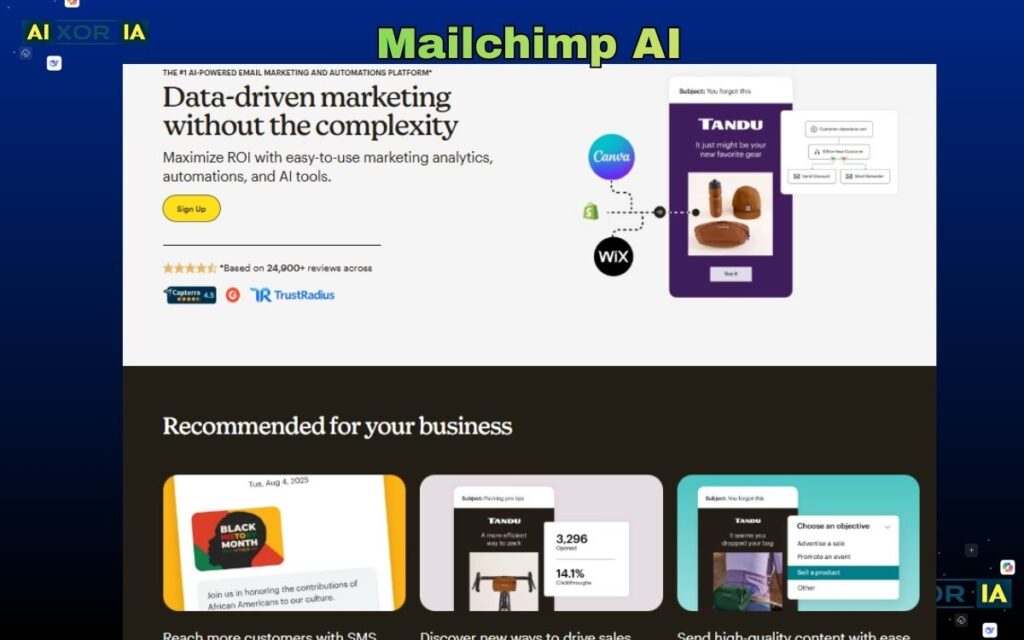
Mailchimp offers AI-generated subject line suggestions designed to improve open rates.
In practice, these subject lines often follow familiar patterns such as:
- “You won’t believe this deal”
- “Last chance to save”
- “Don’t miss out today”
While these suggestions are technically optimized, they frequently feel clickbait-oriented.
In several campaigns, AI-generated subject lines achieved decent open rates but lower click-through rates.
This suggests users opened the email out of curiosity but did not find the content meaningful enough to continue.
Human-written subject lines that used storytelling or curiosity performed better in those cases.
HubSpot AI Content Assistant
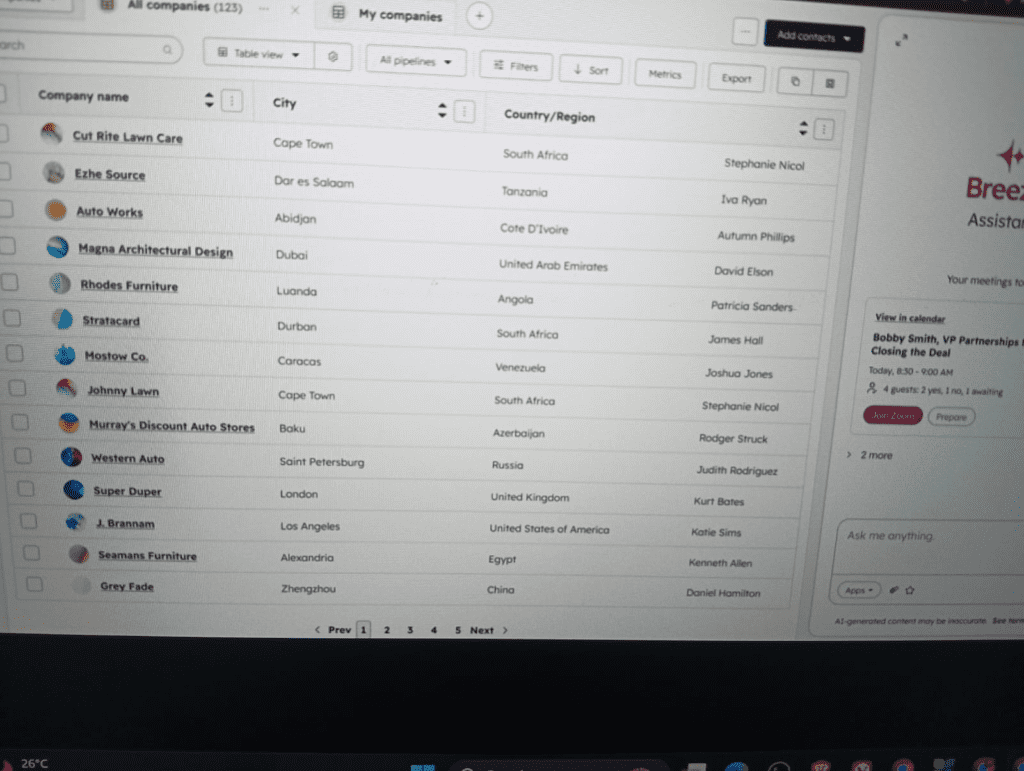
HubSpot includes AI tools that generate full email drafts.
The drafts are usually structured and grammatically correct.
However, they often lack distinct brand personality.
For example, when generating promotional emails for different brands, the tone tends to feel similar:
- formal
- safe
- generic
This happens because AI models rely on common training patterns.
Without careful editing, many brands using AI can unintentionally produce very similar marketing messages.
ActiveCampaign Predictive Sending
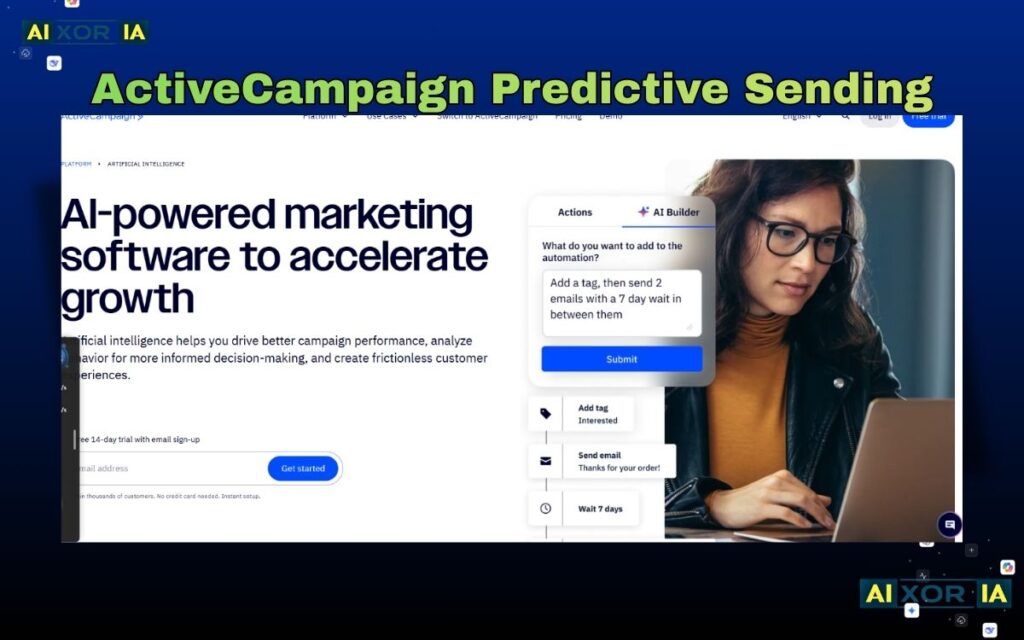
ActiveCampaign includes predictive sending features that analyze subscriber engagement to determine the best time to send emails.
This feature works well when engagement history is strong.
However, problems appear when subscriber behavior changes suddenly.
For example:
- seasonal buying patterns
- new product launches
- shifts in audience interests
Because the AI relies on historical engagement data, it may continue recommending outdated send times.
Human marketers often recognize these changes faster than the algorithm.
The Deliverability Risk of Over-Automation
Email providers such as Google and Microsoft constantly update spam filtering systems.
These systems analyze patterns such as:
- identical subject lines across campaigns
- repetitive promotional language
- unusually high send frequency
AI-driven automation sometimes unintentionally triggers these signals.
For example, if a tool repeatedly generates similar subject line structures, spam filters may detect a pattern resembling automated marketing campaigns.
Human marketers are more likely to vary language, adjust messaging, and recognize when audiences feel overwhelmed.
Data Fragility: The Hidden Weakness of AI Marketing Systems
AI systems require large datasets to perform well.
However, most email lists degrade over time.
Subscribers may:
- change jobs
- lose interest in a topic
- stop checking certain email accounts
As data quality declines, AI predictions become less accurate.
This creates a fragile system where automation decisions are based on increasingly unreliable signals.
Without continuous list maintenance, AI tools may target the wrong audience segments.
Why Human Creativity Still Wins in Email Marketing
AI can generate functional content quickly.
But successful marketing emails often contain elements that AI struggles to replicate:
- unexpected humor
- cultural references
- narrative storytelling
- emotional resonance
These elements depend on real-world human experiences.
A human marketer can draw from:
- personal observations
- customer conversations
- cultural trends
AI models only analyze historical data.
They cannot create genuinely new emotional insights.
Ethical and Privacy Constraints
AI-driven email marketing also faces increasing privacy restrictions.
Regulations such as the General Data Protection Regulation limit how companies collect and analyze user data.
These regulations introduce challenges such as:
- restricted behavioral tracking
- stronger consent requirements
- limits on automated decision-making
As privacy laws expand globally, AI marketing systems may have less data available for prediction models.
This further increases the precision gap between predictions and real user behavior.
The Real Future of AI Email Marketing
AI will continue improving rapidly.
Future tools may become better at:
- analyzing emotional tone
- detecting behavioral shifts
- generating more personalized messaging
However, the most effective email marketing strategies will likely remain hybrid systems.
AI will handle:
- automation
- testing
- data analysis
Humans will handle:
- storytelling
- strategic positioning
- emotional messaging
This collaboration between machine efficiency and human insight will shape the next generation of email marketing.
Final Thoughts
AI email marketing tools have dramatically increased the speed and scalability of digital marketing campaigns.
Yet the current generation of tools still faces fundamental limitations.
They struggle with:
- emotional intelligence
- contextual understanding
- data quality dependency
- brand voice consistency
Understanding these limitations allows marketers to use AI wisely rather than relying on it blindly.
The most successful campaigns today combine automation with human creativity, ensuring that email marketing remains both efficient and genuinely engaging for subscribers.