Is It Easier to Get a Personal Loan or Debt Consolidation Loan?

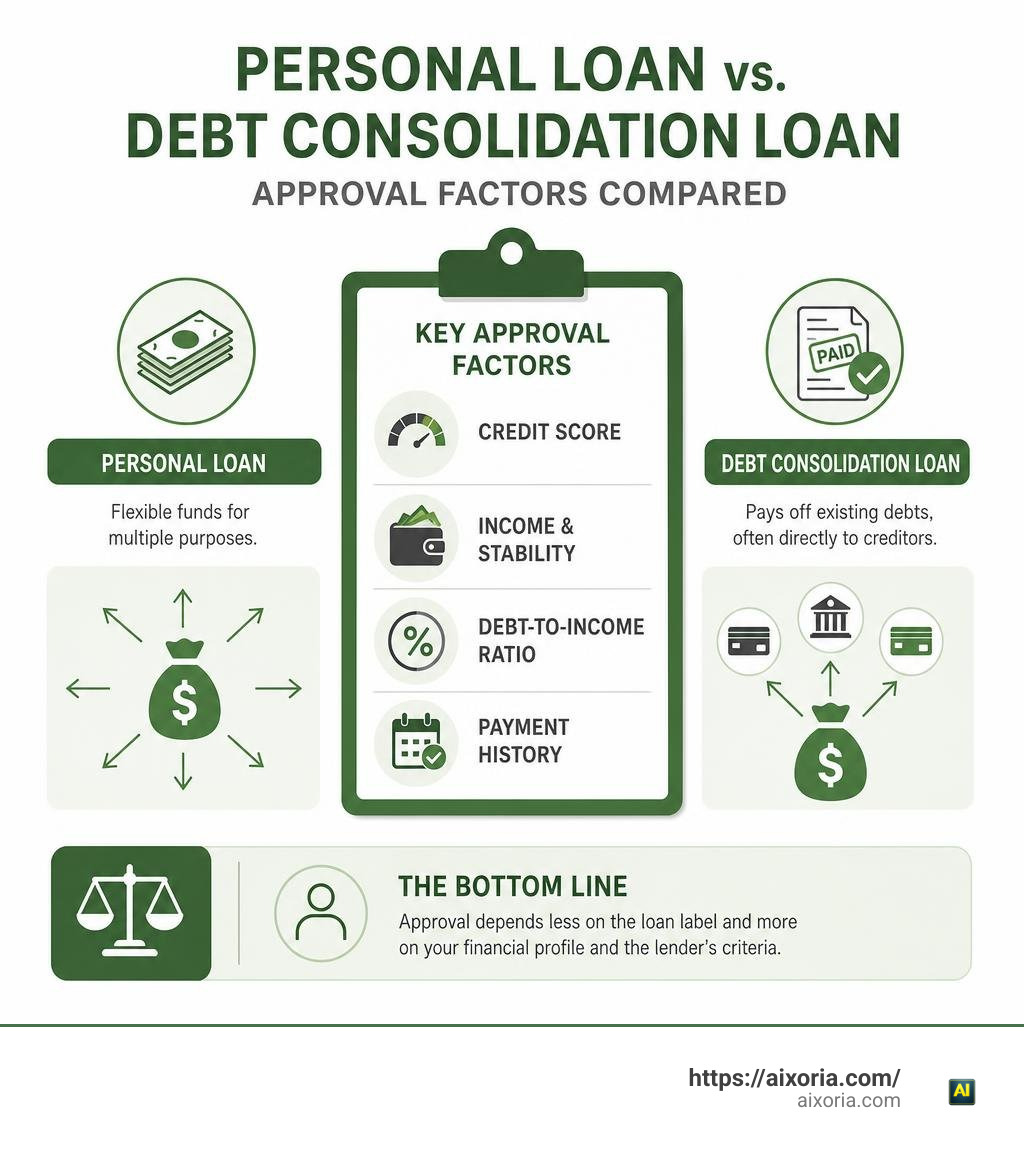
Is it easier to get a personal loan or debt consolidation loan? Usually, neither is automatically easier because a debt consolidation loan is often just a personal loan used to pay existing debts. The same core factors usually decide approval: your credit score, income, debt-to-income ratio, and payment history.
| Loan type | What it is | Is approval usually easier? |
|---|---|---|
| Personal loan | A lump-sum loan for many eligible purposes | Depends on your credit, income, and debts |
| Debt consolidation loan | A personal loan used to pay off debts, sometimes paid directly to creditors | Often similar; direct payoff may help some lenders assess the purpose and risk |
The label matters less than the lender and your financial profile. A consolidation-focused lender may view direct payments to credit card companies as less risky than unrestricted cash. But high card balances can also raise your debt-to-income ratio and make either application harder.
This question matters because the potential savings can be large. In late 2025, the average APR for credit card balances carrying interest was 22.30%, compared with 11.65% for a 24-month personal loan. Still, a lower advertised rate is not a promise of approval – or proof that a loan will save money after fees and a longer repayment term.
Understanding Personal Loans vs. Debt Consolidation Loans
When you begin searching for ways to streamline your monthly bills, you quickly encounter a confusing array of financial jargon. You see offers for standard unsecured personal loans alongside promotions specifically targeting debt consolidation. This often leads to a fundamental question: is it easier to get a personal loan or debt consolidation loan, or are you looking at two entirely different financial animals?
In reality, a debt consolidation loan is not a completely unique financial product. Mechanically, it is almost always a personal loan earmarked for a specific goal: replacing existing debts with a single, structured installment loan. To make sense of how approval works, we must evaluate both the loan mechanics and how underwriting teams view your application. To explore whether consolidating makes mathematical sense for your budget, check out our guide on whether Personal Loan Debt Consolidation: Is It Worth It?.
Product Mechanics and Fund Disbursal
Both options are traditionally structured as unsecured installment loans. This means you do not have to put up collateral—such as your house or car—to secure funding. Instead, lenders evaluate your creditworthiness, income stability, and overall risk profile to decide if you qualify.
The core distinction lies in how loan proceeds move from the lender to the debt:
- General Personal Loans: Upon final approval, the lender deposits a lump sum of money directly into your personal checking account. What you do with that money is entirely up to you (within legal parameters). You can pay off medical bills, remodel a kitchen, repair a vehicle, or manually pay down your credit card balances.
- Dedicated Debt Consolidation Loans: When applying specifically for debt consolidation, many specialized lenders offer a direct payoff feature. Instead of depositing cash into your bank account, the lender transmits the approved funds directly to your named credit card issuers or third-party creditors. Any remaining balance after your debts are paid off is then deposited into your account.
This fund disbursal mechanism is more than a convenience feature—it actively impacts how an underwriter evaluates your risk profile.
How Purpose Impacts Underwriting Criteria
Underwriting is the process lenders use to evaluate how likely you are to repay borrowed funds on time. When an underwriter looks at a standard personal loan application, they see an applicant asking for a cash payout. If your credit report shows $25,000 in credit card balances, the lender must assume that giving you an additional $20,000 in cash will increase your total debt load to $45,000.
If your current income cannot support $45,000 in combined debt, a general personal loan application may be declined due to an excessively high debt-to-income (DTI) ratio.
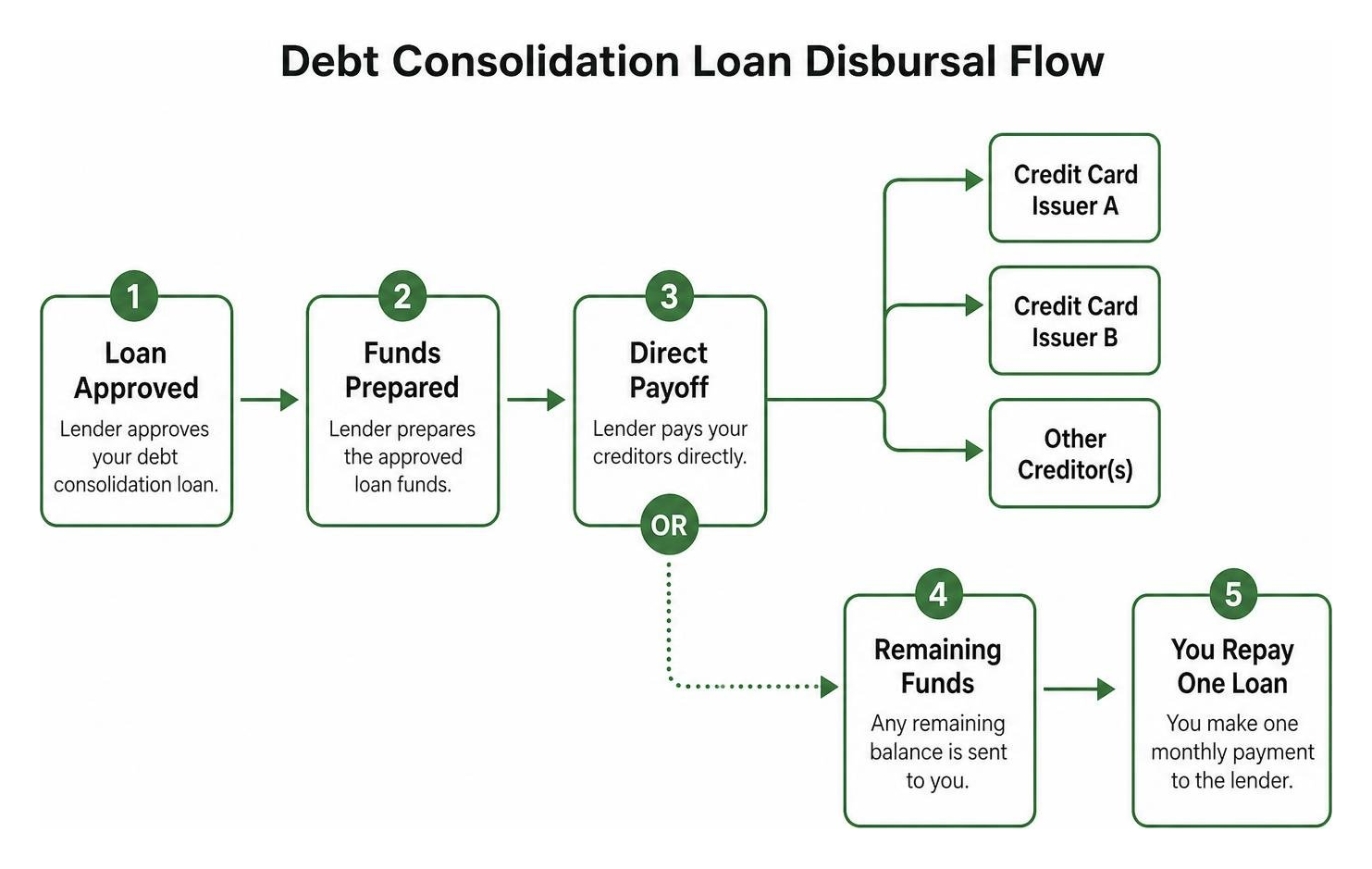
Conversely, when you specify that your loan purpose is debt consolidation—and choose direct payoff—the underwriter evaluates your application through a different lens. They recognize that the new loan is not adding fresh debt on top of your existing obligations; it is replacing revolving high-interest debt with a lower-interest fixed installment payment. By committing to debt restructuring, you reduce the lender’s concern that you will take the cash and run up even more debt.
Is It Easier to Get a Personal Loan or Debt Consolidation Loan?

To directly answer whether is it easier to get a personal loan or debt consolidation loan, we have to look at how different lenders calculate applicant risk. Neither product has a blanket guarantee of easier approval across the board. However, debt consolidation loans often provide an approval edge for borrowers carrying heavy credit card debt, provided the lender uses direct creditor pay.
When comparing qualification criteria, underwriters focus on whether your existing debt load will remain after funding or if it will be completely cleared out.
| Qualification Metric | General Personal Loan | Debt Consolidation Loan (with Direct Pay) |
|---|---|---|
| DTI Calculation | Includes existing debt + proposed new loan payment | Replaces existing revolving debt with new loan payment |
| Risk of Debt Stacking | Higher (borrower receives liquid cash) | Lower (lender directly closes/clears accounts) |
| Credit Score Requirement | Starts around 580–600 (Prime at 720+) | Starts around 580–600 (Prime at 720+) |
| Fund Control | 100% borrower control upon disbursal | Lender pays creditors directly |
| Approval Odds for High Card Balances | Moderate to Low | Higher (due to debt offset calculation) |
When Debt Consolidation Loans Have Easier Approval Requirements
A dedicated debt consolidation loan can significantly boost your approval odds if your primary qualification hurdle is a high debt-to-income ratio or high credit utilization.
When you apply for a personal loan without earmarking it for consolidation, the lender adds the projected monthly payment of the new loan directly to your current debt obligations. If you currently spend 35% of your gross monthly income paying minimum card payments, adding a $400 monthly personal loan payment pushes your DTI ratio to nearly 50%—a common auto-rejection threshold for many financial institutions.
Debt consolidation loans overcome this barrier through a balance transfer offset. Lenders who specialize in debt consolidation calculate your post-loan DTI ratio by subtracting the minimum payments of the credit cards being paid off. Because personal loans almost always offer fixed, lower interest rates than revolving credit cards, replacing three or four credit card minimum payments with one consolidated installment payment frequently lowers your total monthly obligation. As a result, your adjusted DTI ratio drops, making you a much safer bet for the lender.
Why General Personal Loans Might Face Stricter Underwriting
General personal loans carry strict underwriting requirements when an applicant holds high revolving debt balances because of the inherent risk of “debt stacking.”
Debt stacking occurs when a borrower takes out an unsecured loan intended to clear credit cards, receives the cash in their bank account, but ultimately spends the funds elsewhere or fails to pay off the cards. The borrower is then left with both the original credit card balances and a brand-new loan payment. Lenders view liquid, unrestricted cash disbursals as higher risk because they have no guarantee that your financial profile will actually improve post-funding.
Because of this unmitigated risk, lenders offering general personal loans maintain rigid limits on acceptable DTI ratios and credit utilization. Unless your credit score sits comfortably above 700 and your debt-to-income ratio is under 30%, qualifying for an unrestricted cash personal loan can be noticeably harder than securing a direct-pay consolidation loan for the exact same dollar amount.
Key Factors Influencing Approval: Credit Scores and DTI Ratios
Regardless of which loan purpose you select, your financial profile remains the primary driver of approval decisions, interest rate offers, and fee structures. Understanding how credit scores and debt-to-income ratios interact allows you to optimize your application before hitting submit.
Credit scores determine which underwriting tier you fall into:
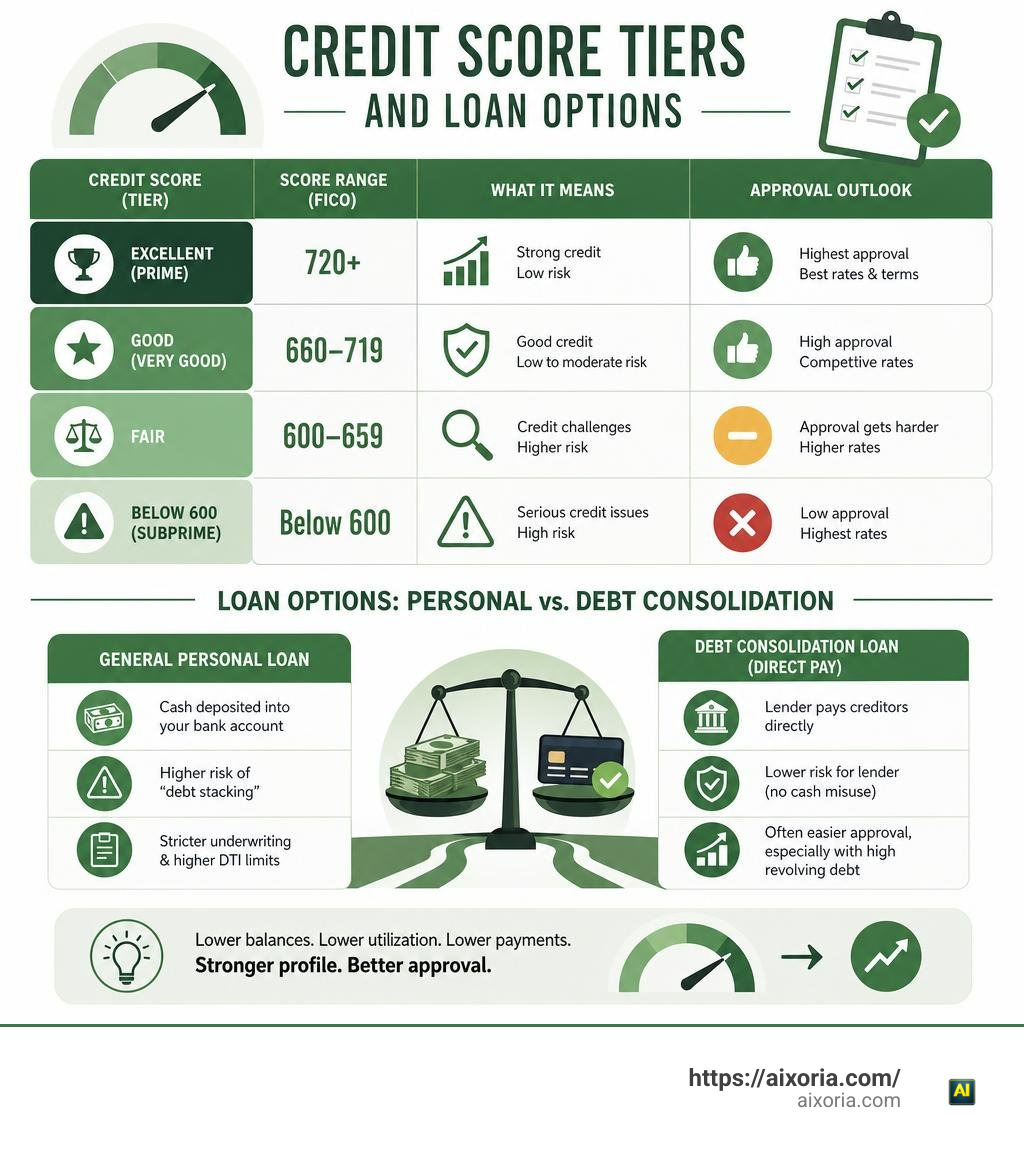
- 720+ FICO (Excellent/Prime): Unlocks the lowest available APRs (routinely below 10% to 12%), zero origination fees, and flexible loan terms ranging from 24 to 84 months.
- 660–719 FICO (Good/Very Good): Yields competitive interest rates (typically 11% to 18%) with moderate origination fees (1% to 5%). Approval odds are high for both general personal loans and consolidation loans.
- 600–659 FICO (Fair): Approval becomes trickier. APRs increase significantly (18% to 28%), and lenders examine DTI ratios closely. Debt consolidation loans with direct pay become distinctly easier to qualify for than general personal loans in this tier.
- Below 600 FICO (Subprime): Qualification is challenging across all unsecured personal loans. APRs approach maximum legal limits (29% to 36%), and lenders often require a co-signer or secured collateral.
Credit card utilization accounts for 30% of your FICO score calculation. Moving heavy credit card balances—say, from an 80% utilization rate down to near 0%—using a consolidation loan can add dozens of points to your credit score within a single billing cycle. For a detailed breakdown on mathematical models and credit score tiers, see our guide on how to Refinance Credit Card Debt into Personal Loan 2026.
Is It Easier to Get a Personal Loan or Debt Consolidation Loan with Bad Credit?
If you are navigating the borrowing landscape with bad credit (typically a FICO score below 600–620), asking is it easier to get a personal loan or debt consolidation loan becomes a critical financial question.
For subprime borrowers, dedicated debt consolidation loans from specialized online lenders or local credit unions are generally easier to get than standard personal loans. Because lenders recognize that high credit utilization actively suppresses credit scores, some subprime underwriters will look past a 610 credit score if the loan directly eliminates card balances and lowers your monthly obligations.
When bad credit limits your single-applicant options, consider these three paths to improve approval odds:
- Apply with a Credit Union: Credit unions are member-owned non-profit institutions that often feature lower interest rate caps and more holistic underwriting than traditional commercial banks. However, keep in mind that smaller credit unions may cap unsecured personal loans around $10,000 to $12,000.
- Add a Co-Signer or Joint Applicant: Adding a creditworthy co-signer with a FICO score above 720 significantly reduces lender risk, granting you access to approval tiers and interest rates you could not secure independently.
- Choose Direct-Pay Lenders: Subprime borrowers applying for debt consolidation should exclusively target lenders that guarantee direct payment to creditors. This removes the lender’s fear of debt stacking and serves as a major compensating factor during manual underwriting.
However, be cautious: if a lender offers a bad-credit loan with an APR above 25% plus a 6% to 8% origination fee, consolidation may actually cost you more money in the long run than keeping your current debts.
How Debt-to-Income (DTI) Ratios Shift Approval Odds
Your debt-to-income (DTI) ratio represents the percentage of your gross monthly income that goes toward paying fixed monthly debt obligations (mortgage/rent, minimum credit card payments, student loans, auto loans). It is calculated as:
$$\text{DTI Ratio} = \left( \frac{\text{Total Monthly Debt Payments}}{\text{Gross Monthly Income}} \right) \times 100$$
Most mainstream lenders set strict DTI ceilings around 35% to 40% for unsecured personal loans. If your existing monthly debts eat up 42% of your monthly income before applying for a new loan, a general personal loan application will almost certainly trigger an automated denial.
Debt consolidation loans shift these approval odds by transforming how DTI is calculated. Because revolving credit card accounts require higher minimum monthly payments relative to their total balance, converting those balances into a single fixed installment loan usually lowers your total monthly payment output.
For example, carrying $20,000 in credit card debt across four cards might require combined minimum monthly payments of $600. Consolidating that $20,000 into a 48-month fixed personal loan at 12% APR results in a single monthly payment of approximately $526. By executing the consolidation loan, your monthly debt output decreases by $74, immediately lowering your DTI ratio and improving your overall financial profile.
How Loan Selection Impacts Your Financial Strategy

Selecting between a personal loan and a debt consolidation loan is not merely an exercise in seeing which form is easier to fill out; it is a strategic financial decision that directly affects your long-term wealth building. Americans collectively held over $1.14 trillion in credit card debt in early 2025, paying over $130 billion in interest and fees in a single year. Choosing the right loan product is a powerful first step toward taking your money back.
When evaluating potential lenders, it helps to follow a structured assessment checklist:
- Calculate Your Weighted Average APR: Add up all current debt balances, multiply each by its interest rate, and divide by total debt to find your benchmark target rate.
- Prequalify via Soft Credit Inquiries: Submit pre-qualification requests across 3 to 5 lenders to view realistic rate offers without impacting your credit score.
- Inspect Origination Fees: Origination fees range from 1% to 8% of the total loan amount and are deducted upfront from disbursed funds. Ensure the fee doesn’t wipe out your interest savings!
- Compare Total Repayment Costs: Do not focus solely on lower monthly payments. Look at the total cash outlay over the life of the loan (Principal + Total Interest + Fees).
- Verify Lender Disbursal Policies: Check whether the lender offers automated direct-pay functionality or requires you to distribute funds manually.
To evaluate current macroeconomic trends and timing for consolidation, read Is now a good time to take out a personal loan for debt consolidation? – CBS News.
Is It Easier to Get a Personal Loan or Debt Consolidation Loan for Long-Term Savings?
If your goal is achieving meaningful long-term savings, getting approved for a debt consolidation personal loan is significantly more beneficial than relying on standard revolving credit or un-targeted borrowing.
According to research on borrowing trends, shifting high-interest credit card debt into a fixed-rate personal loan delivers substantial cost reductions.
Let’s look at a realistic scenario: imagine a borrower holding $15,000 in credit card debt at an average 22.30% APR. Paying $450 per month on credit cards could take over 5 years to clear the debt, costing more than $9,000 in total interest alone.
If that same borrower qualifies for a 48-month personal loan at 11.65% APR (with a 3% origination fee of $450 included):
- New Fixed Monthly Payment: ~$392
- Payoff Timeline: Exactly 48 months (1+ year faster)
- Total Interest Paid: ~$3,830
- Net Interest Savings: Over $5,000!
The math speaks for itself. Shifting variable revolving debt into a structured fixed-rate installment loan protects you from rising credit card interest rates while establishing an exact, light-at-the-end-of-the-tunnel debt-free date.
Frequently Asked Questions About Loan Accessibility
When evaluating whether is it easier to get a personal loan or debt consolidation loan, borrowers frequently run into specific technical questions. Below are detailed answers to the most common queries surrounding application ease and loan mechanics.
Does applying for a debt consolidation loan hurt your credit score?
In the short term, applying for any personal loan triggers a hard credit inquiry on your credit report, which typically causes a temporary dip of fewer than 5 points. This inquiry remains on your report for two years but only impacts your score for the first 12 months.
However, in the medium to long term, using a personal loan to consolidate revolving credit card debt often dramatically improves your credit score. Credit utilization accounts for 30% of your FICO score. By paying off your revolving credit card balances with an installment loan, your credit card utilization drops toward 0%. Borrowers who consolidate high-card balances routinely see their credit scores jump by 30 to 80 points within one to two billing cycles.
What credit score is needed for guaranteed loan approval?
No credit score guarantees 100% loan approval. Lenders evaluate a full spectrum of financial factors, including verifiable income, employment stability, housing expenses, and debt-to-income ratios.
That said, holding a FICO score of 720 or higher places you in the prime credit tier. Prime borrowers enjoy the highest approval rates across all loan types, qualify for advertised low rates (often under 10% to 12% APR), and are rarely turned down unless their DTI ratio is exceptionally high or their income is unverified.
Can lenders send loan funds directly to existing creditors?
Yes! Many online lenders, banks, and specialized financial institutions offer a direct payoff feature specifically for debt consolidation loans. During the application process, you provide the lender with your credit card account numbers, balance amounts, and payoff addresses.
Upon final loan approval, the lender issues electronic payments or checks directly to your creditors on your behalf. This direct disbursal model removes the manual hassle of paying off accounts yourself and serves as a major underwriting advantage that can make approval easier if your DTI ratio is tight.
Conclusion
When deciding whether is it easier to get a personal loan or debt consolidation loan, both options share the same fundamental DNA: they are unsecured installment loans designed to give you structured financial flexibility.
While general personal loans offer liquid cash for diverse needs, dedicated debt consolidation loans—especially those with direct creditor payoff features—often provide a smoother approval path if you are managing high credit card balances or a tight debt-to-income ratio. By assuring the lender that your existing high-interest debts will be eliminated rather than stacked, you reduce their risk and maximize your qualification odds.
Before submitting a formal application, take control of your financial strategy:
- Pull your credit scores and review your debt balances.
- Prequalify with multiple lenders using soft credit checks to shop rates risk-free.
- Compare the total loan cost—including origination fees—against your current interest output.
Smart financial planning combined with modern borrowing tools can save you thousands of dollars and cut years off your debt payoff journey. To keep exploring cutting-edge insights on financial tools, smart automation, and decision-making technologies, visit Aixoria AI Updates and let us help guide your path toward long-term financial independence!