Understanding Business Needs: Which Insurance Is Best for a Commercial Vehicle?
Scroll down to D0VVNL0AD
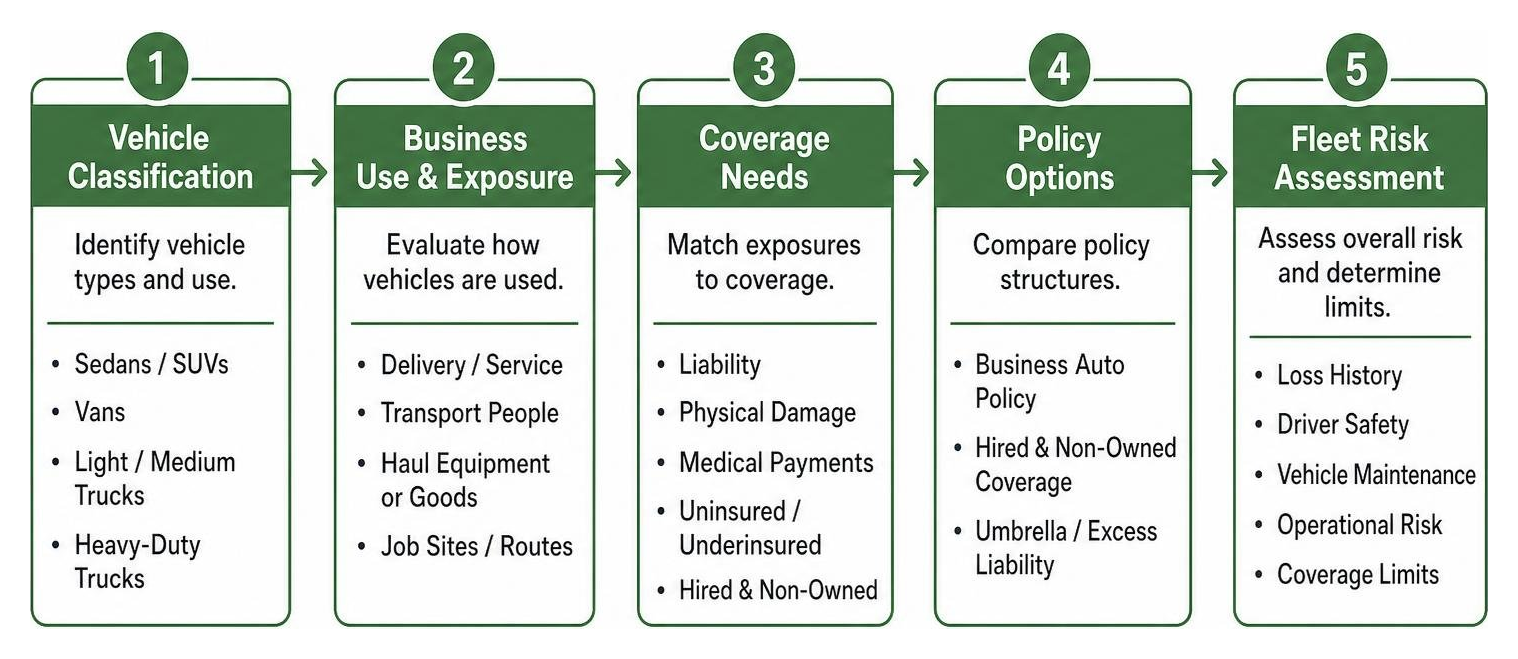
For businesses using connected vehicles, telematics, routing tools, driver monitoring, or AI-supported operations, commercial auto insurance is no longer only a compliance purchase. It is part of a broader risk management system that combines vehicle data, driver behavior, contracts, and operational exposure.
Selecting commercial auto coverage requires looking closely at how your business uses its vehicles every day. Determining which insurance is best for a commercial vehicle? starts with evaluating your operational risk profile, vehicle classifications, data available from fleet systems, and coverage requirements.
A single delivery van servicing local clients carries different exposures than a fleet of heavy-duty utility trucks carrying expensive upfits. Businesses that track mileage, driver safety, maintenance history, and route patterns are often better prepared to compare policies and document risk controls during underwriting.
Determining Which Insurance Is Best for a Commercial Vehicle Based on Business Use
Personal auto insurance policies contain explicit exclusions for business use. If an employee causes an accident while delivering products, traveling between client sites, or hauling equipment, a personal policy will almost certainly deny the claim.
To determine the right coverage, evaluate five key operational criteria:
- Transporting Tools and Goods: Vehicles carrying heavy machinery, trade supplies, or merchandise require higher property damage limits and physical damage coverage.
- Passenger Transport Liability: Driving clients, employees, or passengers introduces high bodily injury exposure, making extensive liability coverage essential.
- Service Call Operations: Electricians, plumbers, and HVAC technicians driving between jobsites need coverage for frequent trips, parking in active work zones, and attached vehicle equipment.
- Fee-Based Delivery Services: Delivering food, packages, or materials for a fee requires specialized commercial underwriting. Personal auto policies treat fee-based delivery as an uninsurable risk.
- Employee Driving Access: Allowing employees to operate company vehicles increases liability. Policies must account for all regular drivers and include permissive-use terms.
Businesses using fleet software or AI-supported dashboards should also review whether their systems can produce useful underwriting records, such as mileage logs, incident reports, garaging locations, maintenance schedules, and driver safety trends.
Evaluating Insurer Types: Which Insurance Is Best for a Commercial Vehicle with High Risk or New Operations?
New businesses and high-risk operators face distinct underwriting challenges. Established businesses with clean loss histories pay roughly $150 to $270 per vehicle per month for light-duty commercial auto coverage. Newer businesses or operators with prior accidents often face higher premiums or strict binding requirements.
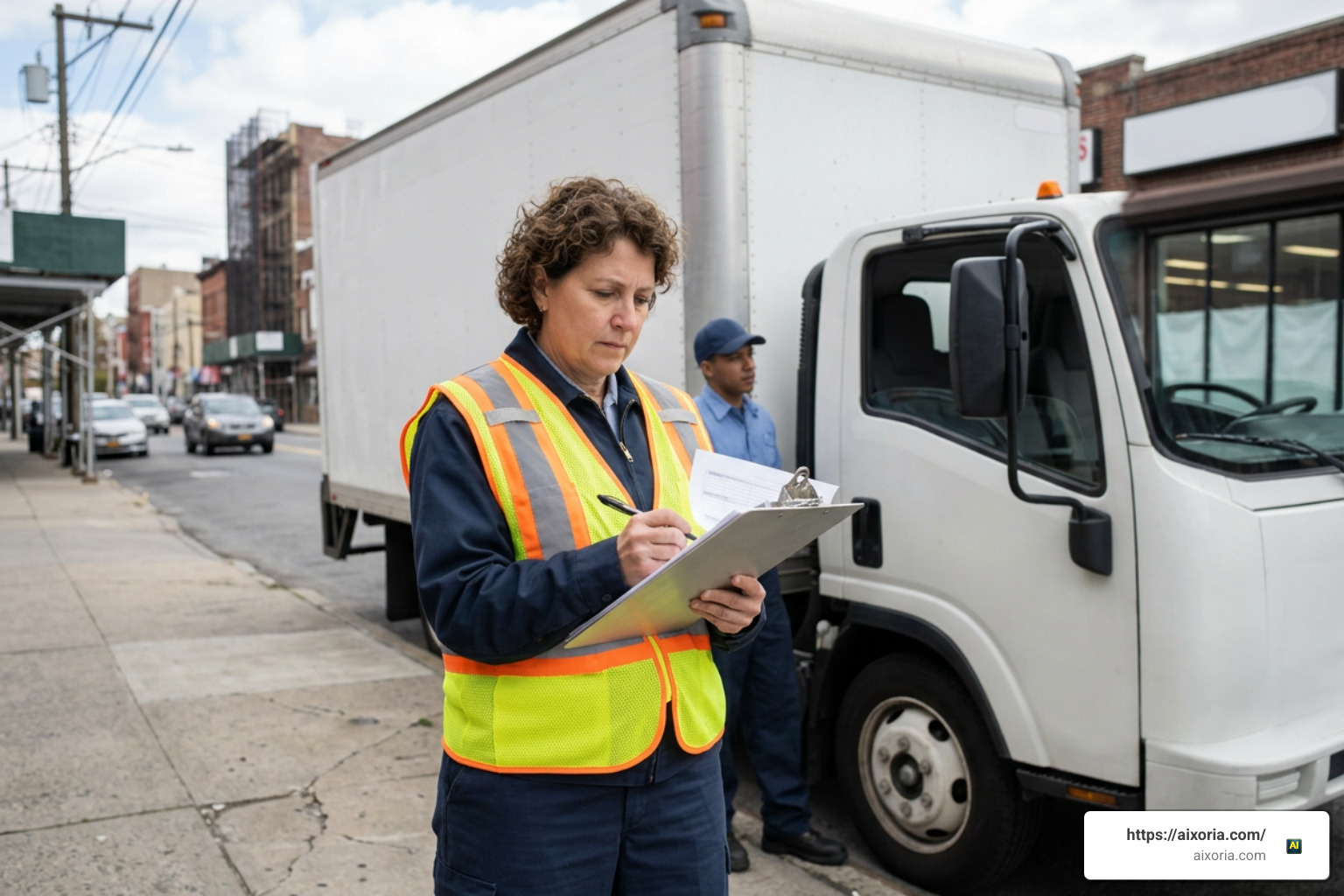
Carriers evaluate risk using several key underwriting factors:
- Business Maturity: Insurers review your time in business. Companies with under two years of operating history may need specialized underwriting markets.
- Motor Vehicle Record (MVR) Screening: Every listed driver’s history impacts your monthly premium. A single DUI or major moving violation can increase rates by 30% to 50%.
- High-Risk Coverage Pools: When standard insurers decline a policy due to claims history, specialized non-standard carriers provide higher-risk coverage options.
- Operating Radius: Local driving within a 50-mile radius presents lower underwriting risk than long-distance regional or interstate travel.
- Risk Data Quality: Driver scorecards, telematics summaries, preventive maintenance records, and documented safety policies can help businesses explain their risk profile more clearly.
Comparing Digital-First and Traditional Commercial Insurers
The commercial insurance landscape is split between direct digital platforms and traditional agency carriers. Choosing between them depends on your fleet complexity, administrative preferences, and the quality of operational data you can provide.
Digital-first providers allow small business owners to buy coverage, adjust policies, and generate proof of insurance online within minutes. Direct online platforms work best for straightforward risks, such as single-vehicle service pickups or small professional fleets.
Traditional agency carriers use networks of independent agents. These carriers excel at managing complex contractor fleets, heavy machinery, specialized upfits, and multi-policy risk management strategies. Independent agents provide direct risk management advice and customize endorsement packages.
For technology-focused operators, the best fit is usually the insurer or broker that can translate fleet data into practical underwriting support, not simply the lowest initial quote.
Commercial Auto vs. Commercial Truck Insurance: Key Differences
While many business owners use the terms interchangeably, commercial auto insurance and commercial truck insurance are distinct categories with different coverage structures, regulatory requirements, and data documentation needs.
| Feature | Commercial Auto Insurance | Commercial Truck Insurance |
|---|---|---|
| Target Vehicles | Sedans, SUVs, pickups, service vans, light box trucks | Class 7-8 tractors, heavy dump trucks, long-haul rigs |
| Weight Threshold | Under 10,000 lbs Gross Vehicle Weight Rating (GVWR) | Over 10,000 lbs (interstate) or 26,000+ lbs (CDL required) |
| Regulatory Body | State Departments of Insurance | Federal Motor Carrier Safety Administration (FMCSA) & State DOTs |
| Standard Liability Limit | $300,000 to $1,000,000 Combined Single Limit (CSL) | $750,000 (FMCSA legal floor) to $1,000,000+ CSL standard |
| Specialized Coverages | Hired & Non-Owned Auto, attached equipment coverage | Motor Truck Cargo, Bobtail/NTL, Trailer Interchange |
| Average Cost Profile | $143 to $285 / vehicle / month | $400 to $1,250+ / truck / month |
Weight Thresholds and Vehicle Classifications
Vehicle weight drives insurance pricing and regulatory oversight. Underwriters categorize commercial vehicles using Gross Vehicle Weight Rating (GVWR) classes:
- Light-Duty (Class 1-3, under 14,000 lbs GVWR): Includes standard passenger sedans, work pickups, and cargo vans. These vehicles typically carry the lowest base premiums.
- Medium-Duty (Class 4-6, 14,001 to 26,000 lbs GVWR): Includes larger box trucks, delivery vehicles, and heavy-duty utility trucks.
- Heavy-Duty (Class 7-8, 26,001+ lbs GVWR): Includes semi-tractors, large dump trucks, and multi-axle freight haulers. Drivers operating these vehicles must hold a valid Commercial Driver’s License (CDL).
The 10,001 lbs GVWR threshold triggers federal safety regulations for interstate commerce. Crossing this weight limit subjects your business to federal safety tracking and specific liability minimums.
For businesses using routing platforms, GPS tracking, or AI-assisted dispatch tools, vehicle classification data should match policy records. A mismatch between the insured vehicle type, GVWR, operating radius, and actual daily use can create underwriting issues or claim disputes.
Regulatory Filings and Federal Compliance
Businesses operating heavy trucks or transporting goods across state lines must maintain compliance with the Federal Motor Carrier Safety Administration (FMCSA). Key regulatory mechanisms include:
- USDOT Number & MC Authority: Required for interstate for-hire operations, hauling hazardous materials, or driving vehicles over 10,001 lbs GVWR.
- FMCSA Liability Limits: Federal law mandates a legal floor of $750,000 in primary auto liability for non-hazardous freight. Hazardous material haulers require $1,000,000 to $5,000,000 in coverage.
- Contractual Standards: While the federal minimum is $750,000, most freight brokers, general contractors, and corporate shippers require a minimum $1,000,000 Combined Single Limit (CSL).
- MCS-90 Endorsement: A mandatory financial responsibility endorsement attached to interstate policies. It guarantees public protection by ensuring the insurer pays valid third-party claims even if a specific policy exclusion applies, though the insurer can later seek reimbursement from the policyholder.
Digital compliance tools can help businesses track renewal dates, driver qualification files, vehicle records, inspection schedules, and proof-of-insurance requirements. Insurance should be reviewed alongside those systems so operational data, regulatory filings, and policy declarations remain consistent.
Core Policy Coverages, Exclusions, and Certificate Issuance
A complete commercial auto strategy combines mandatory liability coverage with optional physical damage endorsements, documentation workflows, and risk controls that protect business capital.

Essential Coverages and Common Policy Exclusions
Standard commercial auto policies include five primary coverages:
- Bodily Injury & Property Damage Liability: Pays for medical costs, lost wages, legal defense fees, and property repair costs if you or an employee causes an accident.
- Collision Coverage: Pays to repair physical damage to your company vehicle following a crash, regardless of fault.
- Comprehensive Coverage: Protects against non-collision losses, including theft, vandalism, weather damage, windshield cracks, and animal strikes.
- Uninsured / Underinsured Motorist: Covers medical expenses and physical damage if a company vehicle is hit by a driver who lacks adequate insurance.
- Hired and Non-Owned Auto (HNOA) Liability: Extends liability coverage to personal or rented vehicles used by employees for business tasks, such as running bank errands or traveling to off-site meetings.
Critical Coverage Exclusions to Know:
- Unattached Tools and Cargo: Commercial auto policies cover permanently attached equipment, such as welded ladder racks or built-in toolboxes. They exclude loose tools, test equipment, and cargo stored inside the vehicle.
- Inland Marine Protection: To protect unattached tools, hand equipment, and materials in transit, businesses must add an Inland Marine policy, often called a Tool and Equipment Floater.
- Cargo Hauling Liability: Hauling goods for hire requires specialized Motor Truck Cargo insurance, as standard commercial auto policies exclude customer freight.
Technology can improve the coverage review process, but it does not replace policy language. Fleet inventory systems, photo logs, asset tags, and maintenance platforms can help document vehicles and equipment, while the policy determines what is actually insured.
Certificate of Insurance (COI) Requirements and Issuance Speed
A Certificate of Insurance (COI) proves your business carries active liability coverage. General contractors, property owners, and corporate clients usually require a valid COI before allowing your vehicles onto a job site.
Digital-first commercial insurance platforms allow users to generate standard COIs online within 10 to 15 minutes. This speed is vital for trade contractors bidding on fast-moving projects. Custom certificates requiring complex endorsements, such as listing a client as an “Additional Insured” or adding a “Waiver of Subrogation,” may take 24 to 48 hours through traditional agency underwriting channels.
Businesses that rely on automated job management, procurement, or vendor compliance systems should keep COIs, policy numbers, vehicle schedules, and endorsement requests organized in one workflow. This reduces delays when clients need proof of coverage before dispatch, delivery, or job-site access.
Monthly Pricing Benchmarks and Cost Factors
Commercial auto insurance costs depend heavily on risk parameters. National benchmarks highlight clear pricing trends across insurance providers:
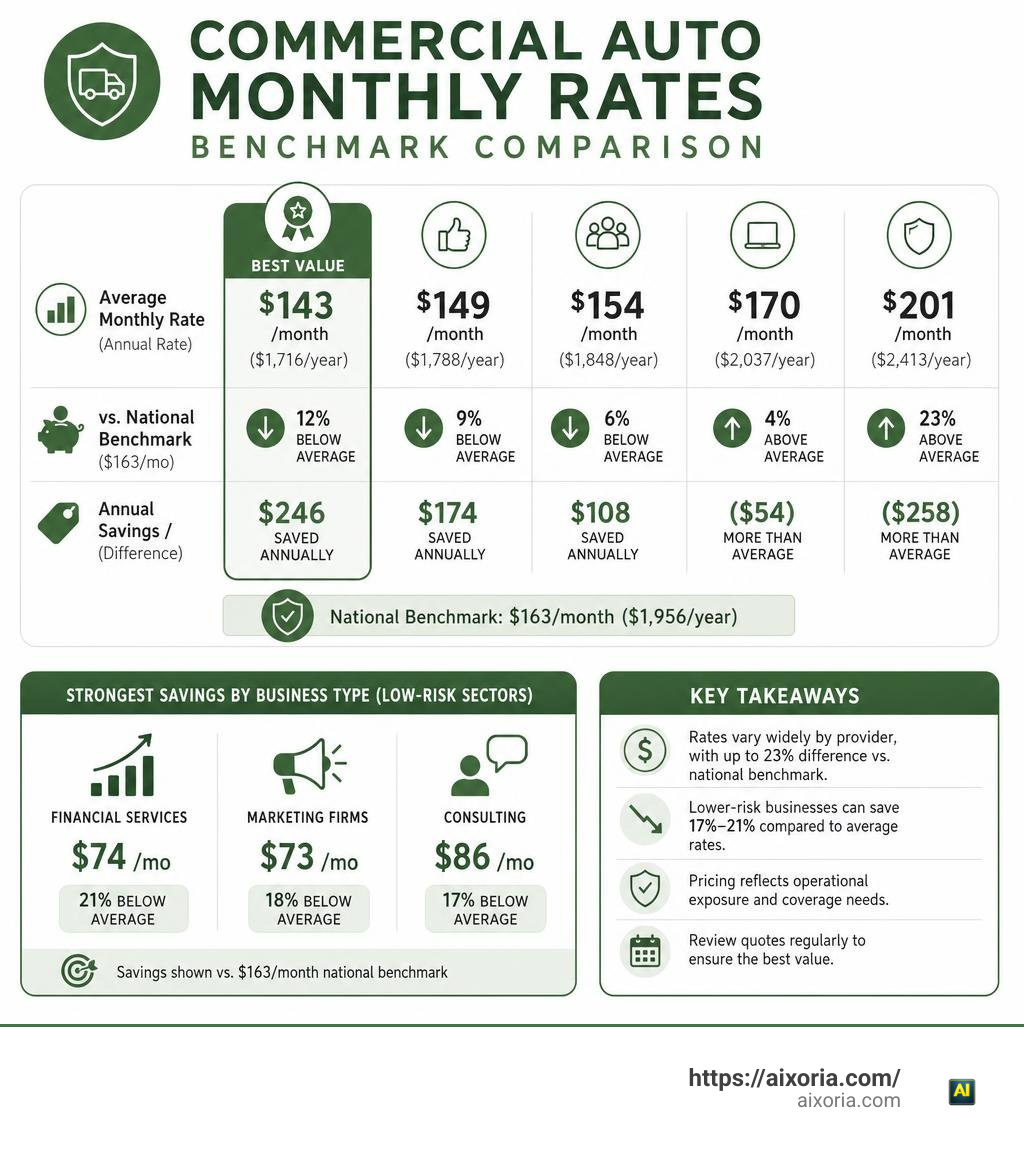
Commercial auto rates vary significantly by provider. Leading direct commercial carriers offer competitive affordability with average rates starting around $143 per month ($1,716/year), saving businesses $246 annually compared to the $163 national benchmark. Top regional carriers rank second at $149 per month ($1,788/year), saving businesses $174 annually. These carriers achieve their strongest savings in low-risk sectors like financial services ($74/mo, 21% below average), marketing firms ($73/mo, 18% below), and consulting ($86/mo, 17% below).
National mutual insurers average $154 per month ($1,848/year), saving policyholders 6% against national benchmarks. Digital direct carriers average $170 per month ($2,037/year), running 4% above national benchmarks. Specialized agency carriers rank highest in standard pricing at $201 per month ($2,413/year), which is 23% above average, though they offer specialized coverage depth for mature fleets.
For specialized trades and business types, pricing reflects operational exposure:
- Construction & Trade Vehicles: Standard light-duty pickups and service vans cost between $175 and $285 per vehicle per month. New commercial auto policyholders with clean driving records pay a median of $203 per month for contractors and $207 per month for general business auto accounts.
- Box Trucks & Medium Vehicles: Medium-duty Class 4-6 vehicles average $330 to $660 per vehicle per month ($4,000 to $8,000 annually).
- Heavy Freight & Class 8 Rigs: Solo owner-operators operating under their own MC authority pay between $750 and $1,250 per month ($9,000 to $15,000 annually) for full coverage stacks.
Review baseline carrier pricing directly on Commercial Truck Insurance Cost: 2026 Quotes and Ranges to analyze detailed weight-class breakdowns.
Proven Cost Reduction Strategies:
- Telematics Programs: Plug-in OBD devices and tracking apps monitor driver safety. Enrolling can unlock initial discounts of 5% to 9%, with safe driving habits providing ongoing savings up to 15%.
- Garaging ZIP Code: Vehicles parked in low-litigation, low-crime suburban or rural ZIP codes cost significantly less to insure than vehicles garaged in congested urban centers.
- Paid-in-Full Discounts: Paying annual premiums upfront instead of monthly can lower overall policy costs by 10% to 13%.
- Deductible Adjustments: Increasing physical damage deductibles from $500 to $1,000 or $2,500 reduces monthly premium expenses.
- Data-Backed Safety Reviews: Regularly reviewing telematics alerts, speeding events, harsh braking, idle time, and maintenance records can support safer operations and stronger renewal conversations.
Frequently Asked Questions about Commercial Vehicle Insurance
How do I know if my small business needs a commercial auto policy instead of personal insurance?
You need a commercial auto policy if your vehicle is owned or leased by a business entity, driven by employees, or used to transport business goods, tools, or paying passengers.
Personal auto policies contain strict commercial exclusions. If an accident occurs while performing work duties, your personal insurer can deny the claim, leaving your business exposed to legal defense expenses and third-party damages out-of-pocket.
If your business uses routing apps, field service software, telematics, or AI-supported dispatching, those records may also show that the vehicle is being used commercially. Your insurance should match the actual operating pattern.
How quickly can a business obtain a Certificate of Insurance (COI) for a job bid?
Digital direct insurance portals issue standard COIs instantly online or within 10 to 15 minutes after policy binding.
If a job contract requires customized endorsements, such as specific liability wording, primary and non-contributory clauses, or waiver of subrogation endorsements, the process may take 24 to 48 hours through an insurance broker.
Businesses with recurring client requirements should store COIs, endorsement requests, renewal dates, and insured vehicle schedules in a centralized system so certificates can be updated quickly when contracts change.
Are loose tools and cargo covered under a standard commercial vehicle policy?
No. Standard commercial auto policies cover permanently attached equipment, such as welded toolboxes, lift gates, and fixed ladder racks. Loose tools, portable power equipment, hand supplies, and customer cargo are strictly excluded.
To cover unattached items, add an Inland Marine tool floater to your coverage package. Hauling cargo for hire requires a separate Motor Truck Cargo policy.
Digital asset lists, equipment photos, barcode records, and maintenance logs can help document what the business owns, but they do not create coverage by themselves. The correct policy endorsement or separate policy must be in place before a loss occurs.
Conclusion

Finding the right insurance for a commercial vehicle requires balancing price, coverage depth, policy flexibility, and the operational data your business can provide. While direct providers deliver competitive rates (averaging $143/mo to $149/mo) for light-duty fleets, specialized businesses may benefit from traditional agency policies or digital direct carriers (averaging around $170/mo).
“https://www.mediafire.com/file/57z7gc7x34esh5h/Skibidi_Toilet_Raids_v1.1_BY_MCMPDL.mcaddon/file“;
For Aixoria readers, the practical takeaway is that insurance decisions should connect with the same technology stack used to manage modern business operations. Telematics, maintenance records, driver monitoring, dispatch systems, and AI-supported reporting can all help businesses understand risk, prepare for underwriting, and maintain cleaner documentation.
Match your policy limits to contract requirements, secure coverage for loose tools through inland marine floaters, and check that driver records are clear before binding coverage. Continuous commercial auto coverage builds long-term loss history, unlocking lower rates as your fleet grows.
Discover modern risk strategies, operational technologies, and fleet integration tools at Aixoria AI Updates to keep your commercial fleet moving safely.