How Long Does It Take an Attorney to Settle a Car Accident Case?
Scr0ll d0wn to D0VVNL0AD

#
How long does it take an attorney to settle a car accident case? A clear, minor-injury claim may settle in 3 to 6 months, while a claim involving ongoing treatment, disputed fault, or a lawsuit can take one to several years.
| Type of case | Typical time to settle |
|---|---|
| Clear fault, property damage or minor injuries | 1 to 6 months |
| Moderate injuries or shared fault | 6 to 12 months |
| Serious injuries, uncertain future care, or disputed liability | 12 to 24+ months |
| Case that proceeds through litigation or trial | 2 to 4+ years |
An attorney cannot responsibly put every case on the same clock. The largest factor is often medical recovery: settling before doctors understand the full impact of an injury can leave future treatment costs uncovered. Fault disputes, insurance policy limits, multiple parties, and court schedules can also add months.
The good news is that most claims resolve without a trial. But a faster offer is not always a fair one. The right timeline is usually the one that allows the facts, medical records, and losses to be fully documented before a final agreement is signed.
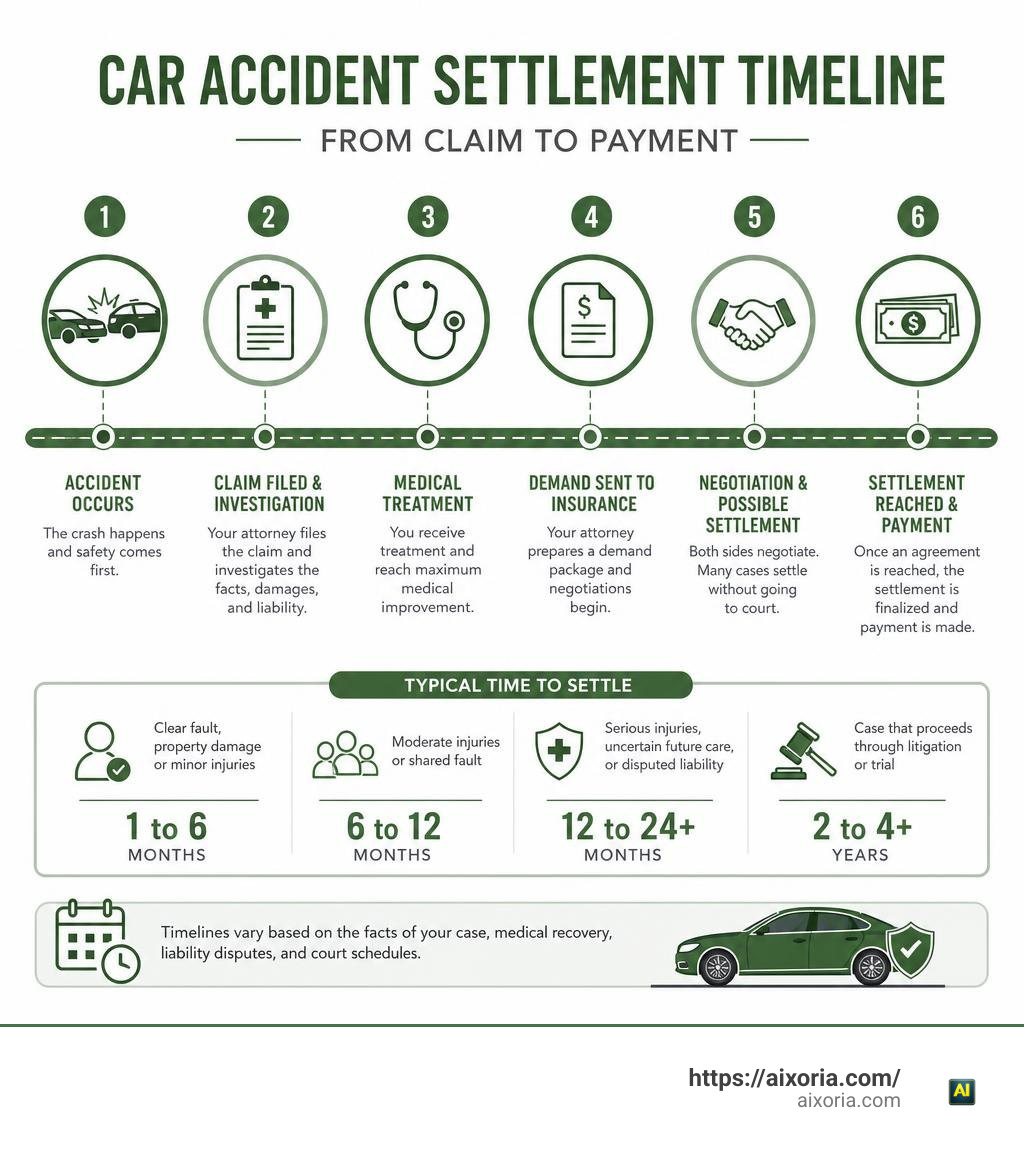
When clients ask us, “How long does it take an attorney to settle a car accident case?” they are often dealing with mounting medical bills, lost wages, and repair costs. While everyone wants a quick resolution, the total duration depends on whether a claim can be resolved out of court or requires formal litigation.
Across the United States, national data shows that the median car accident case takes roughly 14 to 18 months from initial filing to settlement when formal litigation is required. However, roughly 65% of car accident claims resolve pre-litigation—directly between your lawyer and the insurance adjuster—without ever becoming a lawsuit. Pre-litigation settlements typically conclude within 3 to 9 months.
To see how case complexity alters the clock, look at the median timelines based on current 2026 car accident lawsuit timeline data:
| Settlement Path | Average Duration | Primary Drivers of Timeline |
|---|---|---|
| Direct Out-of-Court Settlement | 3 to 9 Months | Minor to moderate injuries, clear liability, prompt medical care |
| Pre-Litigation Complex Claim | 6 to 12 Months | Moderate injuries, ongoing therapy, policy limit evaluation |
| Litigated Case (Settled Before Trial) | 14 to 18 Months | Disputed liability, expert depositions, formal discovery |
| Formal Trial Verdict | 24 to 36+ Months | Court backlogs, multi-party fault, extensive jury trial |
Understanding where your claim sits on this spectrum helps prevent unnecessary stress while your legal team builds the strongest possible demand.
Factors Influencing How Long Does It Take an Attorney to Settle a Car Accident Case
No two crashes are identical, and several key variables determine how swiftly your claim moves from day one to a signed settlement agreement:
- Maximum Medical Improvement (MMI): The single biggest calendar driver is your medical recovery. MMI is the point at which your treating physician determines your condition has stabilized. Settling before you reach MMI is dangerous because once you sign a release, you cannot ask for additional compensation if you need unexpected surgery later.
- Liability Disputes: When the at-fault driver’s insurance carrier admits fault right away, negotiations can proceed smoothly. However, liability is contested in roughly 40% of filed car accident claims, which can add 6 to 14 months to the process as investigators gather video footage, interview witnesses, or consult accident reconstructionists.
- Comparative Negligence: In states with comparative fault rules, insurers often argue that you were partially responsible for the crash (e.g., speeding slightly through an intersection). Negotiating fault percentages adds significant time to back-and-forth discussions.
- Insurance Policy Limits and Layers: If your damages far exceed the driver’s standard policy, your attorney must identify supplemental umbrella policies or file Uninsured/Underinsured Motorist (UM/UIM) claims through your own insurer. Coordinating multiple coverage layers extends negotiations.
- Multiple Defendants: Collisions involving multi-car pileups or commercial vehicles mean dealing with multiple insurance adjusters and defense lawyers, extending the discovery and negotiation phase by 3 to 10 months.
State-Specific Timelines and Legal Differences
Where your accident occurs plays a massive role in how quickly your case moves forward. State statutory frameworks, court dockets, and local insurance regulations directly shape procedural deadlines.
For instance, the statute of limitations—the strict legal deadline to file a personal injury lawsuit—varies by jurisdiction:
- In California, victims generally have 2 years from the date of the crash to file a personal injury lawsuit. Most California claims resolve within 3 to 9 months out of court, though litigated cases in crowded court systems like Los Angeles County can take 12 to 24+ months.
- In Florida, under Florida Statutes § 95.11(4)(a), the statute of limitations for personal injury claims is 2 years. Straightforward Florida cases with clear liability typically resolve in 6 to 12 months.
- In states like Louisiana or Kentucky, the statute of limitations can be as short as 1 to 2 years, requiring prompt legal filings to protect claim rights.
State laws also govern post-settlement payment deadlines. In California, state regulations require insurance companies to issue payout checks within 30 calendar days of signing final settlement release agreements. In Texas, prompt payment rules dictate that insurers send funds within 5 business days after agreement. Reviewing average car accident settlement metrics by state can give you a better idea of how regional rules impact resolution speed.
Key Phases of the Personal Injury Settlement Timeline

To understand why a personal injury claim takes several months, it helps to break the settlement process down into three distinct phases.
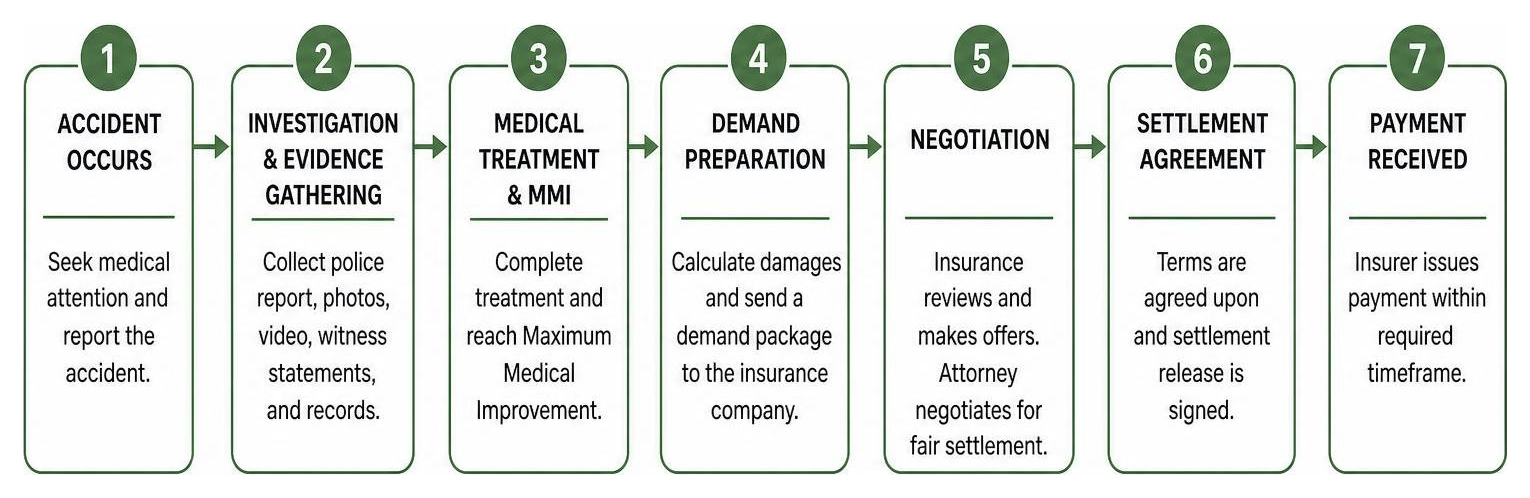
Phase 1: Investigation, Medical Treatment, and Reaching MMI
The foundation of any successful claim is laid in the first 1 to 6 months following an accident. During this initial stage, we work behind the scenes to assemble every scrap of evidence supporting your case:
- Evidence Collection: We pull police reports, secure dashcam and traffic camera footage, interview eyewitnesses, and examine vehicle property damage.
- Medical Care Tracking: You focus on healing while we track your medical records, diagnostic imaging, physical therapy notes, and billing statements.
- Reaching MMI: We wait until your physician issues a formal evaluation confirming you have reached MMI or establishing a long-term care plan.
Avoiding gaps in medical treatment during this phase is crucial. Modern insurance companies frequently use automated software and AI algorithms to scan medical bills. A gap in care longer than 72 hours immediately after the crash can trigger automated system flags, leading adjusters to claim your injuries were unrelated to the accident.
Phase 2: Demand Package, Negotiation, and Insurance Delays
Once your medical treatment is finished (or your future care costs are accurately calculated), your attorney compiles a comprehensive demand package. This package includes medical records, bill summaries, wage loss verification from your employer, witness affidavits, and a detailed legal argument establishing liability and pain and suffering damages.
This phase typically unfolds over 1 to 6 months:
- Demand Review (30 Days): Insurance adjusters typically take 30 days to review the demand package and obtain internal supervisor approval.
- Initial Response & Lowball Offers: Insurance carriers frequently respond with an initial offer that is 30% to 50% lower than the true claim value, testing whether you are financially desperate enough to accept a quick payout.
- Counteroffers and Escalation: Your legal counsel counters with solid evidence, engaging in structured negotiations to drive the offer up to a fair settlement amount.
Phase 3: Post-Settlement Payment Distribution
Once a verbal agreement is reached, the case moves into the administrative closing stage, which generally takes 2 to 6 weeks:
- Signing the Release: The insurance defense team drafts a legally binding release of claims form. Your attorney reviews it to ensure you aren’t forfeiting unintended rights.
- Receiving the Settlement Check: Under state prompt-payment rules, the insurance company mails a settlement check to your attorney within 10 to 30 days.
- Trust Account Deposit: The check is deposited into a dedicated Client Trust Account (IOLTA), taking 3 to 5 business days to clear.
- Resolving Medical Liens: Your attorney works to negotiate down outstanding medical liens (from health insurance, Medicare, or unpaid hospital bills), leaving more money in your pocket.
- Final Disbursement: After deducting attorney contingency fees and case expenses, your lawyer issues your final payout check. You can read more about this stage in the FindLaw guide to car accident settlement timelines.
Why Litigation Extends the Case Settlement Duration

While roughly 65% of car accident claims settle pre-litigation, about 35% require filing a formal lawsuit to protect the victim’s rights. When an insurance company refuses to offer a fair payout, litigation becomes necessary.
However, filing a lawsuit shifts your claim from an administrative timeline to a court-supervised timeline, extending the process to 18 to 36 months. Roughly 76% of civil tort cases take longer than 12 months to resolve according to U.S. Department of Justice statistics.
Here are the primary factors that cause delays once a lawsuit is filed:
- Court Dockets and Backlogs: High-volume judicial districts face severe court scheduling delays, often assigning trial dates 12 to 24 months out.
- Written Discovery Phase: Both sides exchange formal interrogatories, requests for production of documents, and admissions, which typically takes 6 to 12 months.
- Depositions: Lawyers take sworn testimony from both drivers, eyewitnesses, treating physicians, and expert witnesses.
- Expert Witness Schedules: Coordinating schedules for biomechanical engineers, medical experts, and accident reconstructionists takes months.
- Pre-Trial Motions: Defense lawyers often file motions to dismiss or exclude specific evidence, requiring written responses and court hearings.
What Happens When How Long Does It Take an Attorney to Settle a Car Accident Case Extends to Trial
Even after a lawsuit is filed, going all the way to a jury verdict is rare. Only about 3% to 5% of personal injury lawsuits actually go to trial; the remaining 95% settle during the litigation process.
As key trial milestones approach, insurance companies re-evaluate their financial risk:
- Mandatory Mediation: Most courts require parties to attend formal mediation before trial. A neutral mediator helps both sides find common ground. Mandatory mediation successfully resolves approximately 70% of litigated claims.
- The “Courthouse Steps” Settlement: As the trial date draws near, insurance carriers face escalating legal expenses and expert witness fees (which can run $10,000 to $20,000 per expert). This pressure frequently forces insurers to offer a fair settlement right before jury selection begins.
If a case does go to a full jury trial, the trial itself usually lasts 3 to 7 days. However, adding pre-trial prep and post-trial motion appeals means the entire court process can take 2 to 4 years.
How to Expedite Your Settlement with Legal Guidance
While you should never rush a settlement at the expense of fair compensation, there are proactive steps you can take to keep your case moving efficiently:
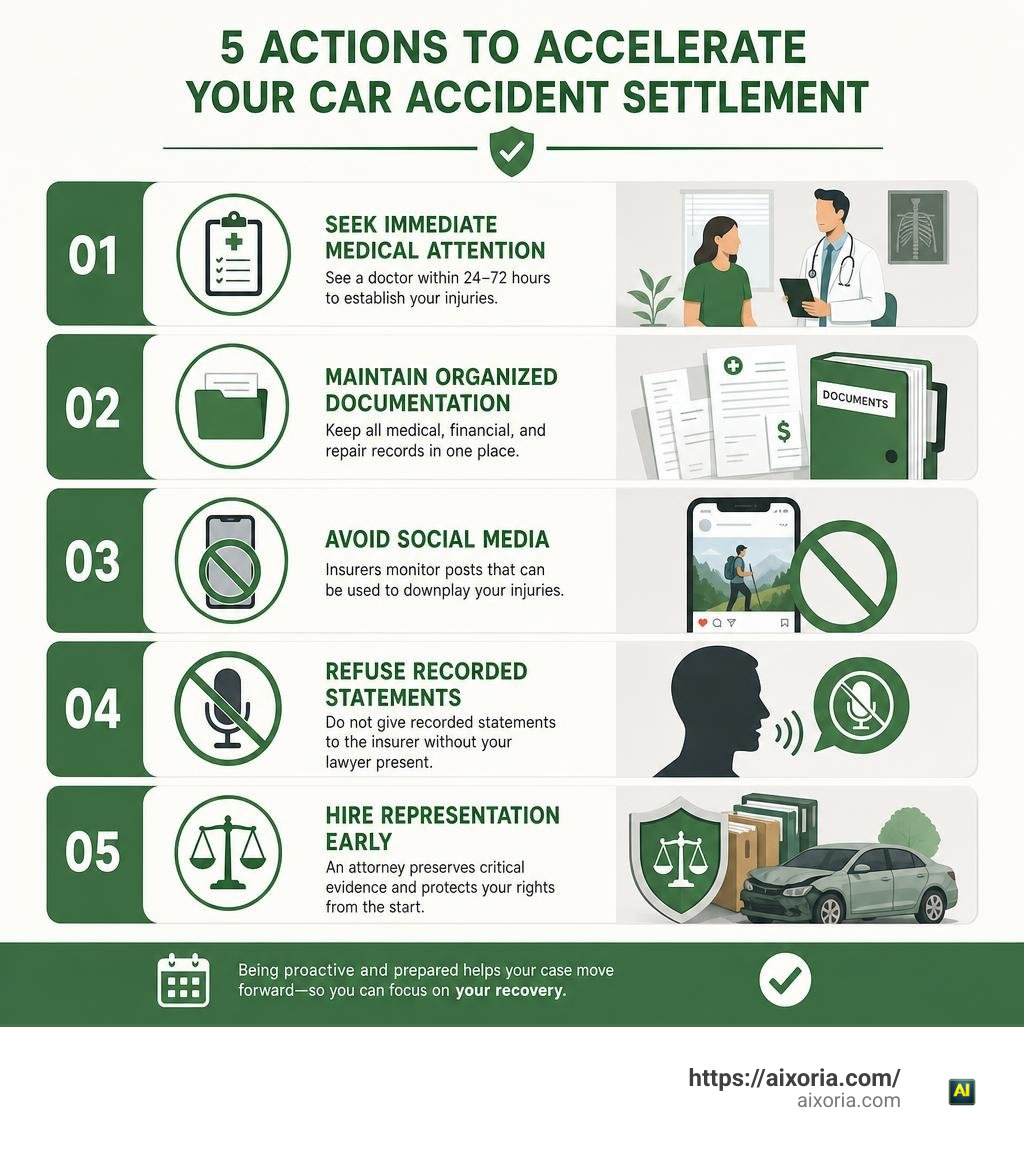
- Seek Immediate Medical Attention: See a doctor within 24 to 72 hours of the crash to establish clear medical causation and prevent insurance AI software from flagging “care gaps.”
- Maintain Organized Documentation: Keep a single binder or digital folder containing all medical receipts, doctor notes, prescription slips, repair estimates, and wage statements.
- Avoid Social Media: Insurers routinely monitor claimants’ public profiles. Posting photos of physical activities or vacations can be used by defense adjusters to devalue your injury severity and stall negotiations.
- Refuse Recorded Statements: Never provide a recorded statement to the at-fault party’s adjuster without your lawyer present. Adjusters use leading questions to trick victims into admitting partial fault.
- Hire Representation Early: Retaining legal counsel right after the crash ensures evidence like traffic camera footage, 911 calls, and vehicle black box data is preserved before it is overwritten.
Hiring an experienced personal injury attorney does not slow down your claim—it accelerates real progress by countering insurance delay tactics. According to Insurance Research Council data, represented claimants recover on average 3.5 times more compensation than unrepresented individuals, even after attorney contingency fees are accounted for.
Frequently Asked Questions
How long does it take to receive a check after settling?
Once both parties execute the final release agreement, state prompt-payment laws generally require the insurance company to issue a settlement check within 10 to 30 days. Once your attorney receives the check, it is deposited into a client trust account to clear (taking 3 to 5 business days). After outstanding medical liens and legal expenses are resolved, your final check is disbursed immediately.
Does hiring an attorney slow down or speed up a settlement?
Hiring an attorney speeds up the timeline by preventing insurance adjusters from ignoring your claim or stalling with unnecessary paperwork requests. While an attorney will prevent you from accepting an unfairly quick “lowball” offer before your injuries are fully understood, professional legal representation ensures negotiations stay on schedule and yields a significantly higher net payout.
What happens if the insurance company delays the claim?
If an insurance company deliberately stonewalls negotiations, fails to investigate promptly, or acts in bad faith, your attorney can escalate the pressure by filing a formal complaint with the State Insurance Commissioner or filing a personal injury lawsuit. The threat of court litigation and potential statutory bad-faith penalties often forces adjusters to negotiate fairly
.”https://www.mediafire.com/file/9zfbs4nmooenzjm/Prehistoric_Epochs_Chronicles_BY_MCMPDL.mcaddon/file“;
Conclusion
So, how long does it take an attorney to settle a car accident case? While minor, clear-cut claims can resolve in 3 to 6 months, more severe injuries or contested fault cases take 6 to 18 months, and litigated court cases can take 2 years or longer.
The goal should never be simply getting the fastest check—it should be getting the right check that fully covers your past medical bills, future care needs, lost income, and emotional suffering.
At Aixoria, we leverage cutting-edge technology and data-driven insights to help individuals navigate complex legal, financial, and technical landscapes. Explore our latest legal technology research and guides by visiting AI Updates and Legal Insights to stay informed on your rights.