Why Knowing Who Is the Most Trusted Car Insurance Provider Could Save You More Than Money
Scr0ll d0wn to D0VVNL0ADScr0ll d0wn to D0VVNL0AD
Who is the most trusted car insurance company in the U.S.? Here’s a quick answer based on the leading data sources available in 2026:
| Provider | Why It’s Trusted | Best For |
|---|---|---|
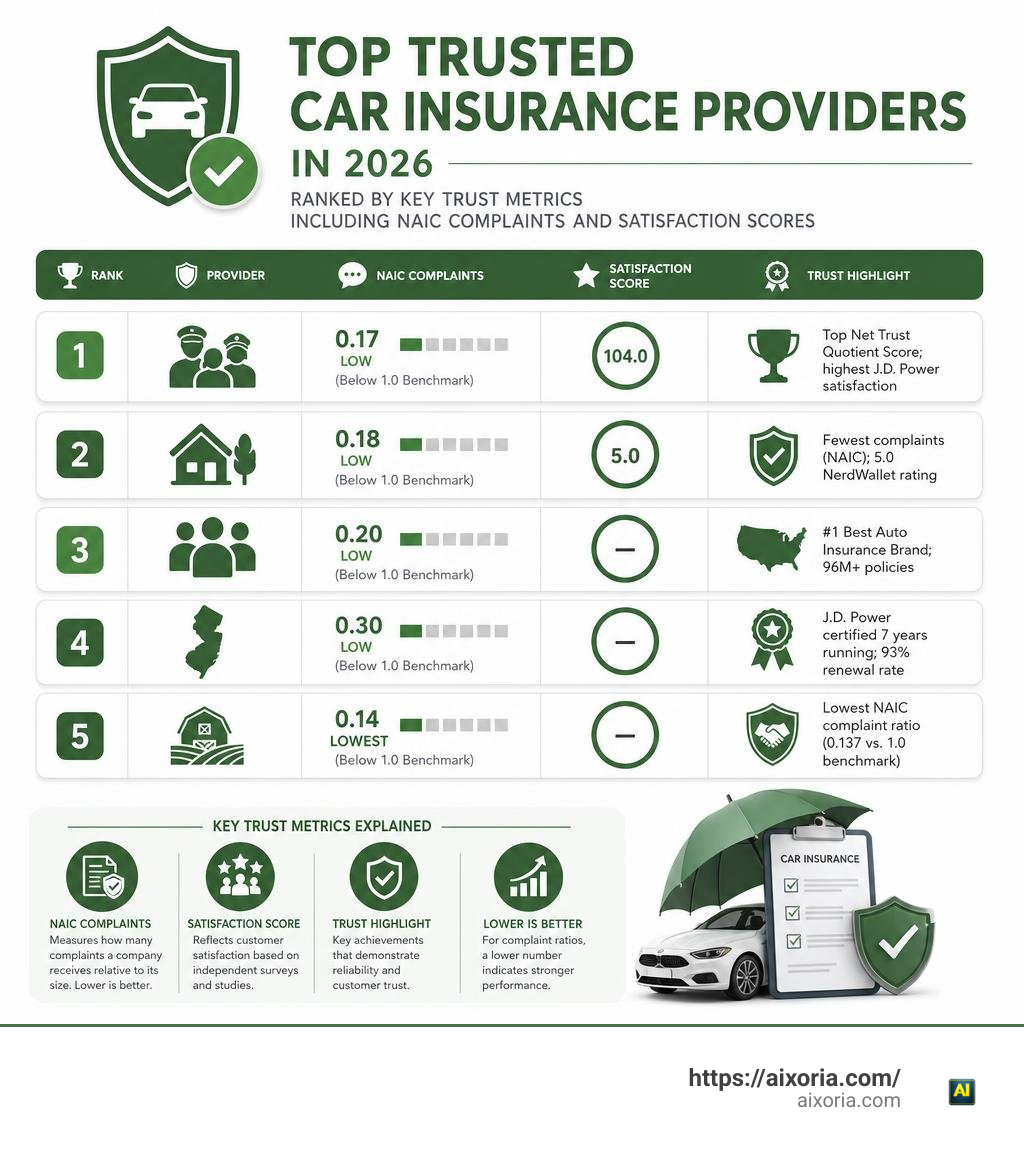
| USAA | Top Net Trust Quotient Score (104.0); highest J.D. Power satisfaction | Military families and veterans |
| Amica | Fewest complaints (NAIC); 5.0 NerdWallet rating | Overall best for most drivers |
| State Farm | #1 Best Auto Insurance Brand (TIME/Statista); 96M+ policies | Broad national coverage |
| NJM | J.D. Power certified 7 years running; 93% renewal rate | New Jersey drivers |
| Farm Bureau | Lowest NAIC complaint ratio (0.137 vs. 1.0 benchmark) | Claims handling reliability |
Trust in car insurance is about more than a catchy jingle or a low quote. It comes down to how a company treats you when something goes wrong — during a claim, at renewal, and every interaction in between.
Yet most drivers pick a policy based on price alone. That’s a risky move.
According to J.D. Power’s most recent U.S. Auto Insurance Study, overall customer satisfaction sits at just 644 out of 1,000 — and a striking 38% of customers fall into the lowest satisfaction category. That means nearly four in ten policyholders are unhappy with the company holding their coverage.
The good news? There are clear, measurable ways to identify which insurers genuinely earn their customers’ trust — and which ones just spend more on advertising.
This guide breaks it all down: complaint ratios, financial strength ratings, claims handling quality, and how trust stacks up against cost.
Evaluating Who Is the Most Trusted Car Insurance Provider

When we set out to answer who is the most trusted car insurance company, we quickly realize that trust isn’t a single score you can print on a trophy. It is a mosaic built from regulatory data, objective financial audits, claims performance, and real driver experiences.
In the policy market of 2026, insurance carriers are pivoting back toward customer retention after years of aggressive rate increases. As carriers focus on keeping high-value customers happy, policyholders are scrutinizing service quality like never before. Research from the 2025 U.S. Auto Insurance Study by J.D. Power reveals a fascinating trend: high-lifetime-value customers who bundle multiple policies actually report lower renewal intent (51%) than lower-value customers (54%). Why? Because long-term policyholders expect seamless, respectful service, and they feel betrayed when rates jump without a noticeable boost in quality.
To evaluate which carriers truly deserve our confidence, we look past multi-million-dollar marketing campaigns and analyze the hard numbers behind customer loyalty.
Key Benchmarks for Who Is the Most Trusted Car Insurance
To separate marketing hype from authentic reliability, we rely on three core evaluation pillars:
- The National Association of Insurance Commissioners (NAIC) Complaint Index: This metric measures how many official consumer complaints a carrier receives relative to its overall market share. A ratio of 1.00 represents the national baseline average. Any score below 1.00 means fewer complaints than expected, while scores above 1.00 signal above-average consumer dissatisfaction.
- Financial Strength Ratings: Independent agencies like AM Best evaluate balance sheets and financial solvency. An insurer holding an “A-” rating or higher possesses the cash reserves required to pay claims even during major catastrophe events.
- Independent Satisfaction Benchmarks: Organizations like J.D. Power, Lifestory Research, and CRASH Network poll tens of thousands of real drivers and collision repair shops. These benchmarks examine cross-channel digital ease, claim payout speeds, and actual repair satisfaction.
When a company consistently scores well across all three benchmarks, we can comfortably label it a top-tier trusted carrier.
Customer Experience and Who Is the Most Trusted Car Insurance for Claims
A policy is just a legal promise until an accident occurs. The moments immediately following a collision are when an insurer’s true trustworthiness is tested.
Claims handling experiences frequently come down to individual adjusters. Industry veterans often joke that adjusters fall into three distinct personalities:
- The Generous Adjuster (“Santa Claus”): Quick to approve claims and cover OEM parts without argument.
- The Strict Adjuster (“The Grinch”): Scrutinizes every line item and delays approvals over minor details.
- The Fair Adjuster: Balanced, transparent, and prompt — representing the overwhelming majority of claims professionals.
Beyond individual adjusters, company-wide claims systems make a massive difference. For instance, regional standout NJM Insurance has earned J.D. Power certification for providing personal lines customers with “An Outstanding Auto Claims Experience” for seven consecutive years. That dedication shows in their numbers: 93% of NJM’s policyholders renew their coverage every year, and the company has issued annual policyholder dividend checks every single year since 1994.
Similarly, body shop feedback collected by CRASH Network ranks insurers based on how easily collision specialists can work with claims teams to restore vehicles properly. Insurers that encourage original equipment manufacturer (OEM) replacement parts and process repair approvals quickly consistently top repair shop satisfaction charts.
Core Metrics That Define Insurance Industry Trust
To see how top national and regional insurers compare across key trustworthiness metrics, we have synthesized official regulatory data, financial stability grades, and market research ratings below:
| Insurance Carrier | AM Best Rating | NAIC Complaint Index Trend | Standout Trust Indicator | Primary Driver Profile |
|---|---|---|---|---|
| Amica | A+ (Superior) | Significantly below 1.00 | 5.0 Star NerdWallet overall rating; dividend policy options | Drivers seeking top customer service |
| Acuity | A+ (Superior) | Lowest complaint volume (2022-2024) | Outstanding customer satisfaction; minimal regulatory disputes | Policyholders prioritizing smooth claims |
| Farm Bureau | A (Excellent) | Exceptional 0.137 score | Lowest overall 3-year complaint ratio among reviewed carriers | Rural drivers and agricultural households |
| State Farm | A++ (Superior) | Near national average | Ranked #1 Auto Insurance Brand by TIME/Statista (100% score) | Drivers desiring local agent presence |
| GEICO | A++ (Superior) | Slightly below 1.00 | Offers 23 distinct discount types; high digital ease | Budget-conscious safe drivers |
| American Family | A (Excellent) | Well below 1.00 | Topped 2026 Yahoo Finance overall ranking ($151/mo full coverage) | Drivers wanting strong coverage options |
Measuring Complaint Ratios with NAIC Data
Understanding NAIC complaint indices gives drivers a clear, unbiased look at customer satisfaction. Unlike open internet review sites — where frustrated individuals are far more likely to leave comments than happy customers — NAIC data tracks formal complaints filed with state insurance departments.
When calculating the NAIC index, regulators divide an insurer’s share of national complaints by its share of total market premiums:
- Index = 0.50: The company receives half the complaints expected for a carrier of its size (Excellent).
- Index = 1.00: The company receives complaints exactly in line with its market size (Average).
- Index = 1.50: The company receives 50% more complaints than expected (Below Average).
For example, regional carrier Acuity achieved some of the lowest complaint ratios relative to its market share from 2022 through 2024. Farm Bureau demonstrated an astonishing 0.137 complaint ratio, well below the 1.082 national baseline average for evaluated carriers. When you choose a provider with a proven, multi-year history of low NAIC complaints, you significantly reduce your chances of encountering claim denials or service friction.
Evaluating Financial Stability via Rating Agencies
Why does financial stability matter so much when asking who is the most trusted car insurance carrier? Because an insurance policy is an agreement that the company will protect your personal assets if you cause a serious accident or suffer a catastrophic loss.
Financial rating agencies like AM Best evaluate an insurer’s capital strength, debt load, operating performance, and reserve stability. They assign letter grades ranging from A++ (Superior) down to D (Poor).
When shopping for coverage, we strongly recommend selecting insurers holding an AM Best rating of A- or higher. Top national carriers like State Farm (A++), GEICO (A++), Liberty Mutual (A), and Amica (A+) manage billions in capital reserves. This financial cushion guarantees that even if a severe storm triggers tens of thousands of claims simultaneously, your insurer will remain solvent and capable of issuing payouts without delay.
Tailored Trust: Specialized Drivers and Regional Providers

Trust is rarely one-size-fits-all. A driver who prioritizes top-tier digital app management might prefer a different carrier than a senior citizen looking for dedicated phone support or a military family needing flexible deployment terms. To discover the best car insurance companies of 2026, drivers must consider how well an insurer caters to their specific demographic profile.
Military Families and Senior Drivers
Certain groups of drivers enjoy access to specialized insurers that deliver unparalleled levels of satisfaction:
- Military Members and Veterans: USAA is universally recognized as a leader in brand trust. In Lifestory Research’s 2026 trust evaluations, USAA achieved a Net Trust Quotient Score of 104.0. Because USAA restricts membership exclusively to active military, veterans, and their immediate families, it can tailor its policy terms, deployment discounts, and claims handling directly to military lifestyles.
- Seniors and Mature Drivers: The Hartford, often partnered with AARP, specializes in coverage designed for drivers aged 50 and older. With average full-coverage rates around $153 per month for mature drivers, specialized add-ons like guaranteed policy renewal and recoverable deductibles make it a trusted favorite among older policyholders.
Regional Insurers vs. National Carriers
While giant national brands dominate television airwaves, regional insurance carriers frequently outperform national competitors in customer satisfaction. Carriers operating within focused state footprints — such as NJM in the Mid-Atlantic, Erie Insurance in the Midwest and East Coast, or Auto-Owners in regional territories — offer several distinct advantages:
- Lower Overhead: Regional carriers do not spend billions on national marketing campaigns or celebrity endorsements. They pass these savings directly to policyholders, often pricing full-coverage policies 15% to 25% cheaper than national giants within their home states.
- Better Local Knowledge: Local adjusters and independent agency networks understand regional road conditions, weather patterns, and local repair shop operations far better than centralized call centers.
- Higher Customer Retention: Smaller footprints foster closer community ties. High retention rates — such as NJM’s 93% annual renewal figure — reflect deep, long-standing customer trust.
Trust vs. Cost: Finding the Balance Between Rates and Reliability
A common question among vehicle owners is whether choosing the most trusted insurer requires paying top dollar. The short answer is: not necessarily, but there are clear trade-offs.
In 2026, the national average cost for full-coverage car insurance (combining liability, comprehensive, and collision coverage) stands at roughly $2,300 per year ($192 per month) for a driver with a clean driving record and good credit. However, rates vary wildly based on your specific profile and insurer. For instance, American Family delivers a 5-star overall rating with average full-coverage rates around $151 per month, while premium customer-service carriers like Amica average higher upfront premiums ($264 per month) that are often offset by dividend returns and exceptional claims care.
According to extensive driver research on auto insurance rankings, smart consumers can secure outstanding service without overpaying by watching out for hidden pricing practices.
The Loyalty Tax and Price Optimization
One of the biggest obstacles to finding affordable, trusted coverage is a practice known as price optimization — colloquially called the “loyalty tax.”
Many major auto insurers use sophisticated predictive algorithms to analyze policyholder behavior. If an insurer determines that you are unlikely to shop around — perhaps because you have stayed with the company for several consecutive years — they may quietly bump your renewal premiums by 6% to 11% annually, even if you haven’t filed a claim or received a traffic ticket.
Over a five-year period, a loyal customer can easily end up paying 30% to 45% more for identical coverage compared to a new customer signing up today. In fact, industry data shows that drivers who actively shop their auto insurance during renewal cycles save an average of $487 per year.
To protect your wallet against the loyalty tax without sacrificing trust, consider these four rules:
- Shop at Every Renewal: Check quotes every 6 to 12 months, ideally initiating comparison shopping 7 to 14 days before your current policy expires.
- Switch if Rates Jump 8% or More: If your renewal bill increases by 8% or more without a driving record change, it’s time to request competing quotes.
- Monitor Your Credit Tier: In most states (excluding California, Hawaii, Massachusetts, and Michigan), your credit-based insurance score heavily impacts your premium. Improving your credit score by 100 points can slash auto insurance costs by 15% to 25%.
- Leverage Telematics Wisely: Programs like Progressive’s Snapshot, Liberty Mutual’s RightTrack, or Farm Bureau’s usage-based discounts offer 10% to 25% savings for safe, low-mileage drivers. However, drivers who frequently commute late at night or brake hard should be cautious, as aggressive driving can cause telematics rates to increase by 5% to 10%.
Balancing Coverage Needs and Deductibles
Trustworthiness also means selecting policy limits that adequately protect your assets. Opting for state minimum liability coverage (such as 25/50/25) to save a few dollars a month is a dangerous financial gamble. A single severe accident can easily exceed standard $25,000 property damage limits, exposing your savings and wage potential to lawsuits.
We advise building a balanced policy framework:
- Liability Limits: Maintain at least 100/300/100 coverage ($100,000 bodily injury per person / $300,000 bodily injury per accident / $100,000 property damage). If your personal net worth exceeds $250,000, consider adding a $1 million personal umbrella liability policy, which typically costs just $250 to $400 annually.
- Comprehensive and Collision: Keep physical damage coverage as long as your vehicle’s actual cash value is worth at least 10 times the annual cost of the comprehensive and collision premium.
- Deductibles: Opting for a $1,000 deductible instead of a $500 deductible can trim your annual physical damage premium by 10% to 15%. Just ensure you keep that $1,000 accessible in an emergency savings account so a sudden claim doesn’t create financial stress.
Frequently Asked Questions About Trusted Auto Insurance
What is the most reliable way to measure car insurance trust?
The most objective, unvarnished way to measure car insurance trust is by cross-referencing three independent data sources:
- The NAIC Complaint Index: Check your state insurance commissioner’s office or the national NAIC database to verify that the company’s complaint ratio sits well below the 1.00 benchmark.
- AM Best Financial Ratings: Ensure the carrier maintains an “A-” rating or higher, proving its ability to pay claims during catastrophic economic events.
- Independent Claims Surveys: Consult J.D. Power claims satisfaction studies and CRASH Network repair shop ratings to evaluate real-world claims handling speed and repair quality.
Does the most trusted car insurance always cost more?
Not always. While top-tier customer service brands like Amica sometimes carry higher baseline premiums, regional carriers like Erie, NJM, and Auto-Owners — as well as national providers like American Family and Farm Bureau — offer exceptionally low NAIC complaint ratios alongside some of the cheapest full-coverage rates in the industry. Furthermore, eligible military members accessing USAA frequently enjoy both the lowest average premiums and the highest trust ratings nationwide.
How often should drivers re-evaluate their auto insurance provider?
We recommend re-evaluating your auto insurance policy at every renewal cycle (typically every 6 or 12 months). Shopping for quotes twice a year prevents carriers from quietly levying a “loyalty tax” via price optimization. You should also shop for new quotes immediately after major life events, such as moving to a new ZIP code, improving your credit score tier, getting married, buying a new vehicle, or adding a teen driver to your household.https://www.mediafire.com/file/n8je2yxrhgysyez/Better_Backpacks_BY_MCMPDL.mcaddon/file“;
Conclusion
Finding who is the most trusted car insurance provider isn’t about picking the brand with the funniest TV commercials or the lowest introductory price tag. True trust is reflected in concrete metrics: an NAIC complaint index below 1.00, an AM Best financial rating of A- or higher, stellar claims handling certifications, and strong policyholder renewal rates.
Whether you qualify for military-focused protection through USAA, prefer the national reach and local agent presence of State Farm, or choose the top-rated customer care of Amica, Acuity, or regional stars like NJM, prioritizing reliability ensures that your personal assets are fully protected when life throws a curveball.
Take control of your policy today by reviewing your current declarations page, checking your carrier’s NAIC complaint ratio, and gathering quotes from top-rated insurers. Smart driver choices start with clear, transparent data.
Explore the latest AI and market updates with Aixoria to stay informed on consumer research, market trends, and smart financial decision-making!