Can International Students Get Student Loans in the US?
Scr0ll d0wn to D0VVNL0AD

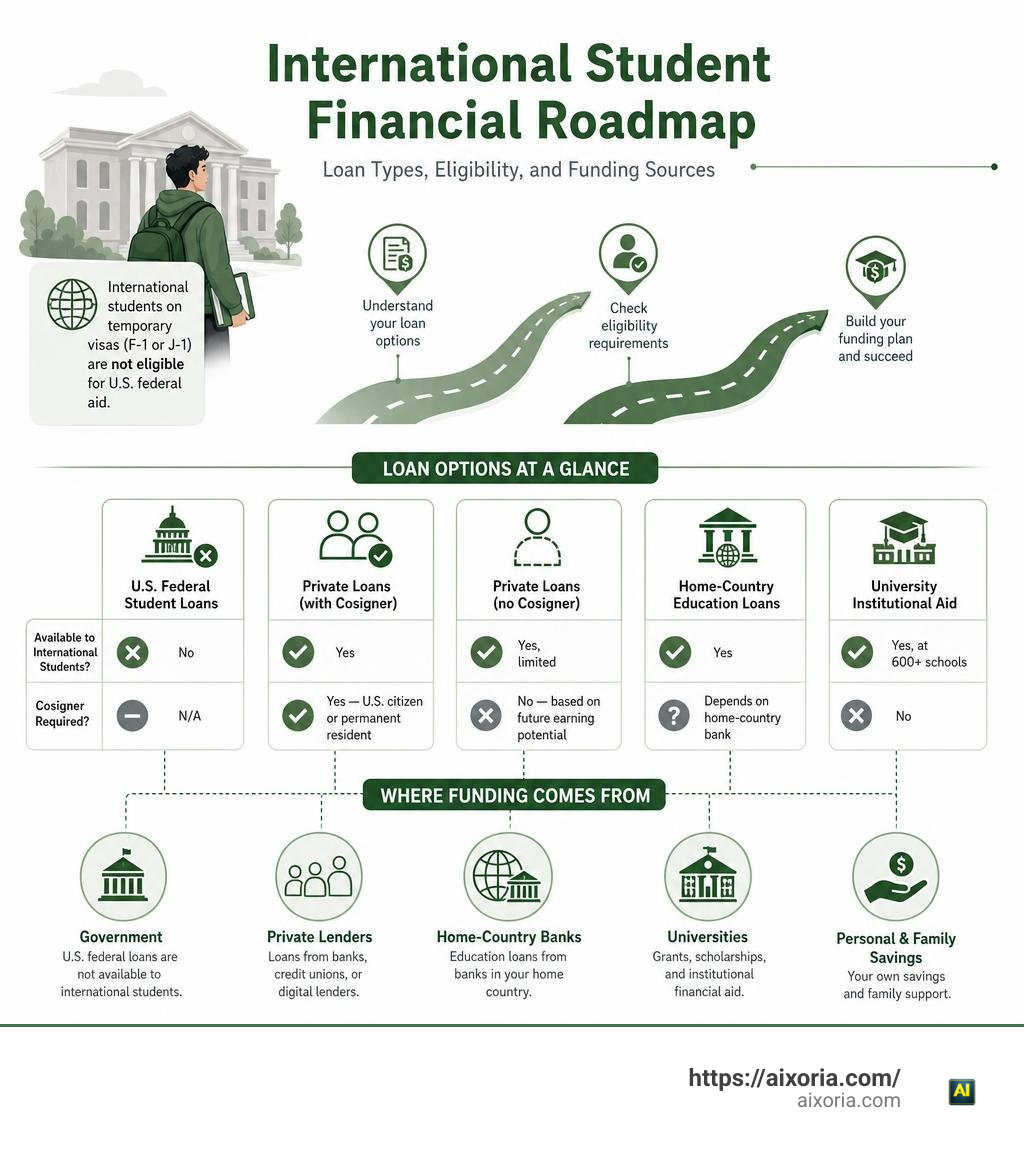
Can international students get student loans in the US? Yes – but not through the federal government. International students on temporary visas like F-1 or J-1 are generally barred from federal aid. Their options are private student loans, institutional aid, home-country financing, and increasingly, technology-enabled lending models that use digital verification, automated underwriting, and data-driven risk assessment.
For readers of Aixoria, this topic sits at the intersection of global education, fintech, and AI-powered decisioning. International students often lack a U.S. credit file, which makes traditional lending difficult. Newer private lending workflows may use school certification data, program information, projected income, document automation, and fraud checks to evaluate applicants more efficiently.
Here’s a quick summary:
| Loan Type | Available to International Students? | Cosigner Required? |
|---|---|---|
| U.S. Federal Student Loans | No | N/A |
| Private Loans (with cosigner) | Yes | Yes – U.S. citizen or permanent resident |
| Private Loans (no cosigner) | Yes, limited | No – based on future earning potential |
| Home-Country Education Loans | Yes | Depends on home-country bank |
| University Institutional Aid | Yes, at 600+ schools | No |
Nearly 1.2 million international students studied in the U.S. during the 2024-25 school year. The average cost? Over $44,000 per year. That’s a serious funding gap for students who can’t access federal loans.
The good news: private lenders, university grants, and overseas bank programs can fill that gap – if you know where to look. The even bigger trend is that AI and financial technology are changing how these options are discovered, compared, verified, and underwritten.
This guide breaks down every option clearly, so you can build a funding plan that works and understand how technology is shaping access to education finance.
Can International Students Get Student Loans in the US?
When non-citizens pack their bags and head to the United States for higher education, they quickly discover that financing a U.S. degree involves navigating a complex matrix of financial rules. So, can international students get student loans in the US? As noted above, the direct answer is yes, but the pathways are distinct from those available to domestic U.S. students.
Because international students contribute over $40.1 billion annually to the U.S. economy through tuition, housing, fees, and general living expenses, both higher education institutions and private lending markets have established specific financial frameworks to accommodate foreign scholars. Technology is also becoming part of that framework: lenders and universities increasingly rely on secure portals, automated document checks, school-certified cost data, and risk models to process applications.
However, international students on temporary non-immigrant visas such as F-1, J-1, or M-1 visas are legally barred from U.S. federal student aid programs created under Title IV of the Higher Education Act.
To navigate this landscape, it is helpful to understand how eligibility rules divide federal assistance from private lending options. For a detailed breakdown of official government criteria, you can review the U.S. Citizenship & Eligible Noncitizens Guide.
U.S. Federal Aid Eligibility vs Private Loans
The core reason international students cannot obtain standard federal student loans comes down to legal citizenship status. The U.S. Department of Education restricts federal student aid, including Direct Subsidized, Unsubsidized, Parent PLUS, and Graduate PLUS loans, as well as Pell Grants and Federal Work-Study, strictly to U.S. citizens, U.S. nationals, and specific “eligible noncitizens.”
Eligible noncitizens generally include:
- U.S. Lawful Permanent Residents (green card holders).
- Conditional permanent residents.
- Individuals holding an Arrival-Departure Record (I-94) designated as Refugee, Asylum Granted, Cuban-Haitian Entrant, or Parolee.
- Victims of human trafficking holding specific visas, such as T-visas.
If you are in the U.S. on a temporary student visa like an F-1, J-1, or M-1, or if you hold DACA status, you are not classified as an eligible noncitizen for Title IV federal funds.
Despite this federal barrier, there is an important nuance to keep in mind: you should still consider completing a paper FAFSA or school-specific financial aid form if your university requests it. While you cannot receive federal money, over 600 U.S. colleges and universities require international students to submit a paper copy of the FAFSA without a Social Security Number, or the International Student Financial Aid Application (ISFAA), to assess eligibility for internal, need-based institutional scholarships and university-funded grants.
How Can International Students Get Student Loans in the US Without Federal Assistance?
Without access to federal funds, international students turn to specialized private education loans to bridge their funding gaps. Private student loans are offered by commercial banks, fintech credit companies, and online niche lenders rather than the government.
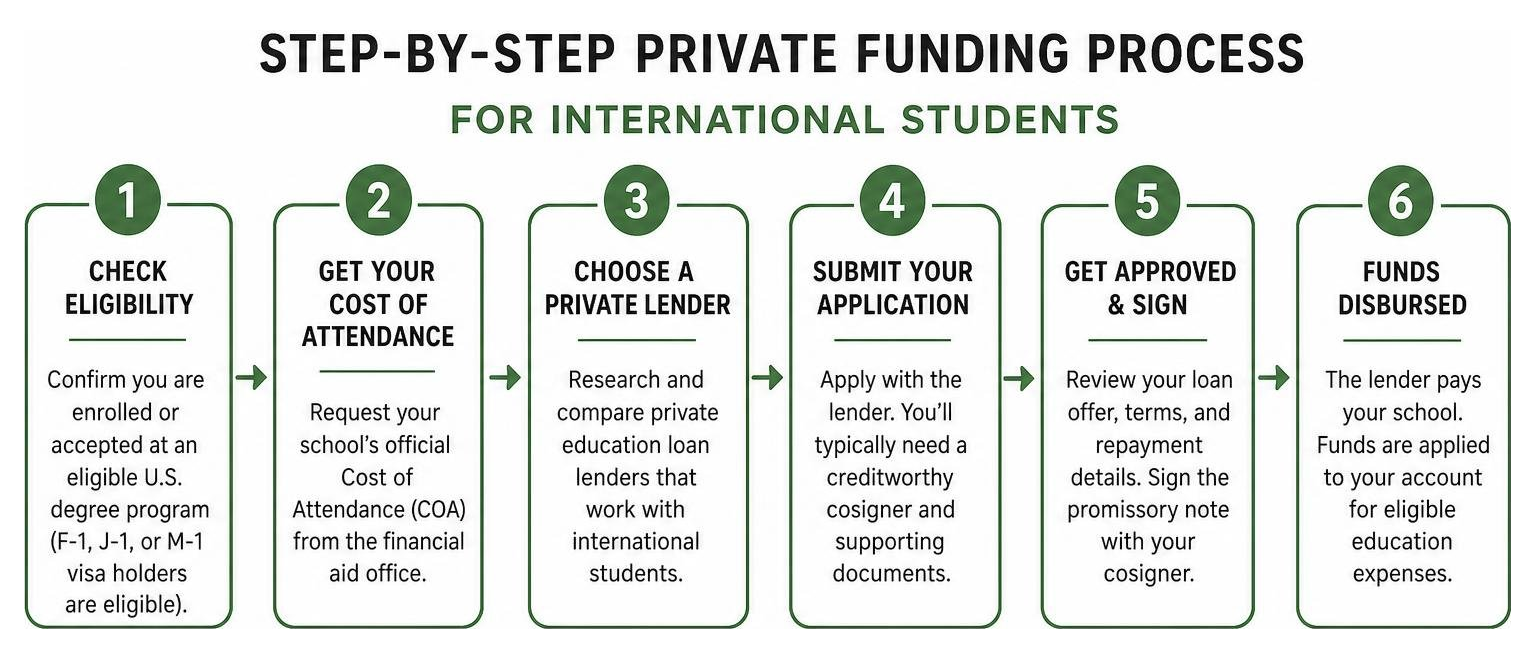
Private lenders evaluate international applicants based on direct enrollment at an eligible higher education institution and the school’s certified Cost of Attendance (COA). The COA is an official figure calculated by the university’s financial aid office that includes:
- Tuition and mandatory student fees.
- Room and board, including housing and meal plans.
- Books, technology, and academic supplies.
- Health insurance premiums, which are often required for international students.
- Personal living expenses and local travel.
Private lenders cannot disburse funds exceeding the total certified COA minus any other financial aid, grants, or scholarships you have already received.
To fund a degree efficiently, smart students assemble a “funding stack.” Rather than relying on a high-interest private loan for 100% of education costs, you begin with non-repayable aid, such as institutional grants and external scholarships, add on-campus student employment earnings, and cover only the remaining net balance with a private international student loan. Combining these funding sources can lower your total out-of-pocket borrowing by 30% to 50%.
From an AI and fintech perspective, this funding stack is also a data problem: students need to compare eligibility rules, APR ranges, visa limitations, application documents, deadlines, and repayment scenarios. Digital tools can help organize that information, but final loan decisions still depend on lender policies, school certification, and legal eligibility.
U.S. Cosigner vs No-Cosigner Loans for Non-Citizens

When seeking private student loans in the U.S., international students encounter two distinct categories of loans: cosigned private loans and no-cosigner private loans. Understanding how these options differ in eligibility criteria, interest rates, and approval odds is critical when evaluating your financing strategy.
This is also where data-driven lending becomes especially important. Because many international students have little or no U.S. credit history, lenders may need alternative ways to evaluate risk. Some products still depend mainly on a U.S. cosigner’s credit profile, while others use forward-looking underwriting based on school, program, academic progress, and expected earning potential.
| Feature | Private Loans WITH a U.S. Cosigner | Private Loans WITHOUT a Cosigner |
|---|---|---|
| Primary Underwriting Focus | Cosigner’s credit score (670+) & income | Future earning potential, major, & academic performance |
| Typical APR Range | 4% – 13% APR | 9.99% – 16% APR |
| Origination Fees | Usually $0 or low fee | Frequently up to 5% |
| Maximum Borrowing Limits | Up to 100% of total certified COA | Typically $2,001 to $100,000 total lifetime caps |
| Eligible Student Types | Undergraduates & Graduates across all years | Mostly upperclassmen (juniors/seniors) & graduate students |
| School Network Restrictions | Available at almost all accredited U.S. colleges | Restricted to select participating universities (150-400+ schools) |
Qualifying With a U.S. Cosigner
For most non-U.S. citizens, applying alongside a creditworthy U.S. cosigner is the most reliable way to secure a private student loan with competitive interest rates. A cosigner acts as a legal guarantor on the debt, agreeing to take full responsibility for making monthly loan payments if the primary student borrower fails to pay.
To qualify as a valid U.S. cosigner for an international student loan, the individual must meet strict criteria:
- Citizenship Status: Must be a U.S. citizen or legal Permanent Resident (green card holder).
- Residency: Must have lived within the United States continuously for at least the past two years.
- Credit History: Must possess an established U.S. credit profile, typically requiring a FICO credit score of 670 or higher.
- Income Verification: Must demonstrate steady, verifiable income and a low debt-to-income ratio to ensure they can manage additional debt obligations.
Applying with a U.S. cosigner dramatically reduces the lender’s risk, resulting in lower interest rates, historically starting as low as 4% to 7% APR for top-tier credit profiles, and broader borrowing limits up to the school’s full Cost of Attendance.
Many cosigned private loans also include a cosigner release clause. This feature allows the international student to remove the cosigner from the loan agreement after graduation once the student secures a full-time job, establishes their own U.S. credit history, and completes 12 to 36 consecutive, on-time monthly payments.
Can International Students Get Student Loans in the US Without a Cosigner?
What if you do not have a relative or close friend living in the U.S. who is willing or able to act as a cosigner? Can international students get student loans in the US without a cosigner?
Yes, select specialized fintech lenders provide no-cosigner loans explicitly designed for foreign citizens. Instead of evaluating traditional credit scores or requiring local guarantors, these lenders utilize forward-looking underwriting models.
Forward-looking underwriting evaluates:
- Academic Standing and Field of Study: Students enrolled in high-ROI fields, such as STEM (Science, Technology, Engineering, Math), business, data analytics, and healthcare, receive preference due to strong labor market demand.
- Expected Graduation Date: No-cosigner loans are heavily tailored toward juniors, seniors, and master’s degree candidates who are within two years of completing their program.
- Future Earning Potential: Lenders project your post-graduation salary based on historic alumni employment metrics from your university and program.
While no-cosigner loans provide vital access to education, they carry higher interest rates, often ranging from 9.99% to 16% APR, and may assess an upfront origination fee, typically around 5%. Furthermore, borrowing caps are generally capped between $2,001 and $100,000 across a student’s academic lifetime.
Students should remember that automated or AI-assisted underwriting does not mean automatic approval. Lenders still apply eligibility rules, school lists, visa requirements, and affordability checks, and the final terms should be reviewed carefully before signing.
Rates, Terms, and Document Requirements
Understanding the financial mechanics of private student loans prevents unwelcome surprises when repayment begins. Interest rates, benchmark indexes, origination fees, and repayment schedules all affect your total debt obligation.
Digital lending platforms can make this process faster by collecting documents online, validating identity information, routing school certification requests, and presenting repayment estimates. However, students should still read the promissory note and disclosure documents themselves, because a faster application process does not reduce the legal seriousness of the loan.
Required Documents and Application Process
Applying for an international student loan requires gathering personal, academic, and legal immigration documents well in advance of tuition deadlines. Lenders generally require:
- Identity & Passport Verification: Clear color copies of your unexpired foreign passport.
- Form I-20 or DS-2019: Official Certificate of Eligibility for Nonimmigrant Student Status issued by your U.S. university.
- Valid U.S. Student Visa: Proof of your F-1 or J-1 visa stamp, or visa approval notice.
- University Acceptance Letter: Official admission offer or proof of full-time enrollment.
- Academic Transcripts: Prior university or high school transcripts demonstrating solid academic performance.
- Financial Aid Summary: Statements listing any institutional scholarships, departmental assistantships, or grants awarded.
- Cosigner Documentation (if applicable): U.S. proof of citizenship/residency, recent pay stubs, W-2 tax forms, and U.S. address verification.
It is wise to begin gathering documentation three to four months before your school’s tuition due date. Prequalifying online with multiple lenders within a condensed 14-to-30-day window allows you to preview potential APR offers without damaging your or your cosigner’s credit scores.
Because many loan workflows are now digital, students should also use basic data-security habits: upload documents only through secure lender or university portals, avoid sending passport scans over unsecured channels, and keep copies of all final disclosures.
Understanding Repayment Plans and Terms
International student loans typically offer three main repayment structures while you remain enrolled in school:
- Full Deferral: No principal or interest payments are required while you are enrolled full-time and during your post-graduation grace period, usually up to 6 months post-graduation. However, interest continues to accrue daily during deferral and is capitalized, meaning added to your principal balance, when full repayment starts, significantly increasing total loan costs.
- Interest-Only Payments: You pay only the monthly accrued interest while attending school and during the grace period. Principal repayments begin approximately 45 days after graduation. This keeps the loan principal from ballooning while in school.
- Immediate Repayment: You begin paying full principal plus accrued interest immediately upon disbursement. While difficult for full-time students on restricted work visas, this option offers the lowest total lifetime loan cost.
Most international student loans carry repayment terms spanning 5 to 20 years. Variable interest rates are typically tied to the Secured Overnight Financing Rate (SOFR) or the U.S. Prime Rate plus a lender-specific margin, while fixed-rate options remain locked for the life of the loan.
Before choosing a plan, run several repayment scenarios. A simple loan calculator can show how deferral, interest-only payments, or immediate repayment changes the total cost. AI-assisted budgeting tools may help estimate monthly affordability, but the assumptions should always be checked against your actual visa status, expected income, and living costs.
Alternative Funding and Post-Graduation Financial Management
Because private loans carry interest charges, smart financial planning dictates relying first on alternative funding avenues, such as institutional grants, merit scholarships, and authorized on-campus employment or Optional Practical Training (OPT), before committing to private student debt and managing post-graduation credit strategically.
Technology can support this planning by helping students track deadlines, compare scholarship criteria, organize documents, and model repayment outcomes. Still, the best funding strategy remains practical: reduce the amount borrowed wherever possible and borrow only what you need after grants, scholarships, and work options are considered.
Home-Country Financing and Exchange Rate Risks
Many foreign scholars look to commercial banks in their home countries before committing to U.S. private student loans. For instance, Indian state banks, such as the State Bank of India, offer specialized overseas education loans with competitive interest rates and home-country collateral requirements.
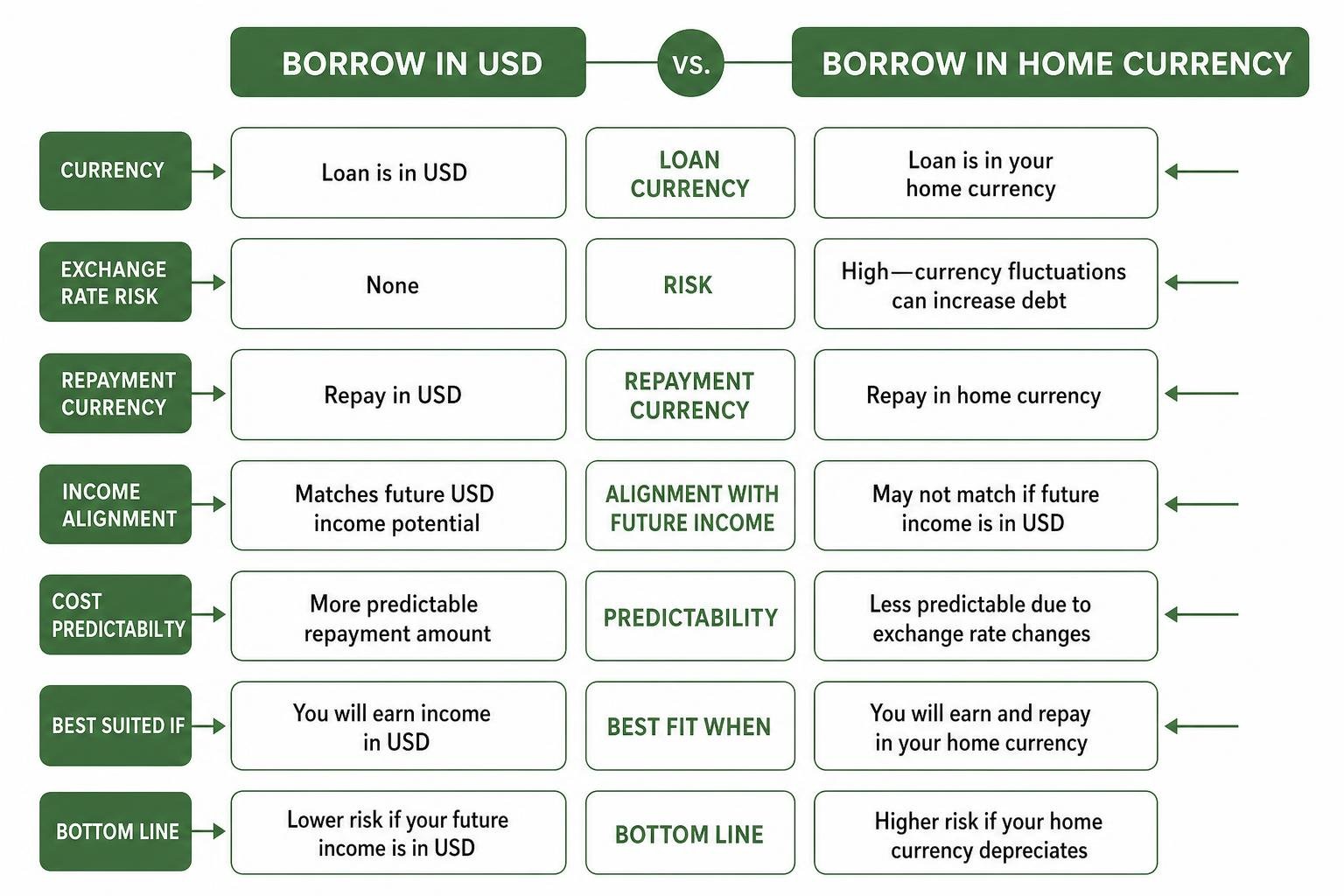
However, taking out a home-country loan introduces foreign exchange rate risk. If you borrow in your home country’s currency, such as Indian Rupees, Brazilian Reais, or Nigerian Naira, while tuition is billed in U.S. Dollars, or if you earn post-graduation income in USD while servicing debt in a depreciating home currency, currency fluctuations can suddenly increase your real debt obligations. As a rule of thumb, it is safest to borrow in the currency in which you expect to earn your post-graduation income.
Exchange-rate monitoring tools and budgeting apps can help you understand this risk, but they cannot eliminate it. Students comparing USD loans with home-country loans should evaluate interest rate, currency risk, collateral requirements, repayment flexibility, and expected income location together.
Building Credit and Refinancing After Graduation
Establishing a solid U.S. credit profile opens doors to lower borrowing costs over time. Once you arrive on campus:
- Apply for an Individual Taxpayer Identification Number (ITIN) or a Social Security Number (SSN) if you secure on-campus employment.
- Open a U.S. checking account and apply for a secured credit card to begin building your credit history.
- Ensure all private student loan payments are made consistently on time.
Once you graduate and transition to authorized post-graduate employment under Optional Practical Training (OPT) or an H-1B visa, your stable U.S. income and newly formed credit score may enable you to refinance your international student loans. Refinancing a high-interest loan, for example from 14% APR down to 6% or 7% APR, can save thousands of dollars in interest charges over a 10-year repayment term.
Credit monitoring, automated payment reminders, and personal finance dashboards can be useful here. They help students protect payment history, which is one of the most important factors in future loan approval and refinancing decisions.
Frequently Asked Questions About International Student Financing
What happens to an international student loan if I return home before completing my degree?
Private student loans are legally binding contractual obligations that remain enforceable across international borders. If you leave the U.S. prior to completing your degree, your debt does not disappear. Lenders work with international credit agencies and global servicing networks to collect outstanding balances.
If you face unexpected circumstances requiring you to return home, contact your loan servicer immediately to explain your situation and request temporary hardship forbearance or adjusted payment schedules.
Can international students work in the U.S. to pay off student loans?
Yes, but within strict federal visa constraints. F-1 visa regulations permit students to work on-campus for up to 20 hours per week during active academic semesters and full-time (40 hours per week) during official academic breaks. Common on-campus jobs include library assistants, dining hall staff, and Resident Advisors (RAs)—the latter of which often provides free housing and meal plans worth $8,000 to $15,000 per year.
Off-campus employment is prohibited during your first academic year. Afterward, off-campus work must be directly related to your academic major through Curricular Practical Training (CPT) or post-graduation Optional Practical Training (OPT).
How much can an international student borrow in private student loans?
The maximum amount an international student can borrow is strictly capped by your university’s official Cost of Attendance (COA) minus any financial aid, grants, assistantships, or scholarships you have received.
While cosigned loans can cover up to 100% of this net financial need, no-cosigner lenders often impose annual borrowing caps (e.g., up to $50,000 per academic year) and maximum lifetime limits (ranging from $100,000 to $220,000).https://modstr.cdn.express/files/big/Jenny-Mod-Skin-Pack-Mega-Collection-MCPE.zip“;
Conclusion
Navigating higher education costs in the United States without access to federal financial aid presents a distinct challenge, but it is far from an impossible obstacle. By strategically combining university need-based aid, merit scholarships, on-campus employment, and carefully evaluated private or home-country student loans, thousands of international scholars successfully finance their academic dreams every year.
For Aixoria readers, the broader takeaway is also technological: AI, fintech infrastructure, digital identity checks, automated underwriting, and data-driven financial tools are reshaping how international students search for funding and how lenders evaluate applicants without traditional U.S. credit histories.
Always exhaust non-repayable aid options first, evaluate borrowing terms carefully, and consider future post-graduation career opportunities when choosing a loan structure. To stay up to date on how technological innovation, automated underwriting, and artificial intelligence are transforming financial access and global education, Explore AI Updates with our team today.