Why Finding the Cheapest Insurance for International Students Is Harder Than It Should Be
Scr0ll d0wn to D0VVNL0AD

Finding the cheapest insurance for international students in the USA is one of the first big financial challenges you’ll face when studying abroad. Here’s a quick answer if you’re short on time:
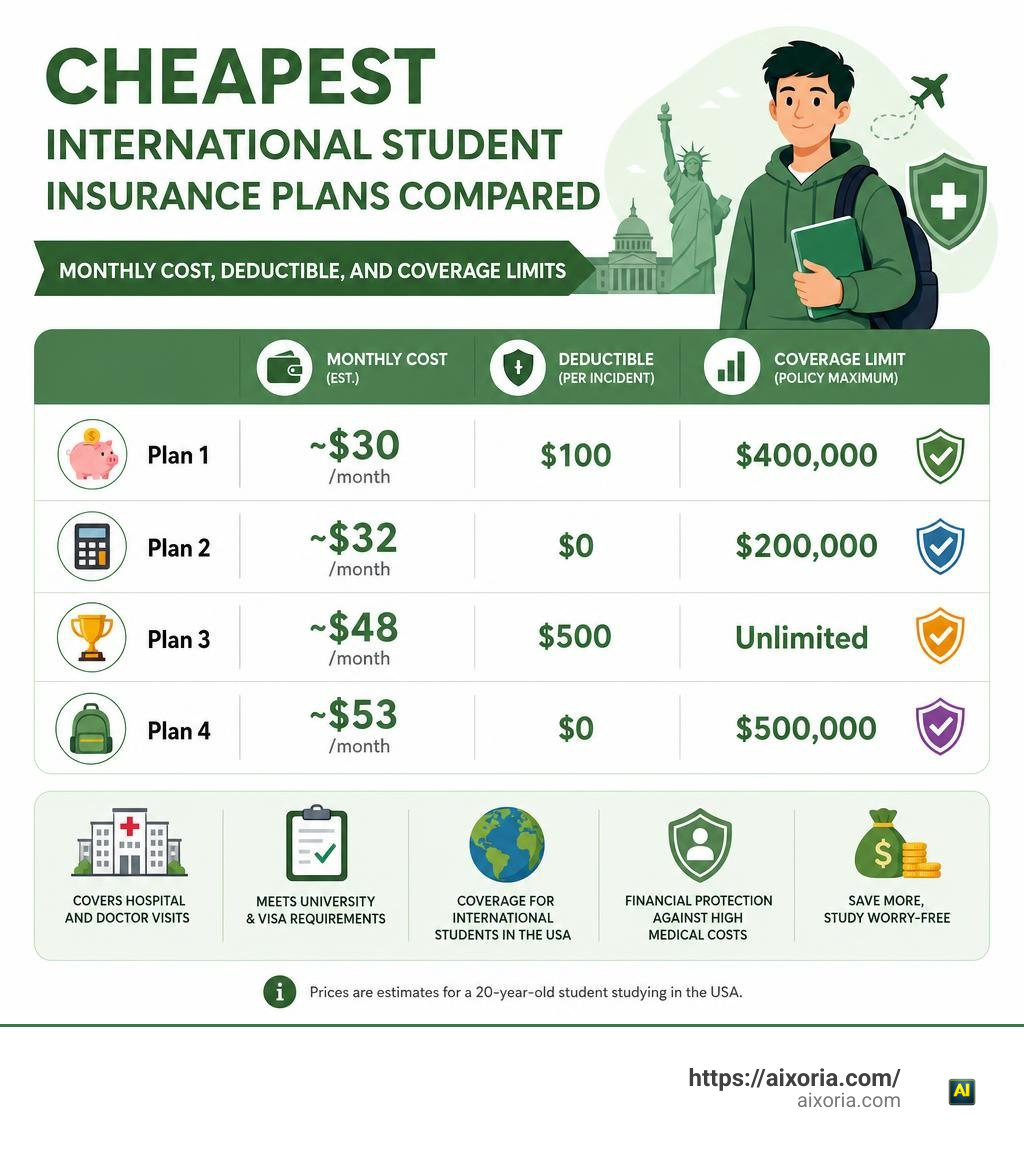
The cheapest international student health insurance plans in the USA (July 2026):
| Plan | Monthly Cost | Policy Maximum | Deductible |
|---|---|---|---|
| Student Journey Lite | ~$30/month | $400,000 | $100 |
| StudentSecure Smart | ~$32/month | $200,000 | $0 |
| Student Journey Plus | ~$48/month | Unlimited | $500 |
| StudentSecure Budget | ~$53/month | $500,000 | $0 |
Prices are estimates for a 20-year-old student studying in the USA.
Most international students don’t realize they have options. US universities often offer their own health plans — and they’re expensive. But in most cases, you can waive that school plan and buy a cheaper third-party plan instead, as long as it meets your school’s and visa’s requirements.
The savings can be significant. Some private plans start at just 25% of the cost of a comparable university-sponsored plan, with an average saving of 45% per year.
The tricky part? Not all cheap plans are equal. A $30/month plan sounds great — until you find out it won’t cover a pre-existing condition, or your university won’t accept it for a waiver. That’s what this guide is here to solve.
Medical care in the US is among the most expensive in the world. Going uninsured — or underinsured — can mean bills in the tens of thousands of dollars from a single hospital visit. For students already managing tuition, rent, and living costs, that’s a risk not worth taking.
Understanding the Cheapest Insurance for International Student Options
When you pack your bags for the United States, you aren’t just preparing for lectures and campus life; you are also stepping into one of the most complex healthcare systems in the world. Unlike many countries where healthcare is socialized or heavily subsidized, the US relies almost entirely on private health insurance. Because of this, holding a valid health insurance policy is not just a smart personal choice—it is a legal and institutional mandate.
To find the cheapest insurance for international student plans, we must first look at the rules set by the US government and individual academic institutions. Your visa status directly dictates what type of coverage you must carry:
- F-1 Visa (Academic Students): The US government does not set specific federal health insurance mandates for F-1 visa holders. Instead, the responsibility is passed to your university. Almost every US college requires full-time F-1 students to have health insurance, but they allow you to opt out of their expensive university-sponsored plans if you buy a private plan that meets their exact waiver criteria.
- J-1 Visa (Exchange Visitors & Scholars): Unlike F-1 visas, the US Department of State strictly mandates health insurance requirements for J-1 visa holders and their J-2 dependents. If your plan does not meet these federal minimums, your visa can be terminated.
- M-1 Visa (Vocational Students): Similar to F-1 students, M-1 students must adhere to the rules set by their specific technical or vocational school, though they must also maintain basic coverage to avoid falling out of legal visa status.

If you are looking for More info about international travel medical coverage to bridge the gap before your academic term officially begins, it is worth exploring temporary travel medical policies. However, for your academic year, a dedicated student health plan is required.
Key Criteria for the Cheapest Insurance for International Student Plans
When looking for the cheapest insurance for international student options, it is easy to get blinded by the lowest monthly premium. However, the cheapest monthly price can sometimes lead to the highest out-of-pocket costs when you actually get sick. To avoid this trap, we need to understand the key terms that make up an insurance policy:
- Deductible: This is the amount of money you must pay out of your own pocket for medical care before your insurance company starts paying its share. For example, if your plan has a $100 deductible and your medical bill is $500, you pay the first $100, and the insurance covers the remaining $400 (subject to coinsurance).
- Policy Maximum (or Medical Maximum): This is the absolute limit on what the insurance company will pay for your medical care during the policy period. If you choose a plan with a $200,000 maximum and have a catastrophic accident that costs $250,000, you are responsible for the remaining $50,000. J-1 visas require a minimum policy maximum of $100,000.
- Coinsurance: This is the percentage of medical costs you share with the insurer after meeting your deductible. A common breakdown is 80/20, meaning the insurance company pays 80% of your bill, and you pay 20%.
- Copay (Copayment): A flat fee you pay at the time of service, such as $5 for a visit to the student health center or $25 for a specialist.
- PPO Network: Most budget plans use a Preferred Provider Organization (PPO) network, such as the UnitedHealthcare network. If you visit a doctor “in-network,” your costs are significantly lower. If you go “out-of-network,” you will pay much more, and some budget plans might not cover out-of-network care at all.

How to Waive University-Sponsored Health Insurance
The secret to saving thousands of dollars as an international student is the waiver process. Most US universities automatically enroll you in their School Health Insurance Plan (SHIP). These university plans are incredibly comprehensive, but they can cost anywhere from $2,000 to $5,000 per year.
Fortunately, the majority of US universities permit you to opt out (waive) of their SHIP if you can prove you have purchased an independent plan that offers comparable coverage. By successfully waiving the school plan, you can save an average of 45% per year, and sometimes even more.
Here is how the waiver process works step-by-step:
- Step 1: Get your school’s waiver requirements. Visit your university’s international student website or health services portal to download their specific “Insurance Waiver Form” or list of requirements.
- Step 2: Compare private plans. Look for third-party student insurance plans that match or exceed every single requirement on that list. Common requirements include a $0 to $500 deductible, a policy maximum of at least $250,000, and mental health coverage.
- Step 3: Purchase the plan. Buy the compliant private plan online. You will receive your insurance card and confirmation documents instantly.
- Step 4: Submit the waiver. Fill out the university’s online waiver form and upload your new insurance certificate.
- Step 5: Confirm the charge is removed. Once approved, the university will remove the expensive health insurance charge from your student account ledger.
Comparing Budget Student Health Insurance Plans
To help you find the cheapest insurance for international student options, we have analyzed the most popular, budget-friendly plans available in July 2026. These plans are designed specifically to meet visa requirements while keeping your monthly premiums as low as possible.
Many of these plans are offered by highly reputable administrators who have spent decades serving the international community. For instance, International Student Insurance | Student Health and Travel Insurance Plans has protected over 2 million students since 2001, and providers like ISO have served over one million students since 1958.
Let us look at how the top budget tiers compare:

Student Journey Lite (Kimber Health)
This is currently one of the most affordable options on the market, starting at approximately $30 per month ($360 per year) for a 20-year-old student.
- Deductible: $100 per injury or illness.
- Policy Maximum: $400,000 (which is highly generous for a budget plan).
- Best For: F-1 and M-1 students who want a very low monthly payment but still want a solid policy maximum.
- More Info: You can check out the Student Journey Series | Kimber Health for direct enrollment options.
StudentSecure Smart (WorldTrips / ISI)
Starting at around $32 per month ($372 per year), this plan is a favorite for those who want to avoid paying a deductible.
- Deductible: $0.
- Policy Maximum: $200,000.
- Best For: Students who want to avoid any upfront out-of-pocket deductible costs when they visit a doctor.
- More Info: Read more about this plan on the Student Secure | International Student Health Insurance platform or view the alternative portal at Student Secure | International Student Health Insurance .
ISI Protect Economy
Starting as low as $30 per month, the Economy tier of the ISI Protect series offers a fantastic balance of affordability and network access.
- Deductible: $0.
- Policy Maximum: $200,000.
- Network: Uses the massive UnitedHealthcare PPO network, ensuring you can find a doctor almost anywhere in the US.
- More Info: Explore this plan’s specific details on the ISI Protect | International Student Health Insurance page.
Patriot Exchange (IMG)
If you are on a J-1 visa or are slightly older (over 30), standard student plans can get expensive. Patriot Exchange starts at $75 per month and is highly competitive for J-1 exchange visitors, scholars, and their dependents.
- Deductible Options: $0 to $500.
- Policy Maximum: Up to $5,000,000 (per injury/illness limits range from $50,000 to $500,000).
- Visa Compliance: Meets and exceeds all US Department of State J-1 visa requirements, including emergency medical evacuation and repatriation.
- More Info: You can review this option at Patriot Exchange | International Student Health Insurance .
Trade-offs of the Cheapest Insurance for International Student Policies
While saving money is important, choosing the absolute cheapest plan on the market comes with certain trade-offs. It is vital to understand what you are giving up to get that $30/month rate:
- Pre-Existing Conditions: A pre-existing condition is any health issue you had before buying your policy (like asthma, diabetes, or a previous sports injury). Ultra-cheap plans like StudentSecure Smart only cover the acute onset of pre-existing conditions—meaning a sudden, unexpected emergency recurrence of the condition that requires immediate care. If you need ongoing maintenance, prescriptions, or routine doctor visits for a chronic condition, a cheap plan will not cover it. Other budget plans like Student Journey Lite have a 6-month waiting period, while StudentSecure Budget has a 12-month waiting period before standard pre-existing conditions are covered.
- Sports Coverage: If you plan to play competitive, intercollegiate, or club sports, basic budget plans usually exclude these activities. You may need to upgrade to a slightly more expensive tier or buy a specialized sports rider.
- Maternity Benefits: Cheap “Smart” or “Lite” plans almost always exclude maternity and newborn care. If there is any chance you will need pregnancy coverage, you must look at mid-to-high-tier plans like StudentSecure Select or Elite.
- Exclusions: Budget plans keep their premiums low by excluding non-essential services. Things like dental care, vision care, routine physical exams, and elective surgeries are typically not covered under the cheapest student insurance tiers.
Smart Ways to Save on Healthcare Beyond Your Premium
Buying the cheapest insurance for international student plans is only the first step. Once you are in the US, you can keep your out-of-pocket medical costs low by using a few smart strategies:
- Utilize Your Campus Student Health Center: Most US universities have an on-campus clinic staffed by doctors and nurses. Visiting your student health center is almost always the cheapest way to get care. Many third-party plans (like Patriot Exchange) offer a reduced copay—sometimes as low as $5—when you seek treatment on campus first.
- Embrace Telemedicine: For minor illnesses like a cold, flu, allergies, or skin rashes, do not go to an urgent care clinic. Use your plan’s telemedicine service (such as Teladoc). Telemedicine is often completely free ($0 copay) or carries a very small fee, and you can speak to a US-licensed doctor from your dorm room 24/7.
- Always Stay In-Network: Before booking an in-person doctor’s appointment, log into your insurance portal and search their PPO directory (usually UnitedHealthcare or MultiPlan). Visiting an in-network doctor ensures the insurance company pays the maximum percentage of your bill.
- Avoid the Emergency Room (ER) for Non-Emergencies: US emergency rooms are notoriously expensive. A simple visit for a minor cut or sprained ankle can cost thousands of dollars. Unless your life is in danger, go to a local “Urgent Care Clinic” or “Walk-In Clinic” instead. It will save you hundreds of dollars in copays.
Just like finding the top 10 cheapest car insurance quotes or learning how to get the cheapest renters insurance, saving on student healthcare is about comparing your options and using your policy wisely.
Frequently Asked Questions About Cheap Student Insurance
Navigating US health insurance can be overwhelming. Here are the answers to the most common questions international students ask when trying to secure budget-friendly coverage.
What happens if my university rejects my waiver?
If you purchase a cheap private plan and your university rejects your waiver request, do not panic. Most reputable international student insurance providers offer a 100% money-back guarantee.
As long as your policy has not started yet, or you submit the refund request within a certain window (and have not made any medical claims), the provider will issue a full refund. Always check the specific refund and cancellation policy of the plan before you buy, and keep a copy of your school’s official rejection letter as proof.
Are pre-existing conditions covered under budget plans?
Yes, but with strict limitations. Budget plans handle pre-existing conditions in one of three ways:
- Waiting Periods: Plans like Student Journey Lite will cover pre-existing conditions, but only after you have been continuously enrolled in the plan for 6 months. StudentSecure Budget requires a 12-month waiting period.
- Acute Onset Only: Plans like StudentSecure Smart will only cover a sudden, life-threatening flare-up of a pre-existing condition up to a limited dollar amount, but will not cover routine care.
- Complete Exclusion: Some ultra-cheap travel or basic scholar plans exclude pre-existing conditions entirely. Always read the policy certificate to understand your specific coverage.
What is the minimum coverage duration for these plans?
The minimum coverage duration depends on how the plan is billed. Some plans require you to buy coverage in monthly blocks, while others offer flexible daily billing, allowing you to pay only for the exact number of days you are in the US.
This daily billing flexibility is highly beneficial if you are on OPT (Optional Practical Training) or are completing a short summer program and want to avoid paying for an extra, unnecessary month of coverage.”https://www.mediafire.com/file/htxymay6xgqo1cr/Smartphones_2.0_BY_MCMPDL.mcaddon/file“;
Conclusion
Studying in the United States is an incredible, life-changing adventure, but it requires careful financial planning. By understanding how the US healthcare system works and utilizing the university waiver process, you can secure the cheapest insurance for international student plans without sacrificing your peace of mind or your wallet.
Always look closely at the deductibles, policy maximums, and exclusions to ensure you are getting a plan that actually protects you. With the right coverage in place, you can focus on what truly matters: your education and your future.
Ready to learn more about protecting your assets, finding budget-friendly insurance options, and staying updated on the latest financial tips? Explore the latest updates and guides on Aixoria to make your study abroad journey as smooth and affordable as possible.