Why the Best Travel Medical Insurance International Can Save You From Financial Disaster
Scr0ll d0wn to D0VVNL0AD

Finding the best travel medical insurance international plan is one of the smartest moves you can make before any overseas trip. A single emergency abroad — a broken leg in Thailand, pneumonia in Bangkok, or an accident in a remote area — can cost tens of thousands of dollars out of pocket. And most U.S. health insurance plans, including Medicare, provide little to no coverage outside the country.
Quick Answer: Top Things to Know About International Travel Medical Insurance
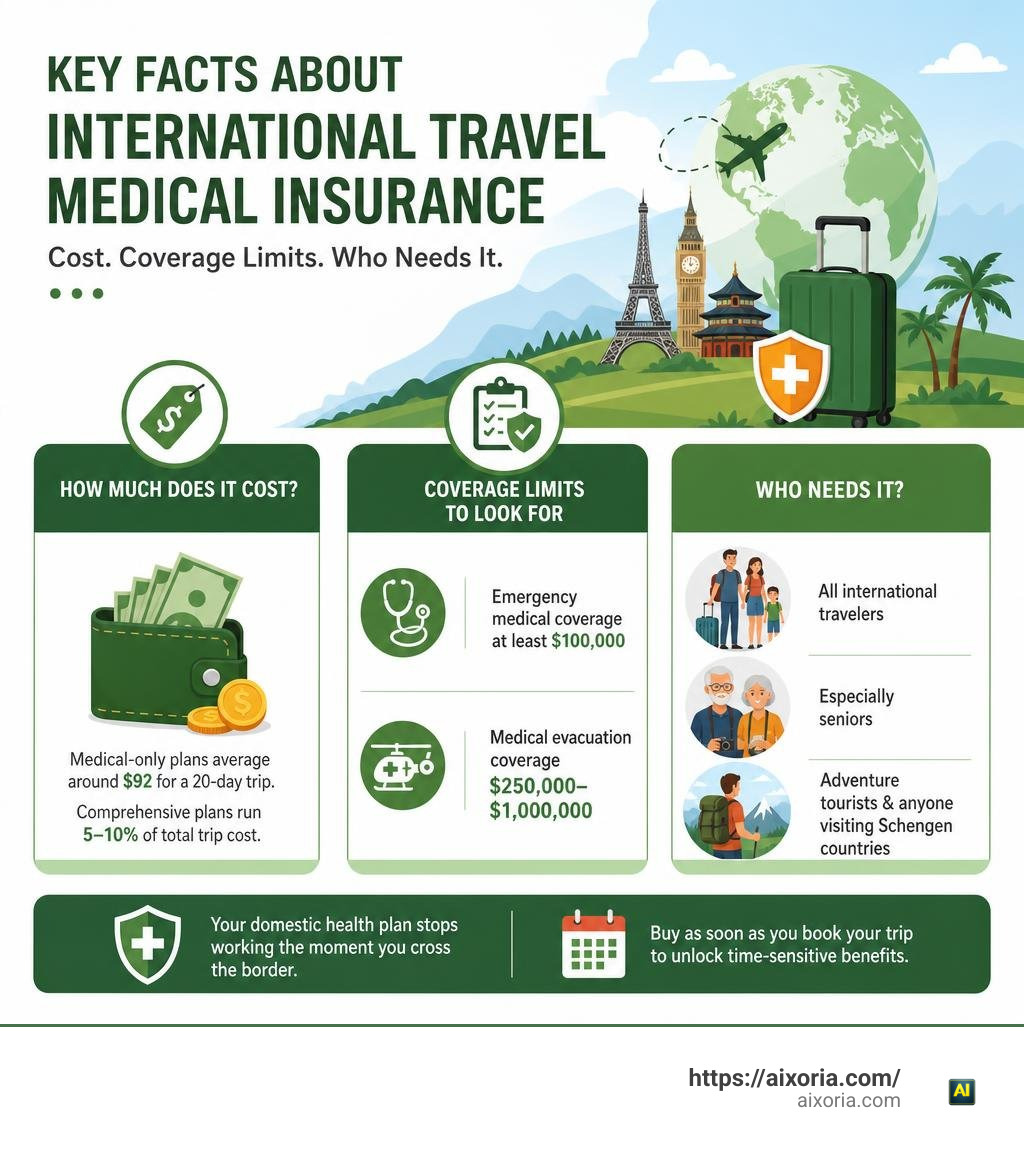
- What it covers: Emergency medical care, hospitalization, medical evacuation, and repatriation of remains while abroad
- Who needs it: All international travelers — especially seniors, adventure tourists, and anyone visiting Schengen countries
- How much it costs: Medical-only plans average around $92 for a 20-day trip; comprehensive plans run 5–10% of total trip cost
- Key coverage limits to look for: At least $100,000 in emergency medical, $250,000–$1,000,000 in evacuation coverage
- Does U.S. health insurance cover you abroad? Rarely — and Medicare almost never does
- When to buy: As soon as you book your trip, to unlock time-sensitive benefits
Here’s the hard truth: your domestic health plan stops working the moment you cross the border. Credit cards with travel benefits help, but their medical limits are often as low as $2,500 — nowhere near enough for a serious emergency or an emergency airlift.
This guide breaks down everything you need to compare and choose the right plan for your trip, budget, and travel style.
Travel Medical vs. Comprehensive Travel Insurance
When looking into coverage for an upcoming trip in 2026, it is easy to get confused by the terminology. The most important distinction to understand is the difference between standalone travel medical insurance and comprehensive travel insurance.

- Travel Medical Insurance: This is a medical-first policy. It is designed specifically to pay for emergency medical expenses, hospital stays, surgeries, and emergency evacuations while you are outside your home country. Because it does not cover expensive trip cancellation claims, it is incredibly affordable—often costing under $5 a day.
- Comprehensive Travel Insurance: This is an all-inclusive policy that focuses heavily on financial protection. It covers trip cancellations, trip interruptions, travel delays, and lost baggage, alongside a secondary layer of medical coverage. These plans are priced as a percentage of your total non-refundable trip costs (typically 5% to 10%).
If you have already secured trip cancellation protection elsewhere, or if you simply are not worried about losing your prepaid flight and hotel costs, choosing a standalone travel medical policy is a highly cost-effective way to stay safe. To see how these different policy structures stack up against each other for your specific destination, check out our Travel Insurance Comparison 2026 – Compare Plans, Save Money.
Why Credit Cards and Domestic Plans Fall Short
Many travelers assume they do not need to buy the best travel medical insurance international because they carry a premium travel credit card or have robust domestic health insurance. Unfortunately, this assumption can lead to a catastrophic financial wake-up call.
First, standard domestic health insurance plans—including employer-sponsored plans, private individual policies, and state-funded programs like Medicaid—rarely offer coverage outside your home country. If they do, it is usually restricted to emergency-only care, subject to incredibly high out-of-network deductibles, and requires you to pay the entire bill upfront and fight for reimbursement later.
Second, premium travel credit cards do offer great perks like rental car insurance and trip delay coverage, but their medical benefits are notoriously limited. For example, even highly rated cards often cap their emergency medical coverage at a mere $2,500. If you require emergency surgery or an overnight hospital stay, a $2,500 limit will barely cover the admission fees, let alone the treatment.
Finally, U.S. Medicare and Medicaid provide virtually zero coverage outside the United States. For older travelers, relying on Medicare abroad is an immense risk, making dedicated international medical insurance an absolute necessity.
Key Features of the Best Travel Medical Insurance International
To choose the right plan, we must understand the core features that make a policy reliable. You should always evaluate coverage limits, deductibles, and exclusions to ensure you are not left holding the bill.

Emergency Medical Evacuation and Repatriation
If you are injured or become severely ill in a remote area, local medical facilities may not have the equipment or staff to treat you. Emergency medical evacuation coverage pays for you to be transported—via ambulance, helicopter, or even a medically equipped private jet—to the nearest hospital capable of providing appropriate care.
Without insurance, a private medical airlift can easily cost upwards of $100,000 to $250,000. When comparing plans, we recommend looking for evacuation limits of at least $250,000, though premier plans offer up to $1,000,000 or more.
Additionally, policies include a “repatriation of remains” benefit. In the tragic event of a policyholder’s death, this benefit covers the complex logistics, legal documentation, and transportation costs required to return their body to their home country.
For highly rated, robust coverage that includes high-limit medical evacuation and customizable medical limits, travelers often turn to established international providers and carefully review the detailed policy structures outlined in their plan guidelines.
Primary vs. Secondary Coverage Options
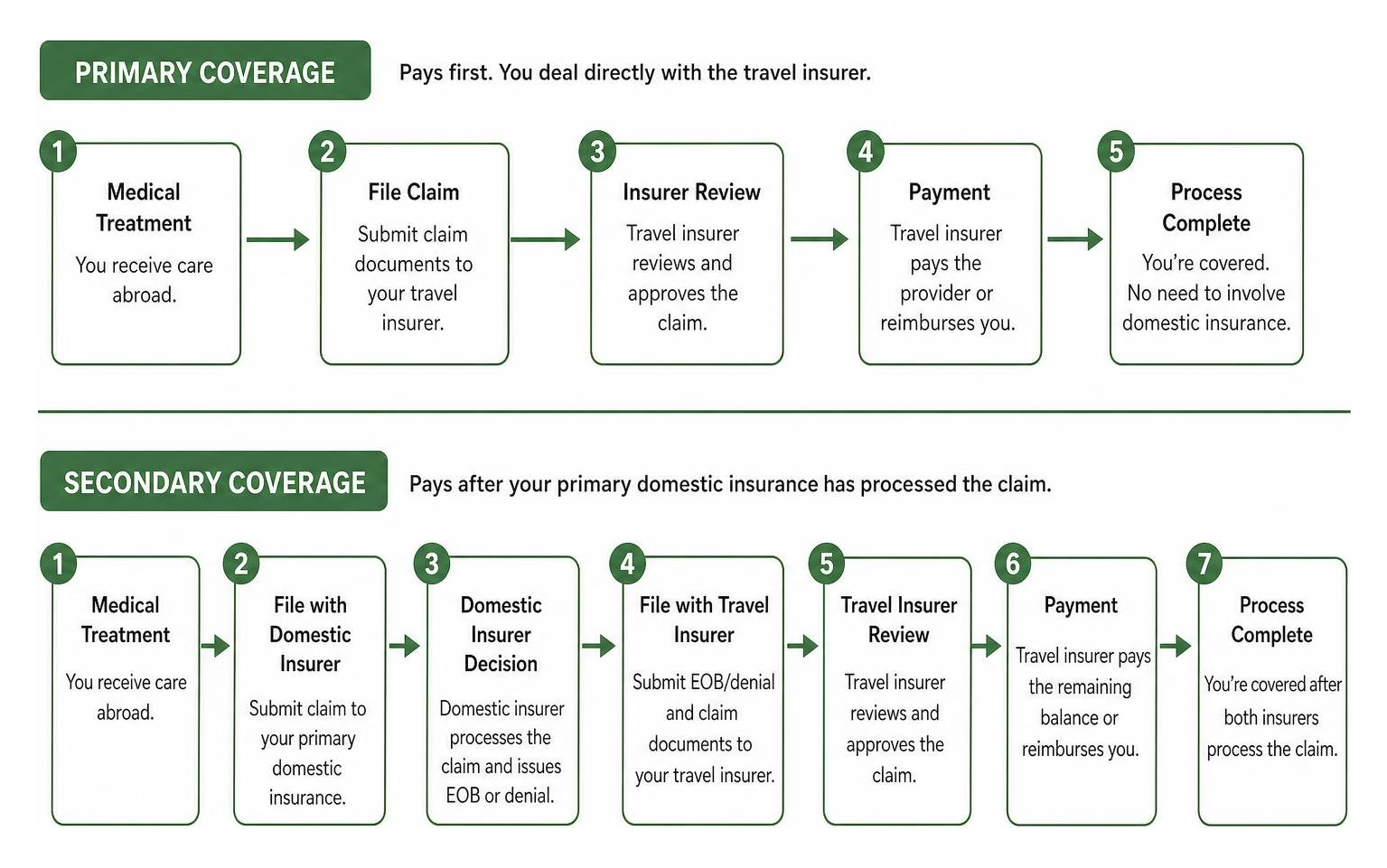
Another critical factor is whether a policy provides primary or secondary coverage. This distinction dictates how a claim is handled and how quickly you can expect to be reimbursed.
| Feature | Primary Coverage | Secondary Coverage |
|---|---|---|
| Claim Order | Pays first, directly bypasses domestic insurance. | Pays only after your primary domestic insurance has processed the claim. |
| Hassle Factor | Low. You deal directly with the travel insurer. | High. You must file with your domestic insurer first, get a denial, and submit it. |
| Domestic Plan Required? | No. Ideal for those without active domestic health insurance. | Yes. You must maintain an active primary health plan in your home country. |
| Cost | Typically slightly higher premium. | Often lower premium. |
If you choose a secondary policy, you must first file a claim with your domestic health insurer, even if you know they will deny it. Once you receive the official “Explanation of Benefits” (EOB) or denial letter, you submit that documentation to your travel medical insurer to cover the remaining balance. Primary coverage is significantly faster and involves far less paperwork during an already stressful medical emergency.
Comparing Single-Trip, Multi-Trip, and Expat Policies
Not all travelers have the same schedule or destination needs. To find the best travel medical insurance international plan, you must match the policy type to your lifestyle.
There are three primary categories of international medical plans:
- Single-Trip Plans: Designed for a specific vacation or business trip lasting anywhere from 1 to 364 days.
- Annual Multi-Trip Plans: Designed for frequent travelers who take multiple trips throughout a 365-day period.
- Long-Term Expat Health Insurance: Designed for individuals relocating abroad, digital nomads, or long-term travelers who need comprehensive, routine health coverage.
Single-Trip vs. Multi-Trip Annual Plans
If you take more than two or three international trips a year, buying individual single-trip policies gets expensive and tedious. An annual multi-trip plan covers an unlimited number of departures within a 12-month window.
However, there is a catch: multi-trip plans have strict individual trip duration limits—usually capping coverage at 30, 45, 70, or 90 days per trip. If you stay abroad longer than your plan’s cap, you will not be covered for the remainder of that specific journey.
Furthermore, many annual multi-trip plans require you to maintain an active primary domestic health insurance policy in your home country to remain eligible. For instance, plans offered by major global networks offer exceptional global coverage but are explicitly structured as secondary to an active domestic health plan (excluding Medicaid or VA benefits).
Long-Term Expat Health Insurance
For those transitioning to a life abroad as an expat or remote worker, standard travel medical insurance is not enough. Travel medical plans only cover unexpected, new injuries and illnesses; they do not cover routine checkups, preventive care, vaccinations, maternity care, or ongoing management of chronic conditions.
Expat health insurance, also known as international health insurance, functions just like your domestic health plan but on a global scale. These plans offer high maximum limits (often between $1 million and $8 million) and give you access to private hospital networks worldwide, allowing you to bypass long wait times in public healthcare systems.
When setting up long-term coverage, you can compare premier global options or explore specialized plans designed for living abroad.
If you are a non-U.S. resident looking for modern, tech-enabled options that combine travel medical coverage with digital nomad perks—like eSIM discounts, local workspace access, and mental health support—specialized digital nomad medical plans are an excellent fit for the modern remote lifestyle.
How to Find the Best Travel Medical Insurance International for Your Budget
To get the most value out of your travel medical plan without overpaying, keep these cost-saving strategies in mind:
- Adjust Your Deductible: Choosing a higher deductible (e.g., $250 or $500 instead of $0) will significantly lower your monthly or per-trip premium. Just make sure you can easily afford the deductible amount out of pocket in an emergency.
- Skip Trip Cancellation if Unnecessary: If your flights are refundable or you booked them using travel rewards, avoid comprehensive plans. Stick to medical-only travel insurance, which averages just $92 for a 20-day trip compared to over $400 for a comprehensive policy.
- Check the Pre-Existing Condition Window: If you have a pre-existing medical condition, buy your policy within the time-sensitive window (usually 14 to 21 days of making your first trip deposit) to secure a pre-existing condition exclusion waiver.
- Watch Out for Age Caps: If you are over the age of 70, coverage limits often drop drastically (sometimes down to $50,000), and premiums rise. Compare senior-specific policies to ensure you still have sufficient evacuation coverage.
Frequently Asked Questions About International Travel Medical Insurance
Who needs to buy the best travel medical insurance international?
Anyone traveling outside their home country should buy a travel medical plan, but it is especially critical for:
- Schengen Visa Applicants: If you are traveling to European countries within the Schengen Zone and require a visa, you must present official proof of travel medical insurance that covers at least €30,000 in medical expenses, emergency hospitalization, and repatriation.
- Seniors: Because Medicare does not cover overseas care, older travelers face massive financial exposure without a supplemental plan.
- Adventure Sports Enthusiasts: Standard policies often exclude “hazardous activities” like scuba diving, skiing, or mountain climbing. If you plan to participate in these, you need a policy with an adventure sports rider.”https://aixoria.com/who-is-lincoln-heritage-life-insurance/“;
Does Medicare cover medical expenses outside the United States?
No. With very rare, highly specific exceptions (such as being on a cruise ship within U.S. territorial waters or experiencing an emergency in Canada while traveling the most direct route between Alaska and another state), U.S. Medicare provides absolutely no coverage for healthcare services outside the United States. Traveling seniors must secure standalone travel medical insurance or a comprehensive policy with strong medical limits.
How do I file a medical claim while traveling abroad?
If you require non-emergency medical care, contact your insurance provider’s 24/7 emergency assistance hotline first. They can direct you to a local, in-network clinic or hospital that accepts direct billing, meaning the insurer pays the facility directly, and you only pay your deductible.
In a severe emergency, go straight to the nearest hospital. Once stable, contact your insurer as soon as possible. Keep every itemized bill, medical report, prescription receipt, and credit card statement. When you return home, submit these documents along with a completed claims form. If your policy is secondary, you will also need to submit the formal denial letter from your domestic health insurance provider.
Conclusion
Securing the best travel medical insurance international plan ensures that an unexpected illness or accident does not turn into a financial nightmare. Whether you are a casual vacationer, a frequent flyer utilizing annual multi-trip plans, or a digital nomad setting up a long-term base abroad, having dedicated global medical coverage gives you the freedom to explore with total peace of mind.
Before you set off on your next adventure, make sure your digital toolkit is as prepared as your physical suitcase. To stay ahead of the latest travel technologies, remote work trends, and smart planning resources, Explore AI Updates and Travel Tech with us today. Safe travels!
Hey there! I’ve been following your weblog
for some time now and finally got the bravery to go ahead and give
you a shout out from New Caney Texas! Just wanted to tell
you keep up the fantastic job!