AI-Generated Content Is Everywhere — Here’s How to Spot It in Your Marketing

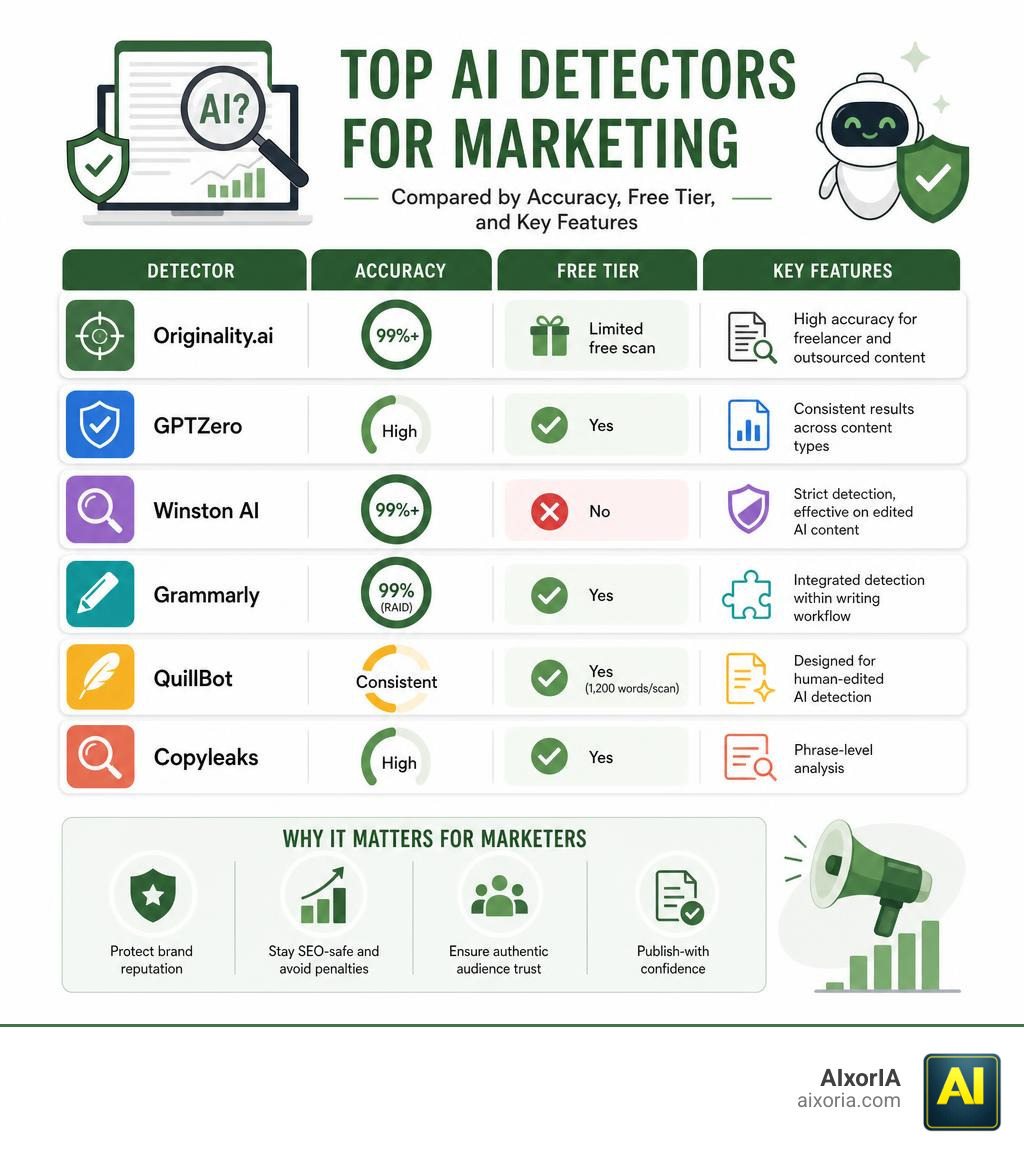
The best AI content detectors for marketing campaigns in 2026 are tools that help you verify whether content is human-written before it goes out under your brand name. Here’s a quick look at the top options:
| Tool | Best For | Free Tier | Accuracy |
|---|---|---|---|
| Originality.ai | Overall accuracy, freelancer content | Limited free scan | 99%+ |
| GPTZero | Consistent results across content types | Yes | High |
| Winston AI | Strict detection, edited AI content | No | 99%+ |
| Grammarly | Integrated writing workflow | Yes | 99% (RAID) |
| QuillBot | Human-edited AI detection | Yes (1,200 words/scan) | Consistent |
| Copyleaks | Phrase-level analysis | Yes | High |
Think about this: a beauty brand runs a hashtag campaign and discovers that 60% of the “customer reviews” they featured were AI-generated. The damage to trust is real — and it happened because no one checked.
That’s the problem marketers face right now.
AI-generated content has become sophisticated enough that most people can’t tell the difference just by reading it. Influencer posts, press releases, user-generated content, agency copy — any of it could be machine-written and submitted as original human work.
The stakes aren’t just about authenticity. Google treats AI content generated primarily to manipulate search rankings as a spam policy violation. And nearly 20% of the top 1,000 websites are already blocking AI crawler bots — a sign that the industry is paying close attention.
The AI content detectors market is growing fast — from $2.31 billion in 2025 to an expected $15 billion by 2035. But more tools doesn’t mean easier decisions. Testing shows that out of eight detectors evaluated, only three achieved perfect accuracy across human-written, AI-edited, and pure AI content.
No tool is 100% reliable. False positive rates can exceed 20% for non-native English speakers. And human-edited AI content is the hardest of all to catch.
That’s why choosing the right detector — and using it correctly — matters more than ever for small marketing teams who don’t have time to waste on guesswork.
Why Marketers Need the Best AI Content Detectors for Marketing Campaigns
As marketers, we live and die by our brand’s reputation. When we outsource work to agencies, hire influencers, or accept user-generated content (UGC), we trust that we are paying for human creativity. If that content turns out to be unedited machine output, the fallout can be severe.
First, there are search engine optimization (SEO) risks. Google’s spam policies explicitly target automation used primarily to manipulate search rankings. If your site is flooded with low-effort, mass-produced AI content, your organic traffic could plummet overnight.
Second, there is the issue of brand safety. AI tools can easily flatten your brand’s unique voice, turning vibrant messaging into generic, repetitive text. Even worse, undisclosed AI content can make your audience feel deceived, instantly destroying years of built-up trust.
Using a dedicated AI Content Checker for Marketing lets you run quick checks on freelancer submissions, PR pitches, and landing page copies. This ensures your brand voice remains consistent and authentic before any campaign goes live.
Key Features to Look For in Marketing AI Detectors
When evaluating the best AI content detectors for marketing campaigns, you shouldn’t just look for a single percentage score. You need a tool that fits into your actual daily production workflow.
Here are the key features to prioritize:
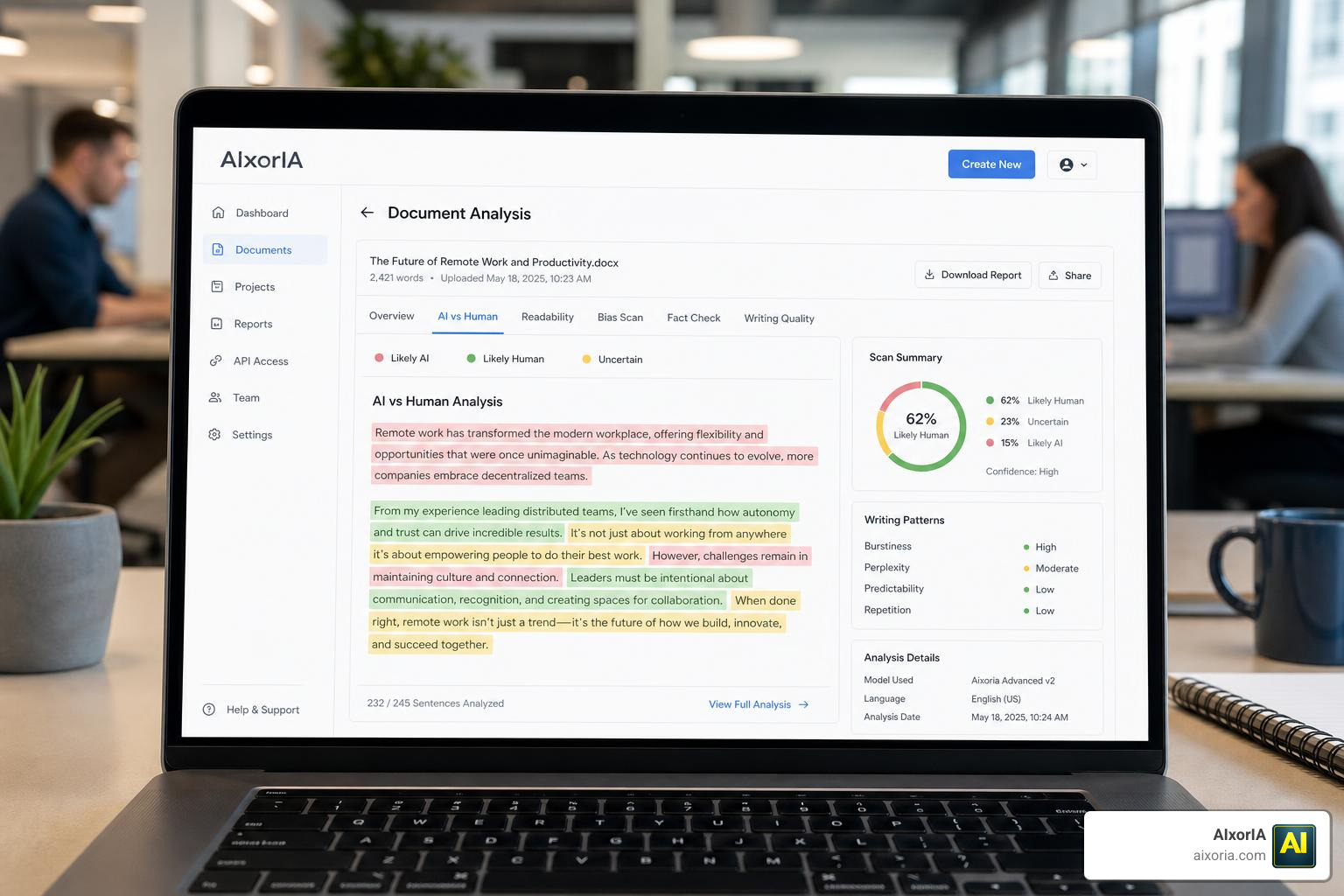
- Linguistic Analysis (Perplexity and Burstiness): Perplexity measures how predictable the words in a text are, while burstiness looks at sentence length and structural variety. Human writing has high perplexity and high burstiness; AI text is typically highly predictable and uniform.
- Sentence-Level Analysis: Instead of a generic “80% AI” score, you want color-coded, sentence-by-sentence highlights. This allows you to pinpoint exactly which paragraphs sound too robotic so you can edit them manually.
- API Access & Integrations: If you manage large content pipelines, API access is vital. It allows you to automatically run checks inside your content management system (CMS) or social listening tools.
- Bulk Scanning: Scanning articles one by one is a bottleneck. Look for tools that support bulk uploads of multiple files at once.
- Multilingual Support: If your marketing campaigns span multiple countries, you need a detector that can accurately analyze non-English text without spiking false-positive rates.
Top AI Content Detectors for Marketing Campaigns Compared
To help you find the right fit for your marketing stack, we have broken down how the top tools perform across key categories.
| Tool | Key Strength | Pricing Model | Best Marketing Use Case |
|---|---|---|---|
| Originality.ai | Most accurate for latest LLMs | Pay-per-scan / Subscription | Verifying freelancer & agency articles |
| GPTZero | Consistent & highly reliable | Free tier / Paid plans | Quick spot-checks of copy drafts |
| Winston AI | Strict detection criteria | Paid plans | High-stakes PR & press releases |
| Grammarly | Seamless workflow integration | Free / Premium | Real-time social media & ad copy checks |
| QuillBot | Great free tier & sentence highlights | Free / Premium | Analyzing partially edited drafts |
| Vizup | Calibrated for marketing patterns | Free / Paid | Checking landing pages & sales copy |
Evaluating the Best AI Content Detectors for Marketing Campaigns for Accuracy
If accuracy is your absolute highest priority, you will likely find yourself choosing between Originality.ai, GPTZero, and Winston AI.
In multiple independent studies, the Originality.ai AI Detector has proven to be incredibly accurate at identifying text generated by the newest LLMs, including GPT-5 and Gemini. Its Turbo model is built to catch heavily paraphrased or edited AI text. However, keep in mind that this high level of sensitivity can sometimes lead to false positives on highly structured human writing.
GPTZero remains one of the most balanced engines on the market. It excels at recognizing the difference between human-written, fully AI-generated, and human-edited AI texts.
Winston AI is known for its strict detection engine. It is highly effective at spotting AI patterns, though some marketers find it slightly too aggressive when scanning heavily human-edited drafts. Even the most accurate tools have a baseline false positive rate of 1% to 2%, which can climb much higher for non-native English writers who naturally use more predictable sentence structures.
Choosing the Best AI Content Detectors for Marketing Campaigns for Workflow Integration
For marketing teams, accuracy is only half the battle—the tool also has to be easy to use.
The Grammarly AI Detector is a massive favorite because millions of marketers already use Grammarly for proofreading. It integrates directly into your browser, Google Docs, and social media platforms. Grammarly also offers an “Authorship” report that tracks whether text was typed manually, edited, or generated by an AI tool, providing a transparent audit trail.
QuillBot is another incredibly accessible option. Its free tier allows you to scan up to 1,200 words per search, making it perfect for checking social media posts, email newsletters, and short blog drafts. It also provides clear, section-level explanations of why certain phrases look suspicious.
If you are writing sales copy, generic detectors often fail because marketing copy naturally uses formulaic structures like call-to-actions (CTAs) and benefit-stacking. Vizup solves this by calibrating its detection thresholds specifically for marketing content types, ensuring you don’t get false positives on perfectly legitimate promotional copy.
How to Handle Human-Edited and Paraphrased AI Content
A challenge in 2026 is “cyborg writing”—content that starts as an AI draft and is then lightly edited by a human. Many writers also use paraphrasing tools to intentionally bypass basic AI detectors.

When AI text is edited or paraphrased, the predictable patterns of perplexity and burstiness begin to break down. A naive detector might look at a lightly edited article and score it as “100% human,” even though the core ideas and structure were completely generated by a machine.
To protect your campaigns, we recommend following these best practices:
- Treat Scores as Probabilities, Not Proof: An AI detector score is a statistical estimate, not a forensic guarantee. Never fire a freelancer or reject an agency’s work solely based on a single high AI score.
- Look at the Details: Use sentence-level highlights to see which parts of the text are triggering the tool. If the introduction and conclusion flag as 100% AI but the body copy is clean, it’s likely a human-edited piece.
- Combine Tools with Human Review: If a scan shows a borderline score, have an editor review the content. Does it have original insights, real-world examples, and a distinct voice? If it reads like generic filler, it needs a human rewrite regardless of what the detector says.
Frequently Asked Questions about AI Content Detection
Can Google detect and penalize AI-generated marketing content?
Yes, Google can detect AI patterns, but its main focus is on content quality. Google’s spam policies state that using automation—including AI—primarily to manipulate search rankings is a violation. If your AI-generated content is helpful, original, and written for users first, it can rank well. However, mass-producing low-quality AI pages to game search engines will result in severe ranking penalties.
Why do AI detectors produce false positives on human writing?
AI detectors look for patterns. Human writers who are non-native English speakers, technical writers, or those writing highly structured business reports often use simpler, more predictable language. Because this writing has lower perplexity and burstiness, naive AI detectors frequently misclassify it as machine-generated.
How do perplexity and burstiness help identify AI text?
Perplexity measures how predictable word choices are. AI models are trained to choose the most statistically likely next word, resulting in low perplexity. Burstiness measures sentence variety. Humans naturally write with a mix of short, punchy sentences and long, complex clauses. AI models tend to generate sentences of very similar lengths and structures, creating low burstiness.
Conclusion
Navigating AI-generated content requires a careful balance of smart technology and human intuition. While the best AI content detectors for marketing campaigns are incredibly helpful for spot-checking work and maintaining quality control, they should never replace a strong editorial eye.
At AIxorIA, we help businesses navigate these exact challenges. We provide custom AI solutions, tool training workshops, practical tutorials, and performance audits designed to help your team use artificial intelligence safely, effectively, and authentically. If you want to build a content workflow that leverages the power of AI without losing your brand’s unique human voice, explore our affordable services and fast customer support.
For more actionable strategies, check out our More info about AI tools for business to see how you can maximize your ROI while keeping your marketing authentic.
3 thoughts on “Best AI Content Detectors for Marketing Campaigns in 2026”