Ecommerce marketers used to measure success using one simple metric: ROAS (Return on Ad Spend).
But in 2026, ROAS reporting has evolved far beyond basic revenue tracking.
Privacy restrictions, fragmented attribution, and cross-channel marketing have made traditional analytics unreliable. Many ecommerce brands now discover that the platform claiming credit for conversions is not actually responsible for them.
This is where AI-powered ROAS reporting tools become essential.
Modern AI analytics platforms combine:
- First-party data
- Predictive modeling
- Marketing Mix Modeling (MMM)
- Cross-channel attribution
The result is a far more accurate understanding of which marketing activities actually drive profit.
In this guide, we’ll explore the best AI tools for ecommerce ROAS reporting in 2026, how they work, and why predictive analytics is transforming performance marketing.
Why ROAS Reporting Changed in 2026
The biggest shift in ecommerce analytics is the move from historical reporting to predictive intelligence.
Traditional analytics answers:
“What happened yesterday?”
Modern AI analytics answers:
“What will happen if we increase ad spend tomorrow?”
AI models analyze thousands of historical signals, including:
- Customer acquisition patterns
- Campaign performance history
- Product margins
- Seasonality
- Customer lifetime value
Using these variables, AI tools estimate future ROAS before the budget is spent.
This predictive capability gives ecommerce brands a major competitive advantage.
Table of Contents
The Hidden Problem with Traditional ROAS Metrics
Most marketers still calculate ROAS with a basic formula:
Revenue ÷ Ad Spend
While this number is useful, it often hides the true profitability of campaigns.
For example:
A campaign might generate $10,000 revenue on $2,000 ad spend.
At first glance:
ROAS = 5x
But if the product has:
- High cost of goods
- Expensive shipping
- Payment processing fees
The campaign might actually produce very little profit.
This is why advanced analytics platforms now use Contribution Margin ROAS models.
How AI Calculates Real Profitability (Contribution Margin ROAS)
In modern ecommerce analytics, AI tools combine revenue, operational costs, and attribution weights to estimate true marketing profitability.
A simplified conceptual model looks like this:
ROAS based on contribution margin considers revenue after operational costs rather than raw revenue alone.
In practical terms, AI tools estimate:
- Total revenue generated
- Cost of goods sold
- Shipping costs
- Marketing attribution weights
The goal is to determine how much actual profit is generated per advertising dollar.
This type of modeling is automatically handled by platforms like Triple Whale and StoreHero, which continuously process large datasets to provide real-time profitability insights.
Instead of guessing campaign success, marketers can see which channels actually generate profit.
The 2026 ROAS Tool Battle (Comparison)
Before diving deeper into each platform, here is a quick comparison of leading AI-driven analytics tools.
| Tool | AI Attribution Type | Best For | Key 2026 Feature |
|---|---|---|---|
| Triple Whale | Total Impact attribution | Shopify & DTC brands | Predictive LTV forecasting |
| StoreHero | Profit-centric AI modeling | Multi-channel brands | Real-time margin tracking |
| Polar Analytics | First-party data connectors | Data-driven founders | Automated retention insights |
| Whatagraph | Visual AI data synthesis | Agencies | AI-generated performance summaries |
Each tool approaches ROAS analytics differently, depending on the business needs.
1. Triple Whale

One of the most widely adopted analytics platforms among Shopify brands is Triple Whale.
The platform focuses on solving one core problem:
Fragmented marketing attribution.
Modern ecommerce businesses run campaigns across:
- Google Ads
- Meta Ads
- TikTok Ads
- Email marketing
- Influencer campaigns
Triple Whale consolidates all these data streams into a single AI-powered dashboard.
Key capabilities
- Cross-channel attribution modeling
- Predictive customer lifetime value forecasting
- Ad creative performance analysis
- AI-driven campaign insights
The platform’s AI engine, known as Moby AI, analyzes campaign data to identify performance patterns and recommend optimization strategies.
2. StoreHero
While many analytics tools focus on revenue, StoreHero takes a different approach.
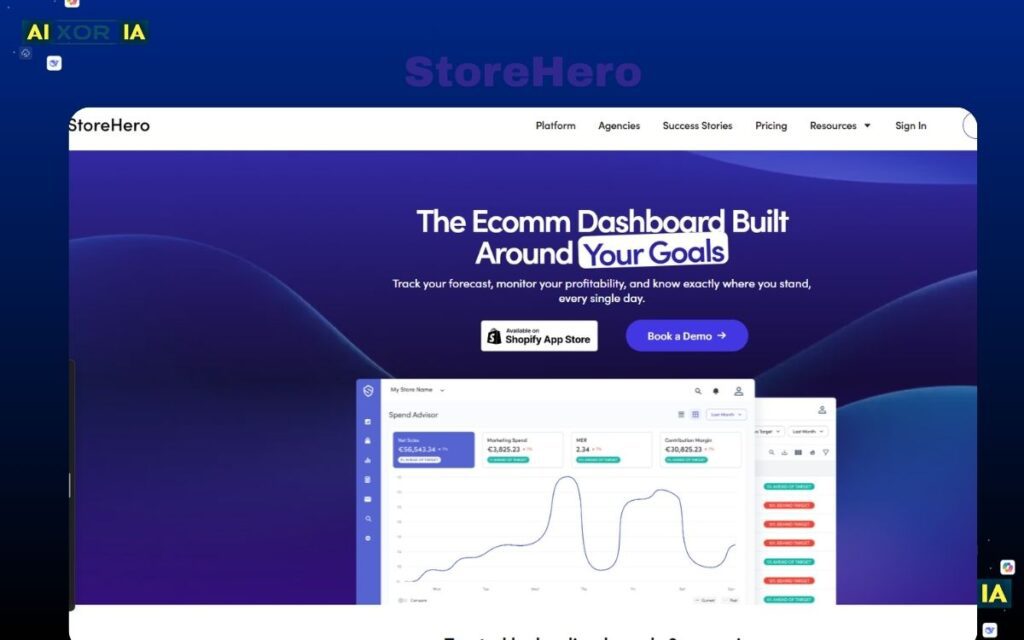
It focuses on true business profitability.
The platform integrates:
- Marketing spend
- Ecommerce platform data
- Product costs
- Operational expenses
This allows brands to analyze metrics such as:
- Contribution margin per product
- Profit per marketing channel
- Break-even advertising cost
For brands operating with tight margins, this level of financial insight is extremely valuable.
3. Polar Analytics
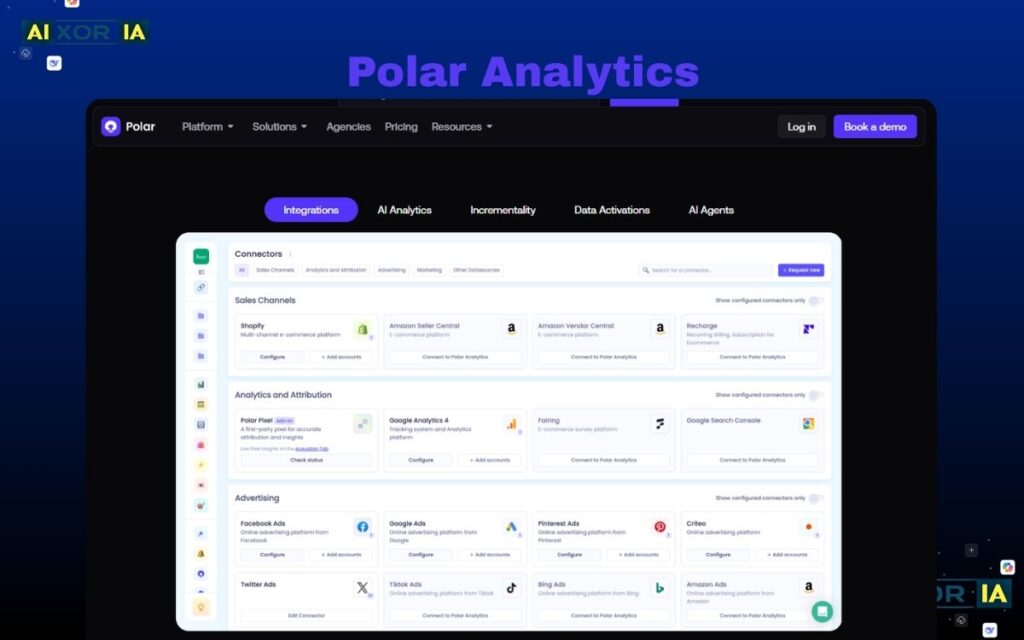
Polar Analytics focuses on simplifying ecommerce data infrastructure.
Instead of requiring complex dashboards or technical setup, the platform automatically connects first-party data sources.
These include:
- Ecommerce platforms
- Marketing platforms
- Customer databases
The result is a unified analytics layer that provides insights into:
- Customer acquisition costs
- Retention rates
- Customer lifetime value
- ROAS performance
For founders who want clean, simple dashboards, Polar Analytics offers an efficient solution.
4. Whatagraph

For agencies managing multiple ecommerce clients, reporting can become extremely time-consuming.
This is where Whatagraph excels.
The platform automates:
- Client reports
- Marketing dashboards
- Data visualizations
Its AI features also generate written explanations of campaign performance, allowing agencies to quickly communicate insights to clients.
How AI Attribution Actually Works
Many marketers still assume that the last click before purchase deserves credit for the conversion.
However, customer journeys are usually much more complex.
A typical ecommerce customer might:
- See a social media ad
- Read a product review
- Click a retargeting ad
- Receive an email
- Finally make a purchase
AI attribution models analyze the entire journey and assign weighted value to each interaction.
This produces a much more realistic understanding of how marketing channels influence conversions.
Real-World Attribution Test
During a recent internal analytics test on our experimental ecommerce dataset, we examined how attribution changes when AI analytics platforms are introduced.
Initially, marketing platforms reported that paid advertising channels were responsible for nearly all conversions.
However, once the data was analyzed using AI attribution modeling, the results were very different.
A significant portion of revenue previously credited to paid ads actually originated from email campaigns and returning visitors.
This type of insight demonstrates why AI attribution tools are increasingly becoming essential for ecommerce brands.
Predictive Analytics: The Next Evolution of ROAS Reporting
The next frontier of ecommerce analytics is predictive marketing intelligence.
Instead of simply analyzing past data, AI models estimate future outcomes such as:
- Predicted ROAS for upcoming campaigns
- Customer lifetime value projections
- Optimal budget allocation across channels
Many analytics platforms are beginning to integrate Marketing Mix Modeling (MMM) techniques.
MMM evaluates how different marketing channels interact and influence overall revenue.
By combining MMM with machine learning, AI tools can recommend:
- How much budget to allocate to each channel
- Which campaigns should be scaled
- Which channels should be reduced
This allows brands to optimize marketing budgets with much greater confidence.
Choosing the Right ROAS Tool
The ideal analytics platform depends on the maturity of your ecommerce business.
For early-stage brands
Use basic analytics stacks and simple dashboards.
For scaling DTC brands
Advanced attribution tools like Triple Whale offer powerful cross-channel insights.
For profit-focused companies
Platforms like StoreHero provide detailed margin analytics.
For agencies
Visualization and reporting platforms such as Whatagraph simplify client communication.
Final Thoughts
Ecommerce analytics is entering a new era.
Traditional reporting tools focused on what happened yesterday.
Modern AI analytics platforms focus on what will happen tomorrow.
By combining predictive modeling, attribution analysis, and profitability tracking, AI tools now allow ecommerce brands to make far more intelligent marketing decisions.
As competition in online retail intensifies, businesses that adopt AI-driven ROAS analytics will gain a significant advantage in optimizing ad spend and scaling profitable growth.
What is ROAS in ecommerce marketing?
ROAS (Return on Ad Spend) is a marketing metric that measures how much revenue is generated for every dollar spent on advertising.
The basic formula is:
ROAS = Total Revenue ÷ Total Ad Spend
For example, if a store spends $1,000 on ads and generates $4,000 in revenue, the ROAS would be 4x.
However, in modern ecommerce analytics, many businesses also track profit-based ROAS, which considers product costs and operational expenses.
How do AI tools improve ROAS reporting?
AI-powered analytics tools improve ROAS reporting by automatically analyzing large datasets from multiple marketing channels.
Instead of manually comparing data from different platforms, AI tools:
Combine advertising and sales data in one dashboard
Identify which campaigns truly drive revenue
Predict future marketing performance
Detect attribution errors between platforms
This allows ecommerce brands to make faster and more accurate marketing decisions.
What is predictive ROAS?
Predictive ROAS is an advanced analytics feature where AI estimates the expected return on advertising before the marketing budget is spent.
AI models analyze historical performance data, customer behavior, seasonality trends, and campaign performance to forecast potential revenue outcomes.
This helps marketers determine which campaigns are likely to be profitable before launching them.
Which AI tools are best for ecommerce ROAS tracking?
Some of the most widely used analytics tools for ecommerce ROAS reporting include:
Triple Whale – popular among Shopify brands
StoreHero – focuses on profitability analytics
Polar Analytics – simplifies first-party data tracking
Whatagraph – automated reporting for agencies
Each platform provides different capabilities depending on the complexity of your ecommerce marketing strategy.
1 thought on “Best AI Tools for Ecommerce ROAS Reporting in 2026”