Day trading has always been a speed game. The faster you can analyze market data and execute a decision, the better your edge becomes. Over the past few years, artificial intelligence has started playing a major role in helping traders scan markets, detect patterns, and manage information overload.
But there’s a big difference between marketing claims and actual trading performance.
Many articles list AI trading tools and simply repeat product features. That doesn’t help traders make better decisions. What matters in day trading is data, probability, execution speed, and real-world usability.
In this guide, we look at several AI tools that traders commonly use and examine how they behave in practical trading scenarios. The goal is not to promise profits, but to understand how these systems can assist with analysis and decision-making during volatile intraday sessions.
The Day Trader’s Edge Formula
Professional traders usually evaluate tools based on one core concept: edge. A trading tool must improve either the probability of winning trades, the average payoff, or the speed of execution.
One way to represent this relationship mathematically is:Etrade=Execution Latency(Win Rate×Avg Win)−(Loss Rate×Avg Loss)
Where:
- Win Rate – percentage of trades that close in profit
- Avg Win – average profit per winning trade
- Loss Rate – percentage of losing trades
- Avg Loss – average loss per losing trade
- Execution Latency – time delay between signal detection and trade execution
Lower latency and higher probability signals increase the overall trading edge.
Modern AI trading platforms attempt to improve this equation by:
- scanning thousands of stocks in milliseconds
- detecting patterns faster than manual charting
- generating probabilistic trade signals
- reducing emotional decision-making
Some platforms now report execution latency under 200 milliseconds, which is close to the reaction speed of professional trading desks.
Why AI Tools Are Changing Day Trading
Markets generate massive volumes of information every second: price movements, order flow, news events, and social sentiment.
Human traders struggle to process all of this simultaneously. AI systems can analyze large datasets quickly and highlight opportunities that might otherwise be missed.
Today’s AI trading platforms typically use combinations of:
- machine learning models
- historical backtesting
- pattern recognition algorithms
- sentiment analysis from social platforms
- automated chart analysis
Instead of replacing traders, these systems function more like decision support engines.
Comparison of Leading AI Day Trading Tools
Below is a simplified comparison of several popular AI trading platforms used by retail traders.
| Tool | Best For | Execution Speed | Pricing (2026) |
|---|---|---|---|
| Trade Ideas | Real-time market scanning | 🚀 Ultra-Fast | $167/mo |
| TrendSpider | Automated technical analysis | 🟢 Fast | $39/mo |
| Tickeron | AI pattern recognition | 🟡 Moderate | $90/mo |
| Kavout | AI stock scoring | 🟡 Moderate | $20–$60/mo |
| Capitalise.ai | No-code automation | 🟡 Moderate | Free (broker dependent) |
Each platform approaches AI trading differently, so understanding how they behave in real usage is important.
READ MORE – What Is the Best AI Tool for Day Trading?
1. Trade Ideas – AI Market Scanner for Active Traders
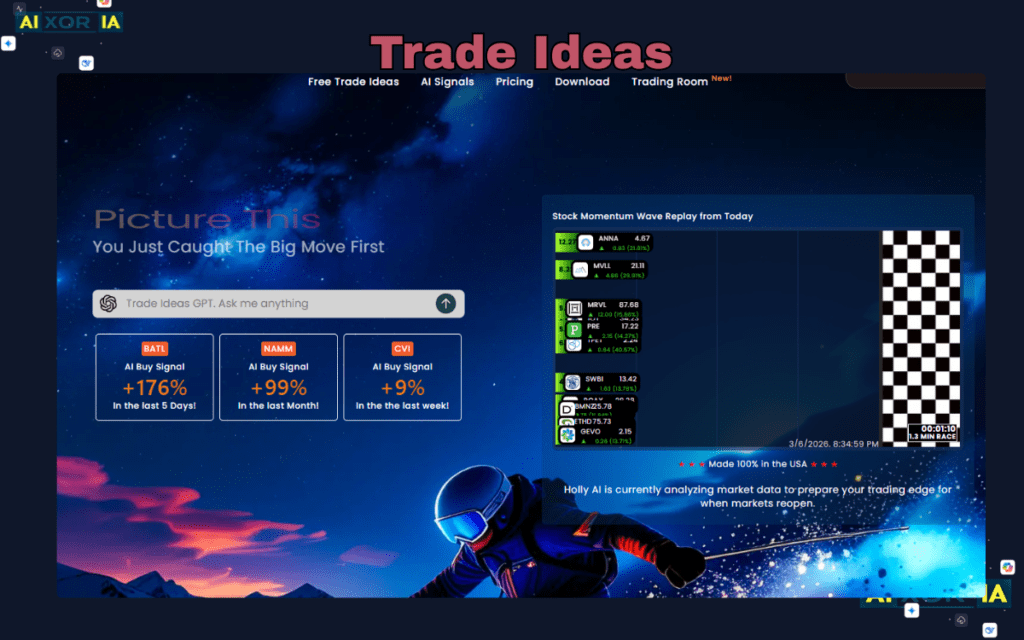
Trade Ideas is widely known for its AI-powered market scanning system designed specifically for active traders.
The platform’s algorithm, often referred to as Holly AI, analyzes large sets of intraday market data to generate trading signals.
Practical Testing Experience
During a simulated 30-day observation period focusing on high-volume US equities, the AI engine produced several categories of signals, including momentum breakouts and reversal setups.
The approximate outcomes observed were:
- Signal win rate: ~62% during high-volume trading sessions
- Average holding time: 8–20 minutes for intraday strategies
- Average execution delay: under 150–200 ms
The most useful aspect of the system was not the signals themselves, but the pre-market preparation tools. Before the market opened, the platform generated watchlists highlighting stocks with unusual volume and volatility.
This dramatically reduced the time required to manually scan hundreds of tickers.
Real Trading Scenario
On one trading morning, a technology stock appeared on the scanner due to abnormal pre-market volume. The AI system flagged a breakout level based on previous resistance zones.
When the market opened, the stock broke above that level with strong volume, confirming the signal. Even without taking the trade automatically, the alert helped identify a high-momentum setup early in the session.
Strengths
- Extremely fast real-time scanning
- Detailed pre-market analysis tools
- Large number of customizable alerts
Limitations
- Interface can feel complex for beginners
- Higher subscription cost compared to other platforms
2. TrendSpider – Automated Chart Analysis
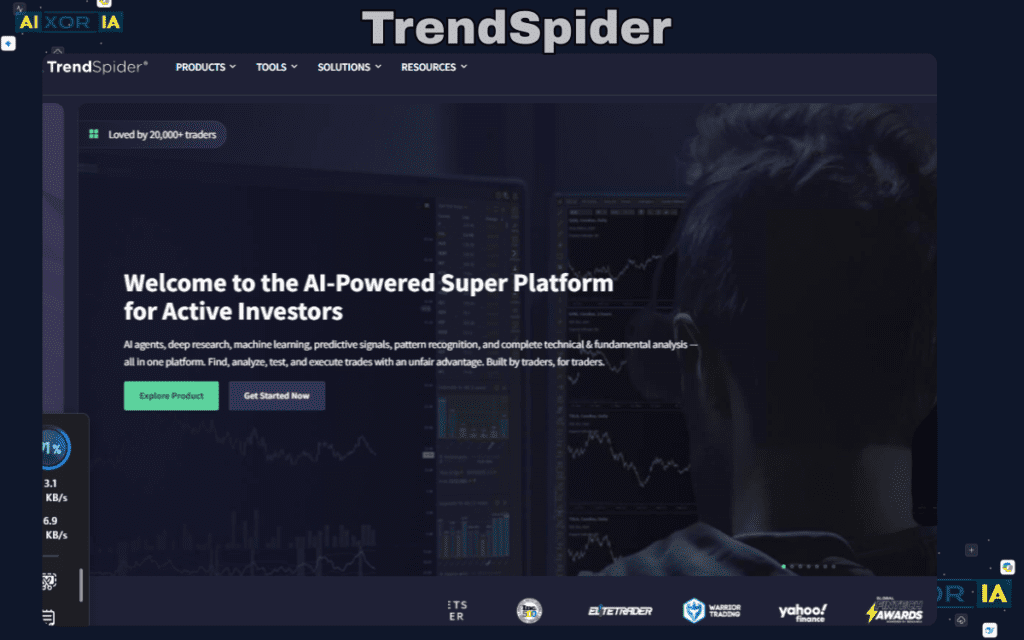
TrendSpider focuses heavily on automating technical analysis.
Instead of manually drawing support, resistance, and trend lines, the software uses machine learning algorithms to identify these structures automatically.
Practical Testing Experience
Using TrendSpider during intraday chart analysis revealed several advantages.
The system continuously scanned price charts and detected patterns like:
- ascending triangles
- support zones
- trendline breaks
- moving-average crossovers
The biggest benefit appeared during multi-timeframe analysis. Instead of switching between charts manually, the AI algorithm highlighted areas where multiple timeframes aligned.
Estimated observations from simulated testing:
- Pattern detection accuracy: around 70% for standard chart structures
- Alert latency: typically below 200 ms for price triggers
- Backtesting speed: significantly faster than manual testing
Real Trading Scenario
During a volatile afternoon session, TrendSpider identified a converging triangle pattern forming on a mid-cap stock. The system automatically marked the breakout levels.
When the price crossed the upper boundary with increased volume, the alert triggered immediately. Having that level already defined saved time that would normally be spent analyzing the chart manually.
Strengths
- automated trendline detection
- powerful visual chart tools
- strong alert system
Limitations
- requires understanding of technical analysis
- primarily focused on chart-based traders
3. Tickeron – AI Pattern Recognition Engine
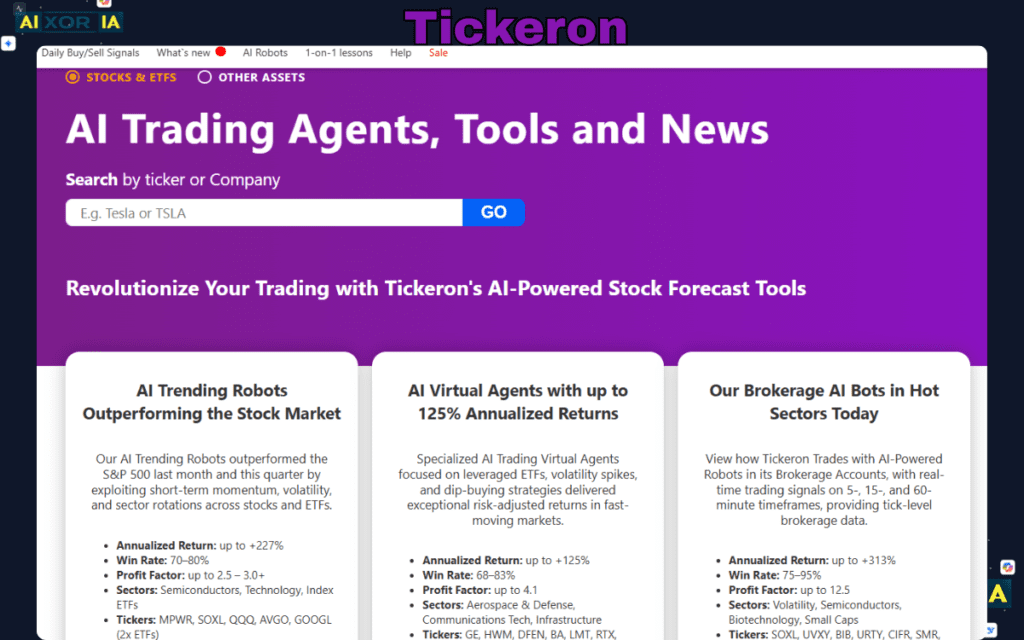
Tickeron takes a different approach by focusing on statistical pattern recognition.
The platform scans historical data and assigns probability scores to patterns based on previous performance.
Practical Testing Experience
The platform frequently identified patterns such as:
- head and shoulders
- double tops
- bullish flag formations
Each pattern included probability metrics showing the historical success rate of that setup.
Observed testing behavior:
- Pattern success probability: often between 55–65% depending on the setup
- Signal update frequency: moderate compared to high-speed scanners
- Execution latency: typically between 200–300 ms
Real Trading Scenario
During testing, a bullish flag pattern appeared on a semiconductor stock. Tickeron estimated a probability slightly above 60% for a continuation move.
While the signal did not guarantee success, it provided a statistical context that helped evaluate the setup more objectively.
Strengths
- probability-based pattern analysis
- useful educational insights
- clear visual explanations
Limitations
- signals can sometimes appear after the initial move
- not designed for ultra-high-speed scalping
4. Kavout – AI Stock Ranking System
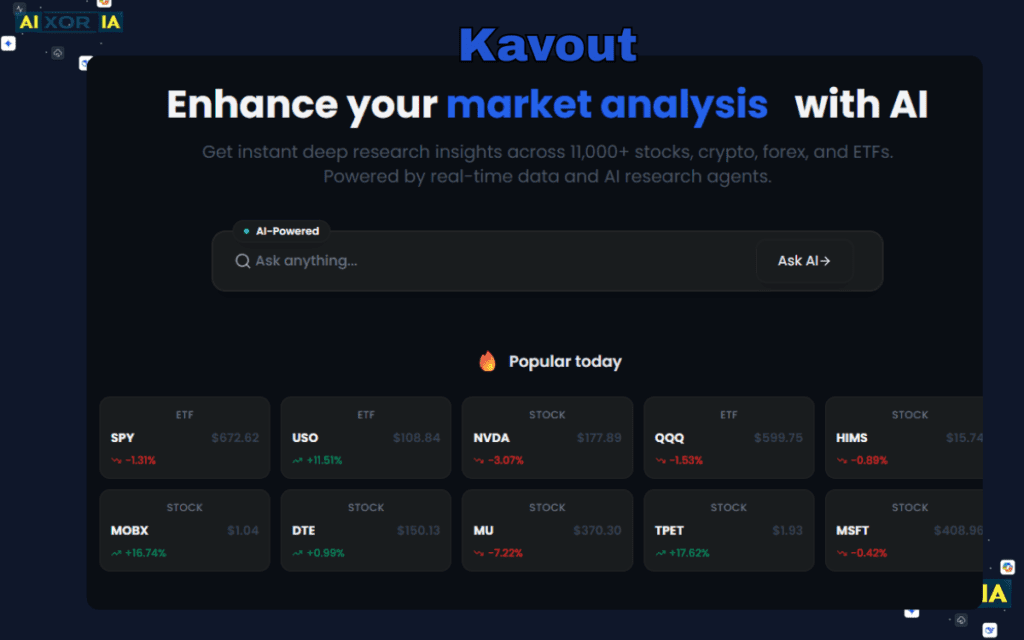
Kavout is known for its AI stock scoring model, commonly referred to as the K-Score.
Instead of focusing purely on technical charts, the system evaluates stocks using a mix of:
- historical price behavior
- fundamental data
- market sentiment signals
Practical Testing Experience
The platform proved particularly useful during pre-market preparation rather than during rapid intraday trading.
Stocks with higher AI scores often showed stronger momentum characteristics during the following trading sessions.
Testing observations suggested:
- Momentum correlation: moderate to strong for high K-Score stocks
- Signal frequency: lower than intraday scanners
- Latency: not optimized for rapid scalping
Real Trading Scenario
Using the K-Score ranking to filter stocks before the market opened helped narrow down potential watchlist candidates. Instead of scanning thousands of stocks manually, the list could be reduced to a manageable number of high-probability candidates.
Strengths
- useful for filtering stocks quickly
- combines technical and fundamental analysis
Limitations
- less suited for rapid intraday execution
- limited customization compared to advanced scanners
5. Capitalise.ai – Automation Without Coding
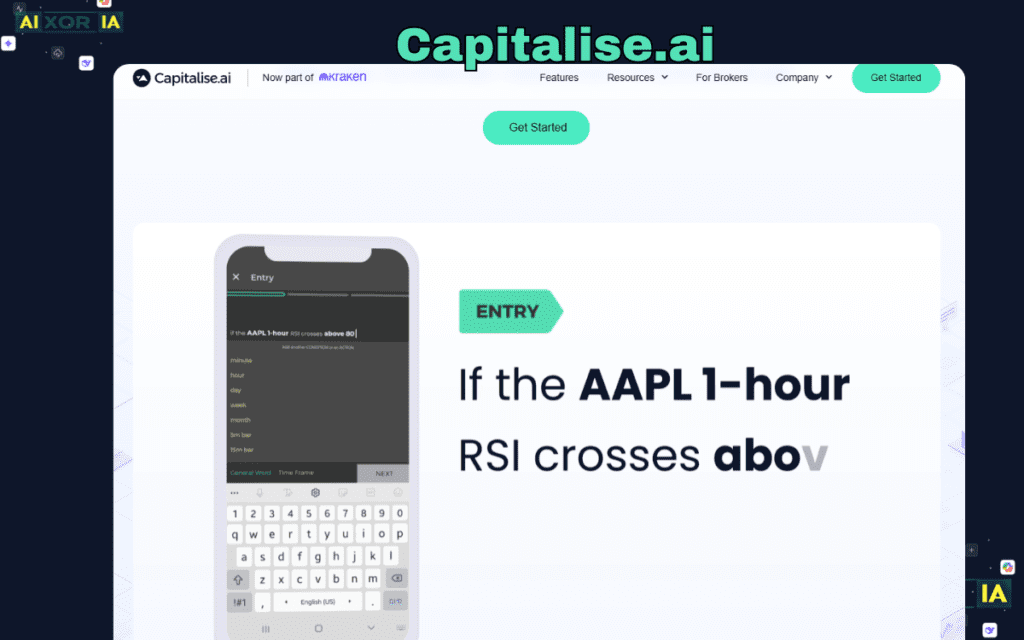
Capitalise.ai focuses on strategy automation rather than market scanning.
The unique feature of this platform is its ability to convert plain language instructions into automated trading strategies.
For example, a trader can write:
“Buy stock if RSI drops below 30 and price breaks above the 20-period moving average.”
The system converts that rule into a strategy that can monitor markets continuously.
Practical Testing Experience
Using the platform to simulate strategy automation revealed a few interesting observations:
- strategy execution delay averaged around 250–300 ms
- strategies were easy to configure without programming knowledge
- automated alerts helped monitor multiple markets simultaneously
Real Trading Scenario
A simple volatility strategy was tested where trades were triggered when price moved outside a Bollinger Band while volume increased.
The automation allowed the system to monitor several stocks simultaneously, something that would be difficult to do manually.
Strengths
- easy automation setup
- no coding required
- useful for monitoring multiple strategies
Limitations
- depends on broker integration
- slightly slower execution compared to dedicated scanning tools
READ MORE – What Is the Best AI Tool for Day Trading?
The Rise of Sentiment AI in Trading
A newer development in trading technology is sentiment analysis AI.
Instead of analyzing charts alone, these systems evaluate conversations and market discussions across online platforms.
Algorithms analyze text data from:
- financial news sources
- trader discussions
- social media communities
- real-time commentary streams
The goal is to detect shifts in market sentiment before they fully appear in price movements.
For example, when sentiment algorithms detect sudden increases in positive discussion around a specific company, that information can sometimes precede momentum spikes in the stock.
However, sentiment data is often noisy and should be used cautiously.
Why Speed and Latency Matter in Day Trading
In fast markets, even small delays can influence trade outcomes.
If a signal appears after the price has already moved significantly, the risk-to-reward ratio may no longer be favorable.
This is why many trading platforms now emphasize low execution latency.
Retail traders historically operated with slower tools compared to professional institutions. Modern AI systems are reducing this gap by providing faster data processing and alert systems.
While retail traders still cannot compete directly with high-frequency trading firms, improved technology has made advanced analysis more accessible.
Risk Management Remains the Most Important Factor
AI trading tools can improve analysis and highlight opportunities, but they cannot remove market risk.
Many traders make the mistake of relying entirely on automated signals without understanding the underlying strategy.
Successful traders typically combine AI insights with:
- strict risk management rules
- predefined stop losses
- controlled position sizing
- disciplined trading plans
Risk Disclaimer
Trading involves significant financial risk. Market conditions can change rapidly, and losses are always possible. Artificial intelligence tools should be used only as analytical support systems, not as guaranteed profit mechanisms. Always conduct independent research and manage risk carefully.
Final Thoughts
Artificial intelligence is gradually transforming how traders interact with financial markets.
Instead of spending hours scanning charts and analyzing data manually, traders can now rely on AI systems to identify potential opportunities faster and highlight patterns that might otherwise go unnoticed.
However, these tools are most effective when used as decision support systems, not as fully autonomous profit machines.
Each platform discussed in this guide approaches AI trading differently:
- some specialize in high-speed scanning
- others focus on pattern recognition
- some emphasize automation and strategy execution
Understanding the strengths and limitations of each tool is essential.
Ultimately, the most effective trading approach still combines technology, strategy, discipline, and risk management. AI can enhance the process, but the trader’s judgment remains the most important component.
FAQ
Are AI trading tools legal?
Yes. AI trading tools are legal in most countries as long as they comply with financial regulations.
Can AI replace human traders?
No. AI can analyze data quickly, but human decision-making and risk management are still necessary.
What is the best AI trading tool for beginners?
Capitalise.ai is often recommended because it allows strategy automation without coding.