A Deep Guide to AI Visibility, GEO Strategy, and the Science Behind LLM Citations
Search is going through one of the biggest transformations since the early days of the web. For more than two decades, websites optimized their pages for traditional search engines—focusing on keyword rankings, backlinks, and click-through rates.
But the rise of AI-powered answer engines such as ChatGPT and Perplexity AI has introduced a new layer of visibility. Instead of presenting a list of links, these systems often generate complete answers based on multiple sources across the internet.
In many cases, users get the information they need without ever clicking a website.
That shift creates a new question for businesses, publishers, and marketers:
How do you measure whether your brand appears inside AI-generated answers?
This is where the Ziptie AI Search Performance Tool enters the picture.
Ziptie is designed specifically to track how brands, websites, and content appear in AI-generated responses across modern generative search engines.
Direct Answer: What Is Ziptie?
Ziptie is an AI-first search visibility platform that monitors brand mentions and citations in generative AI engines such as ChatGPT and Google AI Overviews. Instead of measuring traditional keyword rankings, it tracks Share of Model (SoM)—the percentage of AI responses that include your brand as a recommended source.
Why AI Search Visibility Is Different From Traditional SEO
To understand the importance of tools like Ziptie, we first need to understand how AI search differs from classic search engines.
Traditional SEO focuses on ranking in search result pages, where users choose between multiple links. AI-powered engines operate differently: they analyze large datasets, synthesize information, and generate a single consolidated answer.
Traditional Search Workflow
- User searches a keyword
- Search engine ranks web pages
- User clicks one result
- Website receives traffic
AI Search Workflow
- User asks a natural-language question
- AI analyzes multiple web sources
- AI generates a summarized answer
- Sources may be cited—or sometimes not
Because AI often delivers a complete answer immediately, being included as a source becomes more important than simply ranking for keywords.
This change has led to a new optimization approach known as Generative Engine Optimization (GEO).
GEO vs Traditional SEO
| Factor | Traditional SEO | GEO (Generative Engine Optimization) |
|---|---|---|
| Main goal | Rank pages in search results | Appear in AI-generated answers |
| Metric | Keyword ranking | Share of Model (SoM) |
| Visibility | Link placement | Citation in AI response |
| Optimization focus | Backlinks and keywords | Semantic clarity and authority |
| Measurement | SERP tracking | AI citation monitoring |
Ziptie was built specifically for GEO monitoring, which is something most traditional SEO platforms cannot measure effectively.
READ MORE – What Is Ziptie AI Search Performance Tool? Complete GEO Guide (2026)
What the Ziptie AI Search Performance Tool Actually Measures
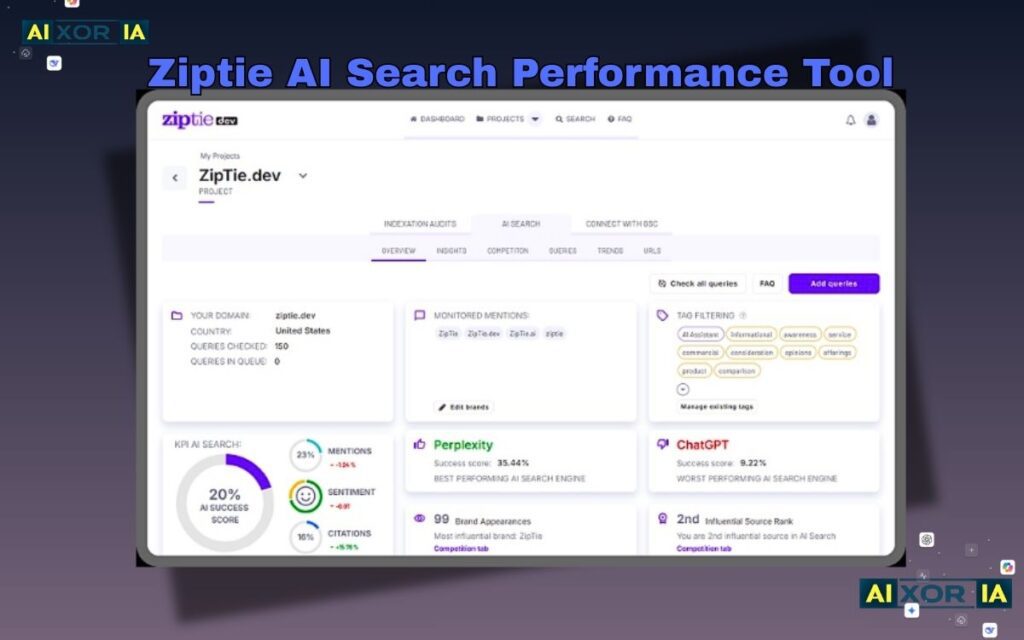
At its core, Ziptie analyzes how often a brand appears in AI-generated responses and how strongly it is associated with certain topics.
Instead of tracking keywords alone, the platform focuses on AI citations and semantic authority signals.
Core metrics inside the platform include:
- AI brand mentions
- Source citations
- Competitor mentions
- Sentiment analysis
- AI visibility score
- Response screenshot capture
Each metric helps marketers understand whether AI models recognize their brand as a trusted information source.
The Science Behind AI Visibility
One of the most interesting concepts behind AI search visibility is citation probability.
Large Language Models (LLMs) such as ChatGPT generate answers by predicting the most likely tokens based on context and training data. When the model references an external source or brand, that source effectively becomes part of the generated answer.
Ziptie attempts to measure this behavior through what analysts often call the AI Citation Probability Score.
The AI Citation Probability Formula
Pcite=Token Distance from Prompt+Competitor Density(Semantic Relevance×Domain Authority)
This simplified model represents the likelihood that a brand will be cited in an AI response.
Explanation of the variables
Semantic Relevance
How closely your content matches the user’s query in meaning rather than just keywords.
Domain Authority
The overall credibility and trustworthiness of the website across the web.
Token Distance from Prompt
How directly your content answers the prompt the user provided.
Competitor Density
The number of competing sources covering the same topic.
If competitor density is high or semantic relevance is low, the probability of citation decreases.
Ziptie’s analytics dashboard allows users to monitor signals related to these factors and identify which topics have the highest potential for AI citation.
How Ziptie Works: A Step-by-Step Overview
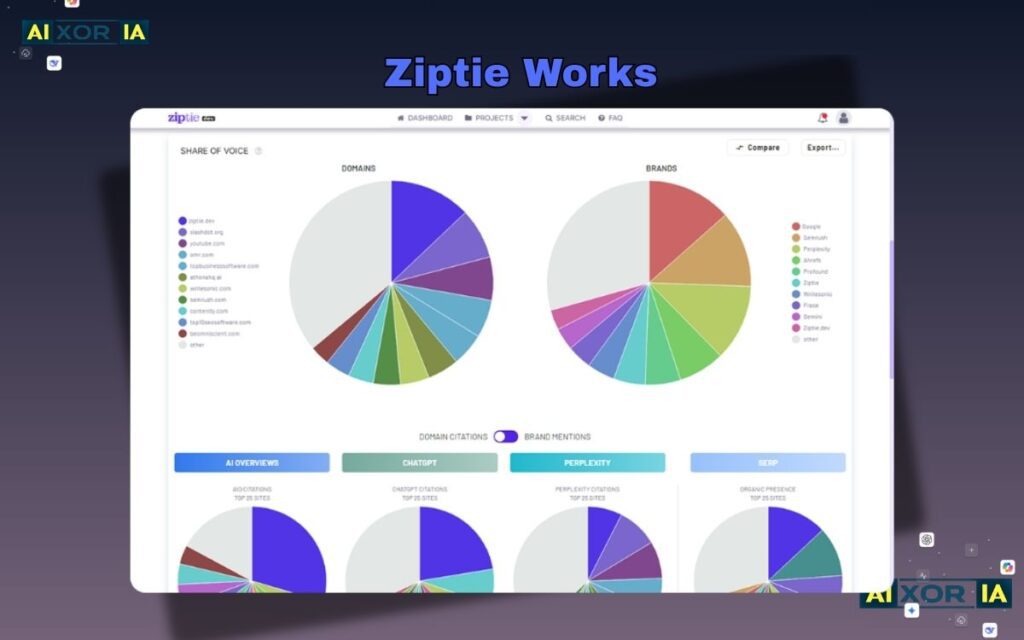
Although the concept sounds complex, the workflow inside Ziptie is relatively simple.
Step 1: Query Monitoring
Users enter prompts that customers might ask AI engines.
Examples:
- “Best AI SEO tools”
- “Top marketing automation software”
- “Best winter boots for snow hiking”
The system runs these prompts across multiple AI engines and records the responses.
Step 2: AI Response Capture
Ziptie stores the generated responses, including:
- Brand mentions
- Product recommendations
- Source citations
- Answer structure
This allows marketers to see exactly how AI systems describe their brand or competitors.
Step 3: Competitive Visibility Analysis
The platform then calculates visibility metrics showing:
- Which brands appear most often
- Which competitors dominate AI responses
- Which queries your brand is missing from
This analysis helps identify content gaps.
Step 4: Performance Dashboard
All data is visualized in dashboards showing trends over time, such as:
- Share of Model (SoM)
- Citation frequency
- Brand sentiment trends
- AI response consistency
These insights help teams refine their content strategies.
Ziptie Metrics Explained
| Metric in Ziptie | What It Measures | Traditional Equivalent |
|---|---|---|
| Citations | Source references in AI responses | Backlinks |
| Sentiment | AI tone toward the brand | Online reputation |
| AI Success Score | Frequency of brand appearance | Keyword ranking |
| Snippet Capture | Screenshots of AI responses | SERP feature tracking |
| Share of Model | Brand visibility across AI engines | Share of voice |
These metrics give a more complete picture of how brands appear inside AI-driven search ecosystems.
Example Scenario: Tracking AI Recommendations
Imagine a user asks an AI assistant:
“What are the best winter boots for extreme cold?”
The AI response recommends five brands.
- Brand A
- Brand B
- Brand C
- Brand D
- Brand E
If your company sells winter boots but does not appear in the response, it means the AI model does not recognize your brand as a strong authority in that topic.
Ziptie would reveal:
- Which brands were recommended
- Which sources the AI used
- How often your brand appears in similar prompts
From there, you could adjust your content strategy to improve semantic authority for winter gear topics.
My Short Real-World Experience Testing Ziptie
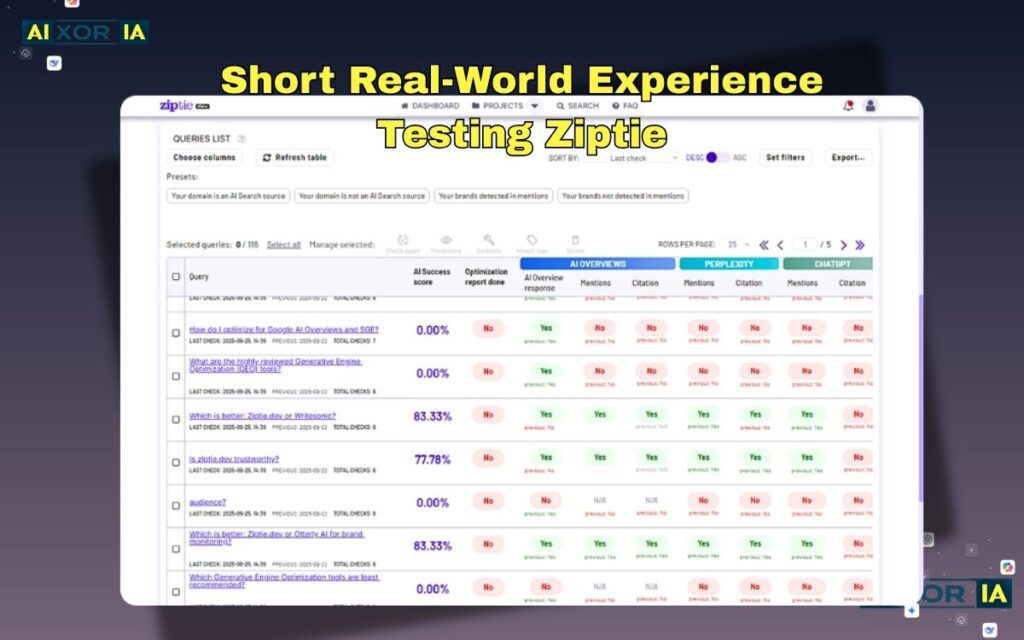
When I first experimented with AI search monitoring tools, I noticed something surprising.
A website I was working with ranked on the first page of traditional search results, yet it was almost invisible in AI-generated answers.
Using Ziptie, I tested several prompts related to digital marketing tools.
Some of the results were unexpected.
For example, when asking an AI assistant:
“Which tools help analyze AI search visibility?”
The response frequently mentioned well-known analytics platforms, even though the site I was analyzing had detailed content about AI search optimization.
Ziptie’s dashboard showed the problem clearly: the site had strong keyword relevance but weak semantic authority signals.
After expanding the content to include:
- clearer explanations
- technical frameworks
- structured comparisons
- real use cases
the brand started appearing more frequently in AI-generated recommendations.
The experience highlighted something important about AI search:
Ranking in search engines does not automatically guarantee visibility in AI answers.
Who Should Use the Ziptie AI Search Performance Tool
Ziptie is particularly useful for organizations that rely heavily on online visibility.
SaaS companies
Software platforms often compete to be recommended in AI tool lists.
SEO agencies
Agencies can monitor how clients appear in AI answers across industries.
Content publishers
Publishers can analyze which articles are cited most frequently.
E-commerce brands
Retailers can see whether their products are recommended in AI shopping queries.
Advantages of Monitoring AI Visibility
Tracking AI-generated responses offers several advantages that traditional SEO tools cannot provide.
Understanding recommendation algorithms
Brands can see which competitors AI models prefer and why.
Identifying authority gaps
If your content is missing from AI answers, it often means there is a semantic or credibility gap.
Improving topic coverage
Monitoring prompts helps identify questions your audience is asking.
Adapting to the future of search
As AI assistants become more integrated into browsers, voice assistants, and productivity tools, visibility inside AI responses will become increasingly important.
Limitations and Challenges
Despite its innovative approach, AI visibility tracking is still an emerging field.
AI responses can change depending on factors such as:
- user location
- conversation context
- prompt phrasing
- model updates
Because of this, AI citation metrics should be interpreted as probabilistic trends rather than fixed rankings.
However, monitoring these trends still provides valuable insight into how AI models perceive brands and information sources.
The Future of Generative Search Optimization
The shift toward AI-generated answers suggests that the definition of search optimization is expanding.
Instead of focusing solely on ranking pages, businesses may need to optimize for:
- semantic clarity
- knowledge authority
- structured information
- contextual expertise
In other words, the goal is not only to rank in search engines but also to become a trusted knowledge source for AI models.
Tools like Ziptie help measure that evolving form of visibility.
Frequently Asked Questions
Is Ziptie a traditional SEO tool?
Not exactly. Ziptie focuses on AI-generated search visibility, while most SEO tools focus on keyword rankings and backlinks.
What does Share of Model mean?
Share of Model measures how often a brand appears in AI-generated answers across different prompts.
Does AI search replace traditional search engines?
AI search does not replace search engines entirely, but it adds a new layer where answers are generated directly rather than linking to individual pages.
Can small businesses benefit from AI search monitoring?
Yes. Even small brands can appear in AI-generated answers if their content is highly relevant and authoritative for a specific topic.
Final Thoughts
Search visibility is evolving from a list of ranked links to a network of AI-generated knowledge.
In this new environment, being cited by AI systems may become just as important as ranking in traditional search engines.
The Ziptie AI Search Performance Tool offers a way to monitor that shift by analyzing how brands appear inside AI-generated responses, measuring citation probability, and helping businesses understand their presence in generative search ecosystems.
As AI assistants continue to shape how people discover information online, tools that track AI visibility and generative search performance will likely become a key part of the modern digital strategy.
3 thoughts on “What Is the Ziptie AI Search Performance Tool?”