Checkout is no longer just the final step in the buying journey—it’s one of the most important revenue opportunities in ecommerce. Traditionally, upsells at checkout relied on static rules: “add this product,” “upgrade to this bundle,” or “buy more to save more.”
AI has changed that.
Modern ecommerce businesses now use AI tools to analyze customer behavior in real time, predict intent, and present personalized upsell offers at the exact moment they are most likely to convert. These systems don’t just automate upsells—they continuously optimize them based on data, outcomes, and user behavior.
For US-based ecommerce brands operating at scale, the challenge is no longer whether to use AI, but which tools can deliver measurable improvements in:
- Average order value (AOV)
- Conversion rate
- Customer lifetime value (LTV)
- Checkout experience quality
The right tool depends on your ecommerce stack, traffic volume, and how much control you need over personalization and experimentation.
Table of Contents
What makes the best AI tools for checkout upsell optimization?
Not all upsell tools are built the same. For 2026, the best AI-driven platforms share a few core capabilities:
Real-time personalization
The ability to generate dynamic upsell offers based on:
- Customer behavior (cart value, browsing history)
- Purchase patterns
- Device, location, and timing
Predictive intelligence
AI models that determine:
- Which product to recommend
- When to show it
- How to price or bundle it
Seamless checkout integration
The tool must work natively with platforms like Shopify, WooCommerce, or custom stacks without slowing down checkout performance.
Experimentation and optimization
Built-in A/B testing and performance analytics to continuously improve:
- Offer placement
- Messaging
- Conversion rates
Revenue attribution
Clear tracking of how much additional revenue is generated through upsells.
The best AI tools for optimizing checkout upsells in ecommerce
1. Rebuy — Best for AI-driven personalization on Shopify
Rebuy is one of the most advanced AI-powered personalization platforms designed specifically for ecommerce brands, particularly those using Shopify. It focuses heavily on optimizing the checkout and post-purchase experience through intelligent upsells.
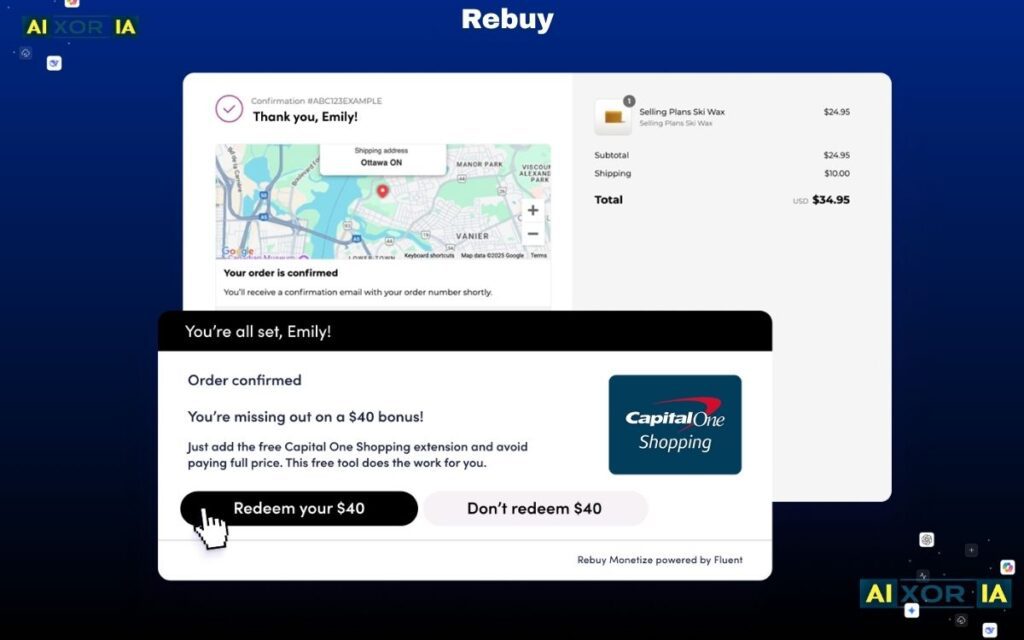
Rebuy uses machine learning models to analyze customer behavior and dynamically generate product recommendations across the entire funnel, including the checkout stage.
Key strengths:
- AI-powered product recommendations based on real-time data
- Smart cart and checkout upsell widgets
- Post-purchase upsell flows
- Deep Shopify integration
How it optimizes checkout upsells:
Rebuy evaluates each shopper’s cart, browsing behavior, and historical data to suggest the most relevant upsell at checkout. Instead of generic offers, it delivers context-aware suggestions such as complementary products or higher-value alternatives.
Best for:
Mid-to-large Shopify stores that want full control over personalization and upsell logic.
Limitations:
Requires setup and optimization to fully leverage its capabilities.
READ MORE – Best AI Tools for Ecommerce in 2026
2. Zipify — Best for high-converting upsell funnels
Zipify is widely known for its focus on conversion optimization, particularly through upsell funnels and proven marketing templates.
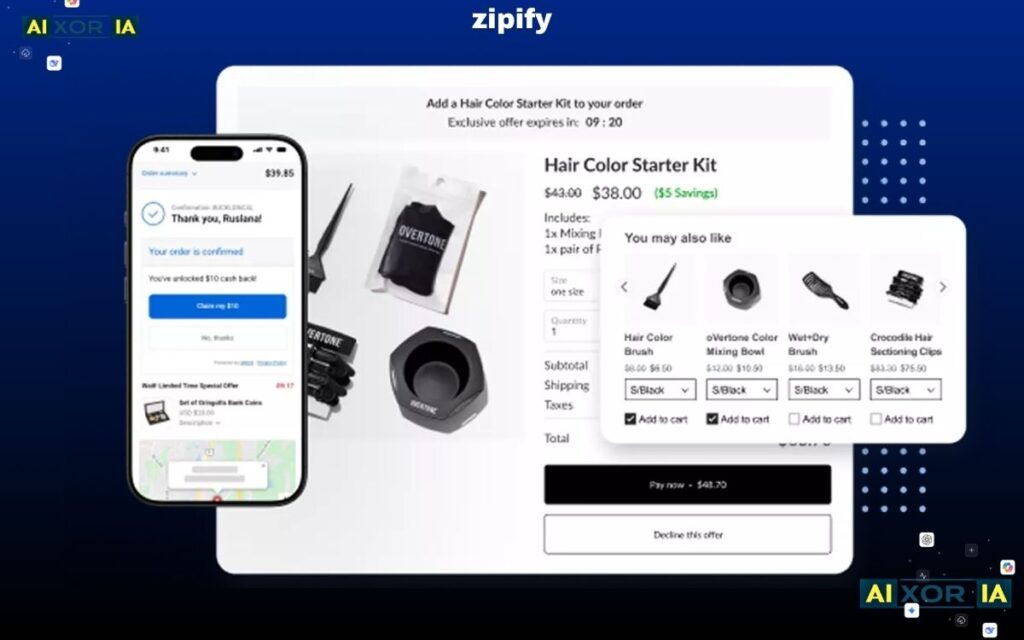
Its AI features help identify which upsell offers are most likely to convert based on historical performance and user behavior.
Key strengths:
- Pre-built upsell funnels
- AI-backed offer optimization
- Strong focus on conversion rate improvement
- Easy integration with Shopify
How it optimizes checkout upsells:
Zipify enables merchants to create structured upsell flows at checkout and post-purchase, then uses data-driven insights to refine which offers perform best.
Best for:
Brands that want a balance between simplicity and performance without building complex systems.
Limitations:
Less flexible than fully customizable AI platforms.
3. LimeSpot — Best for cross-channel personalization
LimeSpot specializes in AI-driven recommendation engines that work across multiple touchpoints, including checkout, product pages, and email.
Its strength lies in delivering consistent personalization across the entire customer journey.
Key strengths:
- Multi-channel AI recommendations
- Audience segmentation
- Behavioral targeting
- Personalization across devices
How it optimizes checkout upsells:
LimeSpot uses predictive analytics to recommend products that align with a customer’s preferences and buying patterns, increasing the likelihood of upsell acceptance at checkout.
Best for:
Ecommerce brands looking to unify personalization across channels, not just checkout.
Limitations:
May require time to fully configure and align with brand strategy.
4. Bold Commerce — Best for customizable checkout experiences
Bold Commerce provides advanced tools for customizing ecommerce checkout flows, including upsells, subscriptions, and pricing strategies.
Its AI capabilities enhance decision-making around what offers to present and when.
Key strengths:
- Flexible checkout customization
- Subscription and upsell integration
- Enterprise-grade scalability
- API-driven architecture
How it optimizes checkout upsells:
Bold allows businesses to design highly tailored checkout experiences where AI determines the most effective upsell based on user behavior and cart context.
Best for:
Enterprise ecommerce businesses with custom requirements and development resources.
Limitations:
More complex setup compared to plug-and-play tools.
5. Klaviyo — Best for data-driven upsell targeting
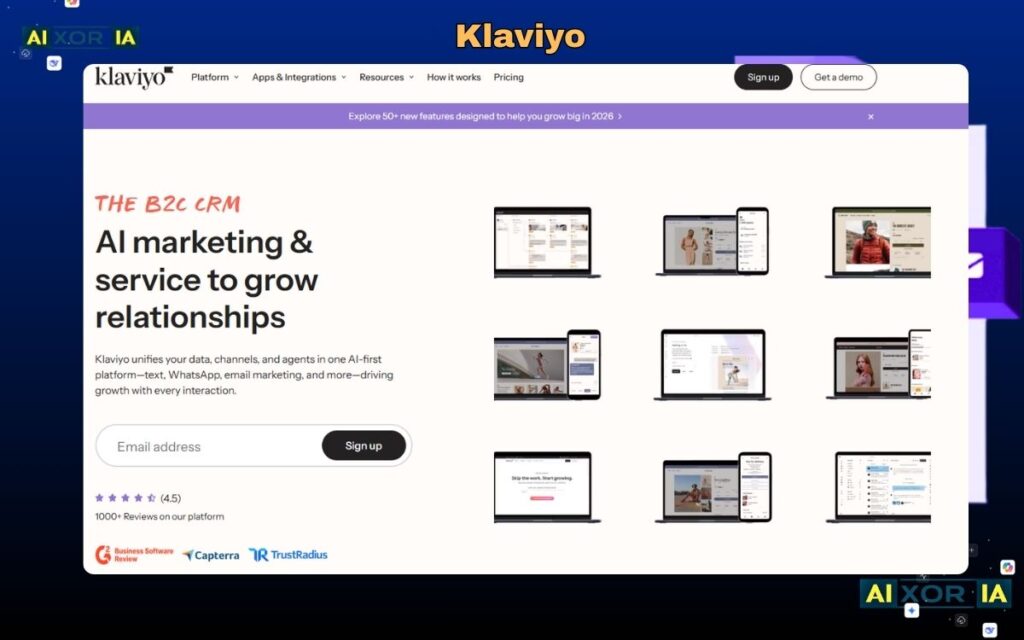
Klaviyo is primarily known as an email and SMS marketing platform, but its AI-powered segmentation and predictive analytics make it highly effective for upsell optimization.
Key strengths:
- Advanced customer segmentation
- Predictive analytics (next purchase, churn risk)
- Integration with ecommerce platforms
- Strong data infrastructure
How it optimizes checkout upsells:
While not a native checkout tool, Klaviyo enhances upsell performance by providing deep insights into customer behavior, enabling better targeting and personalization at checkout through integrations.
Best for:
Brands focused on lifecycle marketing and data-driven personalization.
Limitations:
Requires integration with other tools for direct checkout execution.
How to choose the right AI upsell tool
There is no single “best” tool for every business. The right choice depends on your operational structure and goals.
Choose a personalization-first platform if:
- You want AI to control recommendations
- You prioritize dynamic, real-time upsells
Choose a funnel-based tool if:
- You prefer structured upsell flows
- You want faster implementation
Choose an enterprise solution if:
- You need scalability and governance
- You handle high traffic and complex systems
READ MORE – Best AI Tools for Ecommerce in 2026
Common mistakes to avoid
Even with the best tools, many ecommerce brands fail to optimize checkout upsells effectively.
- Showing too many upsells, causing friction
- Offering irrelevant products
- Slowing down checkout performance
- Ignoring mobile optimization
- Not testing different strategies
AI tools solve these problems only when configured properly and supported by continuous optimization.
The future of AI in ecommerce checkout optimization
In 2026 and beyond, AI-driven upsells will become more autonomous.
Expect:
- Fully automated offer generation
- Deeper predictive analytics
- Voice and conversational checkout experiences
- Hyper-personalized pricing and bundling
The role of ecommerce teams will shift from building rules to supervising AI systems and optimizing strategy.
Final thoughts
AI tools for optimizing checkout upsells in ecommerce are no longer optional for serious online businesses. They directly impact revenue, conversion rates, and customer experience.
The best approach is often a combination:
- A core personalization engine
- A strong checkout integration
- Continuous testing and refinement
If your goal is to increase AOV and maximize revenue from existing traffic, investing in the right AI upsell tool is one of the highest-impact decisions you can make in 2026.