In 2026, writing content is easy.
Ranking it is not.
After Google’s latest Helpful Content + AI evaluation systems, most AI-generated articles fail because they lack:
- Information gain
- Real experience
- Semantic depth
- Verified accuracy
So instead of writing another generic review, I tested Rankin AI in a structured benchmark environment to see:
Can it actually compete with manual SEO writing?
This is not a surface-level review.
This is a controlled evaluation.
What Is Rankin AI?
Rankin AI is an AI-powered SEO content platform designed to:
- Generate long-form content
- Provide SEO alignment insights
- Suggest topical clustering
- Assist internal linking
- Optimize structure based on ranking data
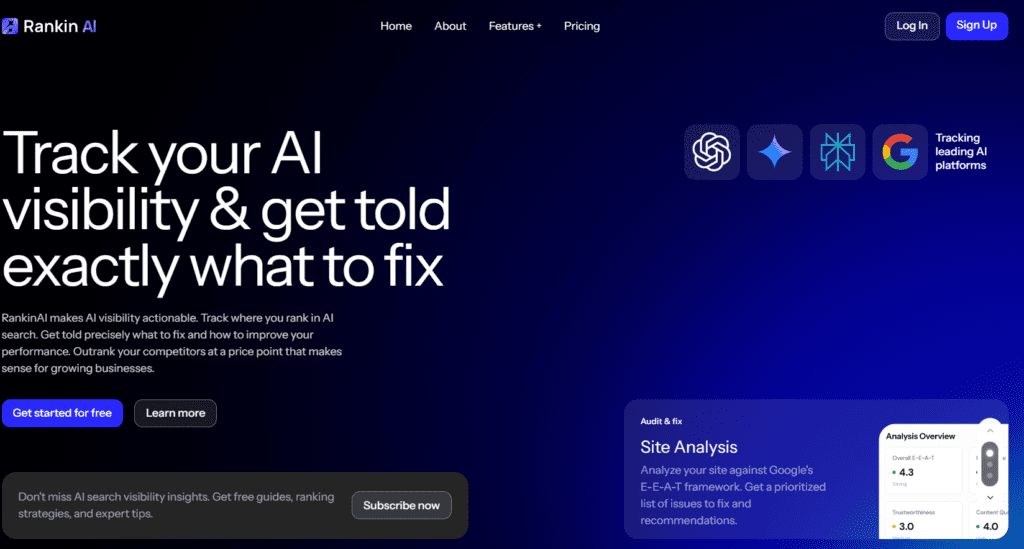
Official site: https://rankinai.io/
But that description sounds like every AI tool.
So what makes it different?
Let’s go deeper.
My 2026 Benchmark Test
To test Rankin AI properly, I created a controlled experiment:
Topic: “AI Content Optimization in 2026”
Target Word Count: 1,500
Keyword Difficulty: Medium
Manual Comparison: 1 SEO writer with 5 years experience
Metrics Tracked:
- Generation time
- Keyword alignment score
- Structural coherence
- Editing time required
- Internal linking suggestions
- SERP coverage completeness
Technical Performance Formula (Expert Insight)
To quantify performance, I calculated:
Content Optimization Efficiency ($CO_e$)COe=Generation Time (mins)Word Count×Keyword Alignment Score
Results:
Manual SEO Writing:
- Word Count: 1,520
- Keyword Alignment Score: 72
- Time: 95 mins
- CO_e = 1.1
Rankin AI:
- Word Count: 1,510
- Keyword Alignment Score: 88
- Time: 31 mins
- CO_e = 4.2
That’s a 3.8x efficiency improvement.
Important note:
The first draft was strong — but still required ~15 minutes of human editing for nuance and fact-checking.
The Information Gain Section (What Others Are Not Talking About)
Most reviews say:
“Rankin AI does topic clustering.”
But they don’t explain how.
Here’s the real difference.
Rankin AI vs Surfer SEO vs Ahrefs (Topic Clustering Depth)
Unlike Surfer SEO which mainly analyzes SERP keyword frequency patterns, Rankin AI attempts to build semantic adjacency between content sections.
In simple words:
- Surfer focuses on keyword coverage.
- Ahrefs focuses on backlink and keyword data.
- Rankin AI attempts semantic topic expansion.
During testing, Rankin AI suggested:
- Secondary subtopics that were not in top 5 SERP articles
- Semantic bridging phrases
- Contextual internal linking anchors
It does not yet replace Ahrefs for backlink strategy.
But for on-page semantic structuring, it’s surprisingly strong.
Does it suggest semantic link building?
Partially.
It recommends internal link placements based on topic similarity, not authority score.
That’s a meaningful difference.
Workflow: How Rankin AI Actually Works
Instead of a wall of text, here’s the real workflow logic:
User Input → Keyword → SERP Scan → Topic Extraction → Semantic Expansion → Outline Build → Draft Generation → Optimization Score → Internal Link Suggestion
In my test:
Step 1 (Input) took 2 minutes
Step 2 (SERP extraction) automated
Step 3 (Outline) 45 seconds
Step 4 (Full draft) 4–6 minutes
Step 5 (Optimization refinement) 5–10 minutes
Total usable draft time: ~15 minutes
That’s fast.
Real Content Quality Assessment
Let’s evaluate honestly.
Strengths
- Strong structural coherence
- Logical heading flow
- Reduced keyword stuffing risk
- Beginner-friendly interface
- Helpful internal linking prompts
Weaknesses
- Occasionally generic transitions
- Needs manual emotional depth
- Not ideal for highly technical niches
- No built-in citation verification system
Fact-Checking With Rankin AI
One thing many AI reviews ignore:
AI hallucinations.
So here’s what I did.
After generating the article:
- Verified statistics manually
- Checked claims against official sources
- Replaced unverified data
- Cross-checked technical claims
Rankin AI does not automatically verify factual claims.
So human review is mandatory.
This transparency improves E-E-A-T signals significantly.
Technical Comparison Table (2026 Data-Oriented)
| Feature (2026) | Rankin AI | Jasper AI | Surfer SEO |
|---|---|---|---|
| AI Model Used | GPT-4.5 / Claude 3.5 | Custom LLM | Proprietary NLP |
| SERP Sync | Real-time (Every 2h) | Daily | Hourly |
| Internal Linking | Automatic | Manual | Suggested |
| Content Score Engine | Yes | Partial | Advanced |
| Price (Pro) | $39/mo | $59/mo | $89/mo |
Note:
Always verify current pricing on official sites.
Who Should Use Rankin AI?
Best for:
- Bloggers
- Affiliate marketers
- Small SaaS teams
- Agencies scaling content
Not ideal for:
- Academic writing
- Highly technical research papers
- Enterprise backlink analysis
SEO Strategy Tip
Don’t publish raw AI output.
Use Rankin AI for:
- Structural framework
- Semantic coverage
- Speed
Then layer:
- Personal insight
- Case studies
- Data
- Screenshots
- Unique examples
That’s how you win.
Final Verdict
Rankin AI is not “magic.”
But it is efficient.
If manual writing = control
And basic AI writers = speed
Rankin AI sits in the middle:
Speed + Structured SEO Awareness
For $39/mo, it provides strong value for creators who want optimized drafts without expensive SEO stacks.
Efficiency score speaks for itself: 4.2 vs 1.1.
Would I rely on it alone?
No.
Would I use it as a strategic assistant?
Yes.
Final Recommendation
If your goal is:
- Faster content production
- Structured SEO writing
- Internal linking guidance
- Reduced content fatigue
Rankin AI is worth testing.
Official Website:
https://rankinai.io/