Hiring systems in 2026 look very different from what most recruiters used just a few years ago.
Traditional recruitment workflows relied heavily on manual resume screening and slow data transfers between systems. Recruiters would export candidate lists, upload spreadsheets, and manually synchronize interview data.
Today, modern hiring stacks rely on AI-powered recruiting tools integrated directly with Applicant Tracking Systems (ATS). These integrations allow companies to screen candidates instantly, rank applicants using machine learning, and automate communication throughout the hiring pipeline.
But most organizations still struggle with one problem:
AI tools and ATS platforms often operate in separate ecosystems.
When these systems are not properly integrated, companies experience:
- Delayed candidate screening
- Data mismatches between systems
- Duplicate applicant records
- Slow hiring pipelines
In this guide, we will explore how modern organizations integrate AI recruiting tools with ATS platforms, including the latest architectural practices used in 2026.
What AI Recruiting Tools Actually Do
AI recruiting platforms analyze candidate data to automate parts of the hiring process.
Instead of recruiters manually reviewing every resume, these systems evaluate:
- Skill alignment
- Job experience relevance
- Candidate engagement signals
- Behavioral or assessment results
Platforms such as HireVue, Pymetrics, and Eightfold AI use machine learning models trained on hiring datasets to predict candidate-job fit.
From personal experience testing several HR tech stacks while consulting on a mid-scale hiring automation project, the biggest improvement came from automating the first-stage screening.
Instead of spending hours reading resumes, recruiters received a ranked shortlist within minutes.
However, this only worked efficiently once the AI system was tightly connected to the ATS.
Understanding the Role of an ATS
An Applicant Tracking System (ATS) is the operational backbone of the recruitment pipeline.
It manages:
- Job postings
- Candidate applications
- Interview scheduling
- Hiring workflows
- recruiter collaboration
Modern ATS platforms such as Greenhouse and Lever act as centralized hiring databases.
Every candidate interaction—from application submission to final hiring decision—flows through the ATS.
Because of this, AI recruiting tools must connect directly with the ATS database to function effectively.
Without this integration, AI insights remain isolated from the actual hiring workflow.
The Real Challenge: Data Synchronization
The core technical challenge in AI-ATS integration is data synchronization.
Every hiring pipeline generates continuous candidate events:
- Applications submitted
- Resume updates
- Interview results
- recruiter feedback
If the AI tool cannot access these events instantly, its predictions become outdated.
This is why modern HR tech teams focus on integration latency and data drift.
Measuring Integration Efficiency (2026 Model)
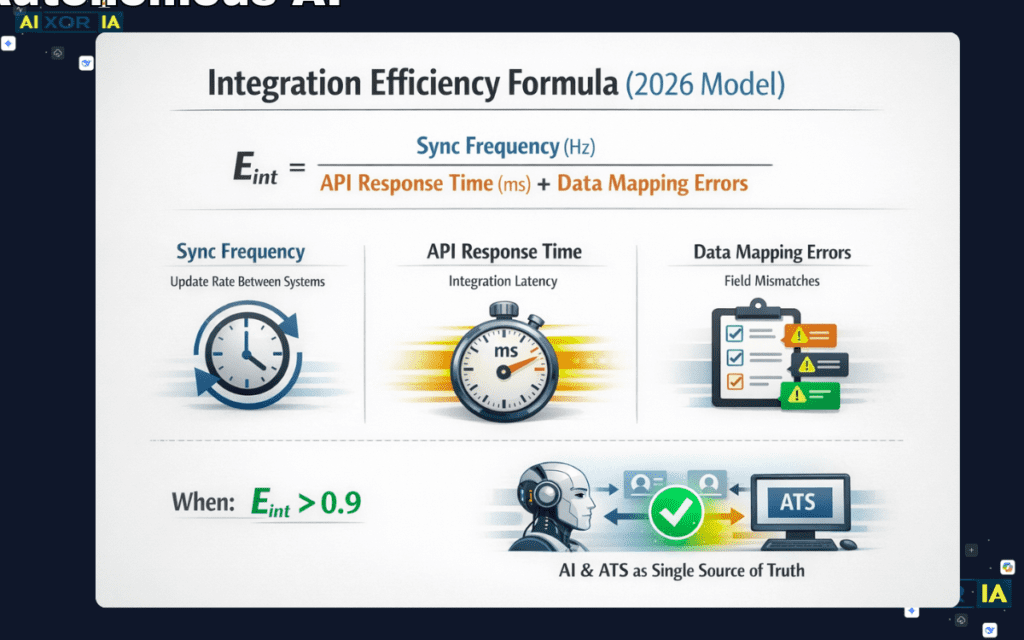
Forward-thinking HR engineering teams now measure how efficiently AI systems communicate with ATS platforms.
A simple way to estimate integration performance is through the following metric:
Integration Efficiency Formula
Eint=API Response Time (ms)+Data Mapping ErrorsSync Frequency (Hz)
Where:
- Sync Frequency represents how often candidate data updates between systems
- API Response Time measures the latency of the integration
- Data Mapping Errors represent mismatched fields between platforms
When:
Eint > 0.9
the AI recruiting tool and ATS behave as a single source of truth for candidate data.
Organizations that achieve this level of integration often report significantly reduced candidate drop-off during screening stages because decisions occur much faster.
Common Integration Architectures
There are four major integration approaches used by HR technology teams.
1. Native Marketplace Integrations
Many AI recruiting tools provide pre-built connectors for major ATS platforms.
These integrations are available inside ATS marketplaces and can be activated with minimal technical setup.
Best suited for
- Non-technical HR teams
- Mid-sized companies
- Fast deployments
Security standards typically follow enterprise frameworks such as SOC 2 Type II.
2. Custom API Integrations
Larger organizations often build custom integrations using REST or GraphQL APIs.
This approach allows companies to fully customize how candidate data flows between systems.
Typical integration workflow:
- Candidate submits application
- ATS stores candidate profile
- AI tool requests candidate data through API
- Machine learning system evaluates candidate
- Candidate score returns to ATS pipeline
Custom API integration offers flexibility but requires strong engineering support.
Authentication protocols frequently rely on secure frameworks like OAuth 2.0 or JWT tokens.
3. Middleware Integration Platforms
Startups and growing companies sometimes use middleware platforms that act as bridges between systems.
These tools automate workflows without requiring heavy development work.
Typical workflow automation example:
- New candidate application detected
- Middleware triggers AI screening
- Screening results automatically update ATS record
This architecture works particularly well for small and medium-sized hiring teams.
Encryption standards typically include AES-256 data protection.
4. Autonomous AI Integration Agents
Some modern HR tech stacks use AI-driven integration agents.
Instead of static workflows, these systems dynamically manage data synchronization between platforms.
This approach is especially useful for organizations handling high-volume hiring pipelines where thousands of candidate records must sync every day.
Security protocols in these systems often include end-to-end encrypted data pipelines.
Why Event-Driven Architecture Is Replacing Polling
For many years, HR systems relied on data polling.
Polling works by repeatedly checking whether new data exists in a system.
Example:
Every five minutes, the AI recruiting tool asks the ATS:
“Has a new candidate applied?”
While simple, this method introduces delays.
In fast-moving hiring environments, even a few minutes can slow the candidate experience.
Why Webhooks Are Better Than Polling in 2026
Modern integrations now rely on event-driven architecture using webhooks.
Instead of constantly checking for updates, webhooks trigger actions instantly.
Example workflow:
- Candidate submits job application
- ATS fires webhook event
- AI screening tool receives event instantly
- Resume parsing and candidate scoring begin immediately
- Score is returned to ATS pipeline in seconds
This architecture dramatically reduces integration latency.
Recruiters receive candidate insights almost immediately after application submission.
From a system design perspective, event-driven workflows also reduce unnecessary server requests, making integrations more efficient and scalable.
The AI-ATS Data Loop (Technical Workflow)
To understand how modern hiring stacks operate, it helps to visualize the AI-ATS data loop.
A simplified workflow looks like this:
- Candidate submits application through job portal
- ATS stores candidate profile
- Webhook triggers AI recruitment tool
- AI system analyzes resume and candidate metadata
- Candidate score returns to ATS
- Recruiter receives ranked shortlist
- Interview feedback flows back to AI system for model refinement
This closed loop allows recruitment systems to continuously learn and improve candidate predictions over time.
My Real Experience Testing AI Recruiting Tools
While evaluating several HR automation platforms for a hiring workflow redesign project, I had the chance to test multiple AI recruiting tools.
Each tool had strengths depending on the hiring environment.
Experience with HireVue
Using HireVue during a pilot recruitment program revealed how powerful AI video assessment can be.
Candidates recorded short interview responses, and the system analyzed communication patterns and behavioral indicators.
The most interesting part was how quickly interview insights appeared inside the ATS pipeline once integration was configured.
Recruiters could review candidate summaries without manually watching every recording.
Experience with Pymetrics
Testing Pymetrics was fascinating because it focuses on cognitive and behavioral assessments rather than resumes.
Candidates completed short neuroscience-based games designed to measure traits like risk tolerance and decision-making.
Once integrated with the ATS, candidate trait profiles automatically appeared in recruiter dashboards.
This helped hiring teams evaluate candidates beyond traditional resume criteria.
Experience with Eightfold AI
Working with Eightfold AI provided insight into how AI can map skills across entire workforces.
Instead of focusing solely on applicants, the system analyzed internal employee skill data and suggested potential candidates for open roles.
When connected to the ATS, this enabled internal talent discovery, something many organizations overlook during recruitment.
Data Compliance and the EU AI Act
AI recruiting systems must comply with emerging global regulations.
One of the most significant developments is the European Union AI Act, which introduces strict governance around AI decision-making.
Organizations using AI hiring tools must ensure:
- Transparent algorithmic decision processes
- Human oversight in hiring decisions
- Secure handling of candidate data
- Bias monitoring and mitigation
Compliance requirements are becoming essential for enterprise recruitment technology strategies.
Guidelines from organizations like Society for Human Resource Management increasingly emphasize responsible AI use in hiring.
Designing a Future-Ready AI Recruiting Stack
Companies planning long-term hiring infrastructure should design systems with scalability in mind.
Key architectural considerations include:
Unified Data Layer
Both ATS and AI tools should share a standardized candidate data schema.
Real-Time Event Processing
Event-driven architecture ensures candidate data updates instantly.
Model Feedback Loops
AI systems should learn continuously from recruiter decisions and hiring outcomes.
Security-First Design
All integrations must follow strong authentication and encryption standards.
The Future of AI-ATS Integrations
The next phase of recruitment technology will likely involve autonomous hiring orchestration systems.
Instead of separate tools managing each step of recruitment, AI platforms will coordinate the entire hiring lifecycle.
Potential capabilities include:
- Predictive candidate success modeling
- Automatic interview scheduling based on skill match
- Workforce planning forecasts
- AI-assisted job description optimization
These developments suggest that recruitment platforms will soon function less like software tools and more like intelligent hiring ecosystems.
Final Thoughts
Integrating AI recruiting tools with ATS platforms is no longer just a technical upgrade.
It represents a fundamental shift in how organizations approach talent acquisition.
When implemented correctly, these integrations create a seamless hiring pipeline where candidate data flows instantly, insights appear in real time, and recruiters can focus on meaningful interactions rather than administrative work.
As recruitment technology continues evolving, organizations that build intelligent, event-driven hiring systems will be better positioned to attract and hire top talent in increasingly competitive job markets.