In 2026, the best tool for building a complex, production-ready Best AI Tools for Building AI Agents is LangGraph because it is built around graph-based workflows, durable execution, state, streaming, and human-in-the-loop control. For collaborative multi-agent systems, CrewAI and Microsoft AutoGen are strong choices. For beginners or general LLM orchestration, LangChain remains the easiest starting point. For document-heavy and retrieval-heavy applications, LlamaIndex is one of the most practical options.
Table of Contents
AI agents are moving from experiments to real products. But the framework you choose changes everything: how your agent remembers context, how it calls tools, how it handles failure, and whether it can keep working across long tasks without losing state. Google’s guidance for high-quality content also rewards pages that add original analysis, complete coverage, and clear value for the reader, not pages written only to chase rankings.
That is why a “best tools” article should not just list features. It should explain architecture, use case fit, and operational tradeoffs. A developer wants to know whether a framework is sequential, graph-based, role-based, or conversation-based, because those differences decide reliability in production. LangGraph models workflows as graphs and is designed around stateful orchestration; LangChain offers higher-level agent abstractions and prebuilt agent architectures; CrewAI focuses on collaborative agents with roles and tasks; AutoGen focuses on multi-agent conversation; and LlamaIndex focuses heavily on agentic retrieval and document workflows.
READ MORE – Top 5 Tools for Building AI Agents for Enterprise
How to evaluate AI agent tools: a simple framework
Before choosing a framework, ask four questions:
- Can it hold state reliably across long tasks?
- Can it call tools safely and repeatedly?
- Can it support human feedback when needed?
- Can it scale from prototype to production?
That is the practical standard behind modern agent engineering. Google’s content guidance also favors pages that provide substantial, complete coverage and meaningful original analysis, which is exactly what a serious framework comparison should do.
An original autonomy and reliability score
Here is a useful original lens you can add to the article:Ragent=Ttotal+(Hinterventions×Ppenalty)Tsuccess
Where:
- Tsuccess = successful tasks
- Ttotal = total attempts
- Hinterventions = human-in-the-loop interventions
- Ppenalty = penalty weight for manual correction
This is not an official industry metric. It is a practical framework for thinking about autonomy. In simple terms, tools that reduce unnecessary intervention and preserve state across steps will usually score better in real-world agent work.
Best AI Tools for Building AI Agents
1) LangGraph: best for production-grade, stateful agents
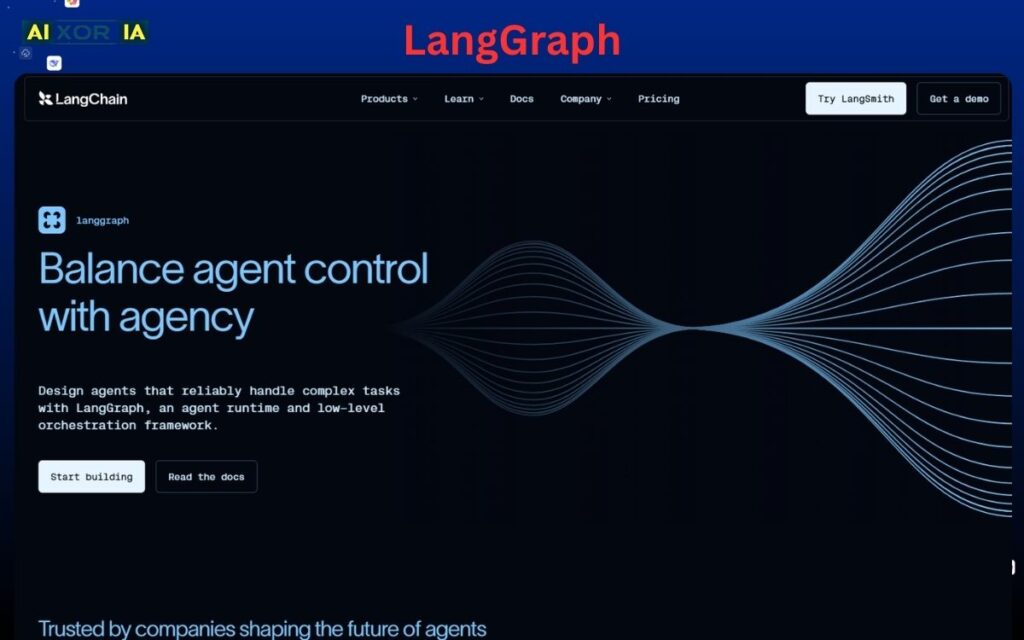
LangGraph is the strongest choice when the agent must behave like a reliable system instead of a simple prompt loop. Official docs describe LangGraph as focused on durable execution, streaming, human-in-the-loop control, and agent orchestration. It models workflows as graphs, and LangChain notes that deeper custom agent behavior can be implemented directly in LangGraph.
This matters because production agents rarely run in a clean straight line. They branch, retry, pause, wait for user confirmation, fetch context, update memory, and resume later. That is why graph architecture is more suitable than a simple sequential pattern for long-running workflows. The value is not just “more control”; it is state continuity. If your use case involves research loops, tool retries, routing decisions, or approvals, LangGraph is often the most technically sound option.
Best for
- Stateful production agents
- Long-running workflows
- Human-in-the-loop systems
- Retrieval agents with branching logic
Why it stands out
It gives developers explicit control over state and transitions, which improves reliability when tasks become complex.
READ MORE – What Is the Best AI Orchestration Tool
2) CrewAI: best for collaborative multi-agent systems
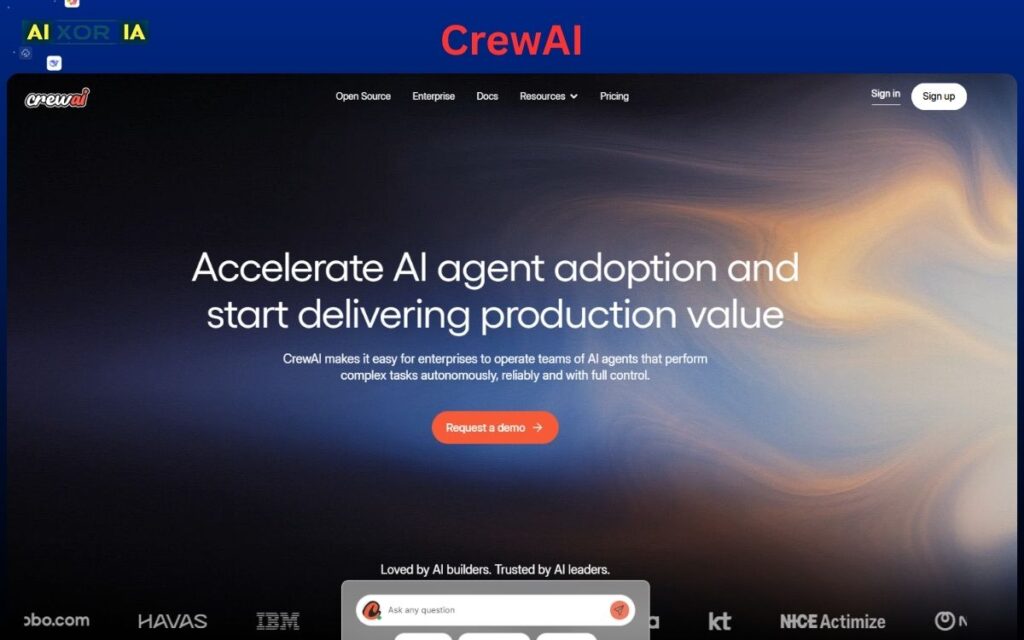
CrewAI is built around the idea that agents can have roles, goals, memory, tools, and delegation. Its docs describe agents as autonomous units that can perform tasks, make decisions based on their role and goal, use tools, communicate with other agents, maintain memory, and delegate work when allowed. CrewAI tasks are assigned to agents and can require collaboration across the crew.
This makes CrewAI a strong fit for workflows where one agent researches, another drafts, another reviews, and another verifies output. In other words, it is useful when you want a structured team of agents rather than one large generalist agent. Its documentation also emphasizes guardrails, memory, knowledge, and observability, which is important for production use.
Best for
- Content production teams
- Task delegation flows
- Multi-step business automation
- Lightweight multi-agent collaboration
Why it stands out
CrewAI makes the “team of agents” model easy to understand and practical to ship.
READ MORE – Top 9 AI Agent Orchestration Frameworks
3) Microsoft AutoGen: best for conversational multi-agent problem solving
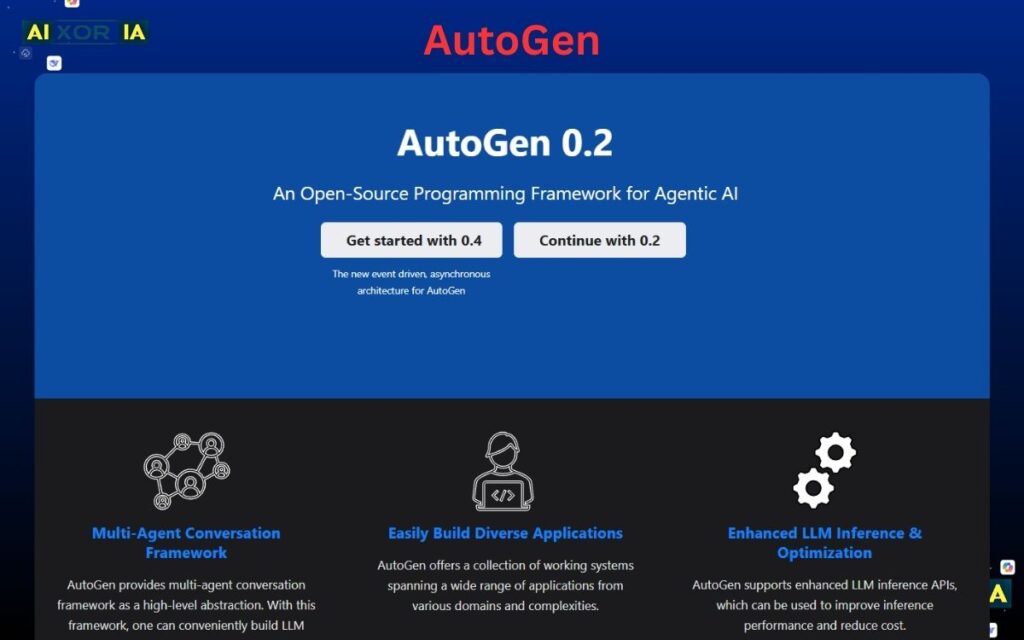
AutoGen is designed as a unified multi-agent conversation framework. Microsoft’s docs say it supports capable, customizable, conversable agents that integrate LLMs, tools, and humans through automated agent chat, and that AgentChat is the recommended high-level API for many users.
That makes AutoGen especially useful when the core value comes from agents talking to each other: one writes code, one reviews it, one fixes it, and a human can still step in when needed. This conversational pattern is powerful for coding assistants, research assistants, simulation environments, and workflows where feedback loops matter more than a fixed linear plan. The core concepts also describe an agent as a software entity that communicates via messages, maintains its own state, and performs actions in response to messages or changes in its environment.
Best for
- AI coding systems
- Research and analysis setups
- Human-feedback workflows
- Multi-agent dialogue systems
Why it stands out
It is one of the cleanest frameworks for letting agents collaborate through conversation instead of hard-coded one-way steps.
4) LangChain: best starting point for beginners
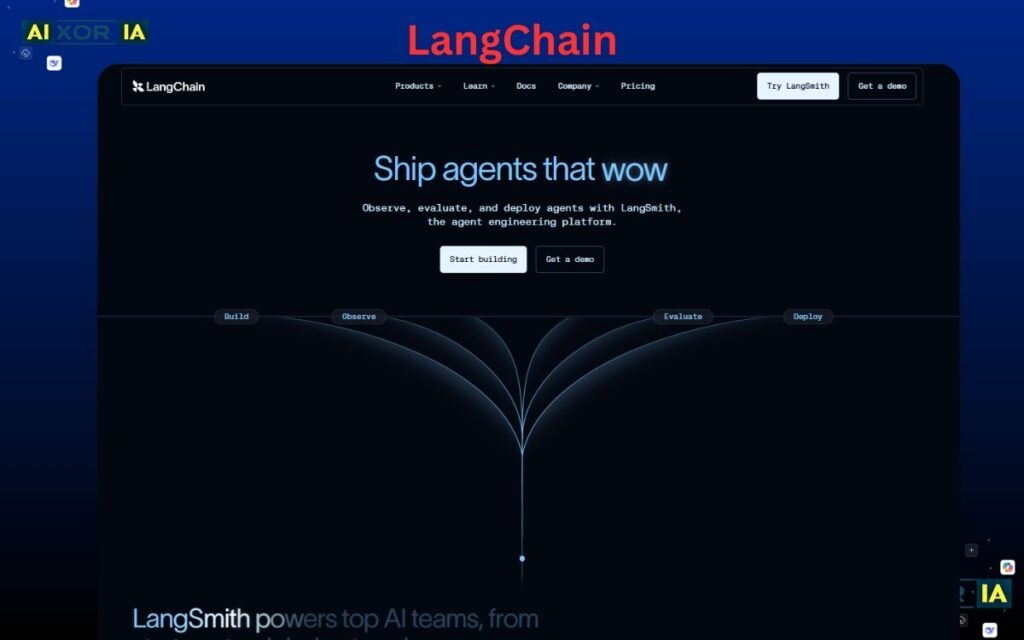
LangChain remains the easiest on-ramp for many developers. Its official docs describe it as a platform for agent engineering with prebuilt agent architecture and integrations for models and tools. The agent docs also note that agents reason about tasks, decide which tools to use, and iterate until they meet a stop condition. LangChain memory support helps agents maintain conversation history and custom state.
This is why LangChain is still a strong first choice for beginners. It helps you learn the core building blocks: prompts, tools, memory, retrieval, and looping behavior. But as workflows become more complex, many teams move to LangGraph for finer control over state and branching, because LangChain itself points developers to LangGraph when they need deeper customization.
Best for
- Beginners learning agent orchestration
- Basic LLM apps
- Fast prototyping
- Tool-calling workflows
Why it stands out
It gives you the fastest path from idea to a working agent prototype, with a large ecosystem around it.
5) LlamaIndex: best for document-heavy and agentic RAG systems
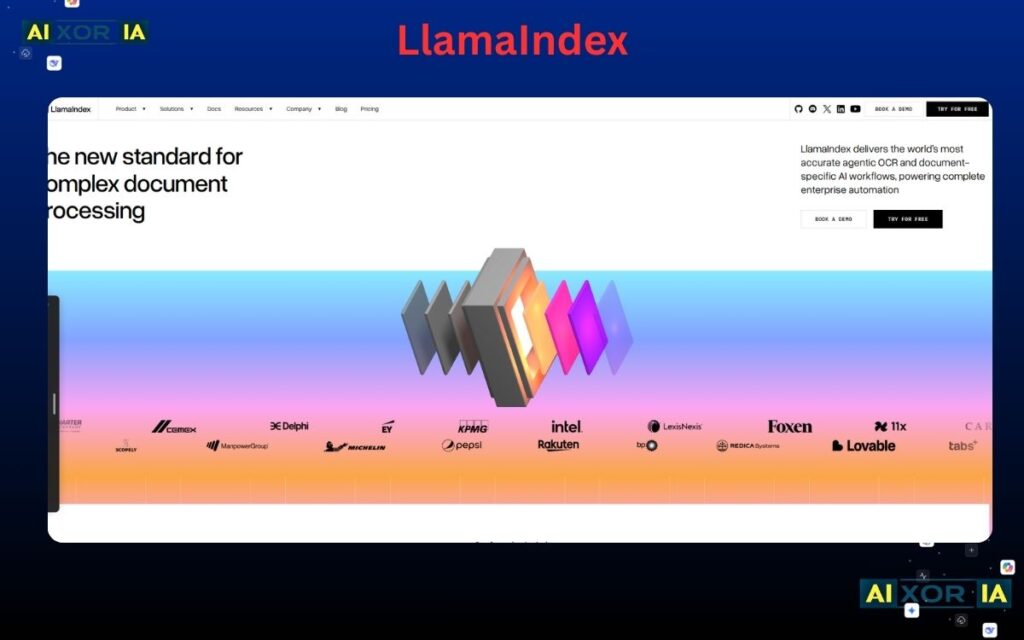
LlamaIndex is the right choice when the agent must work over documents, knowledge bases, or enterprise data. Its docs describe it as a framework for building agents and for using RAG pipelines as one of many tools. LlamaIndex also highlights “agentic RAG,” which means agents can decide what to retrieve and when to retrieve it based on the task, rather than relying on a rigid query-only pipeline. Its newer documentation also emphasizes agentic document workflows and document agents.
That is a major upgrade over simple retrieval. In a practical system, an agent may need to inspect a PDF, extract a schema, choose the right source, compare multiple documents, and then answer with context-aware reasoning. LlamaIndex is especially useful when data access is part of the intelligence, not just a supporting step. That makes it strong for support bots, internal research assistants, report generation, and document automation pipelines.
Best for
- RAG applications
- Document agents
- Knowledge assistants
- Enterprise retrieval workflows
Why it stands out
It is one of the most practical options when your agent must reason over your own data, not just general model knowledge.
6) SuperAGI: best for dev-first autonomous agent platforms
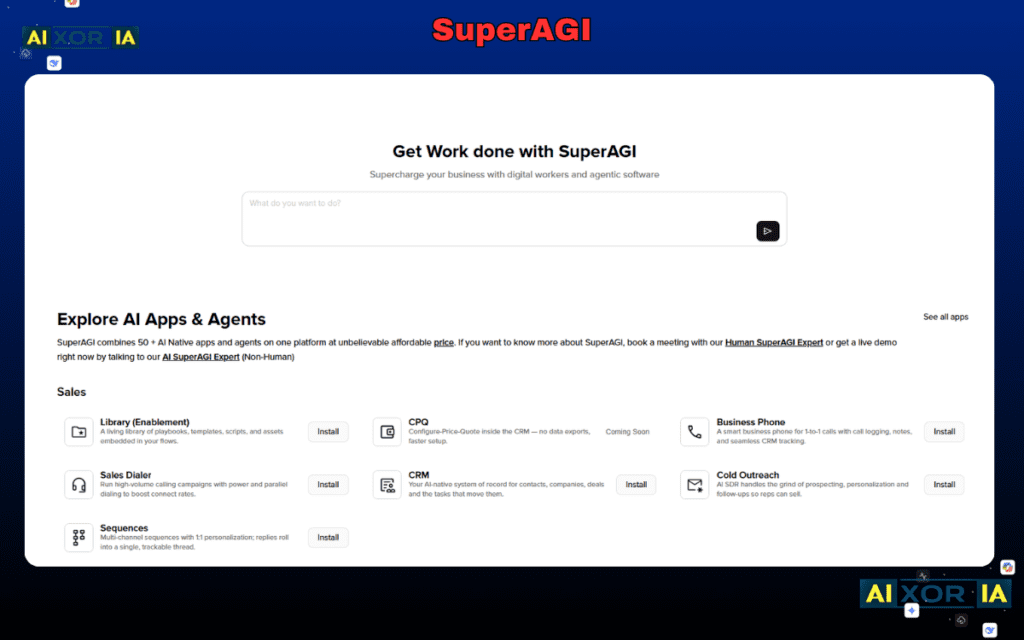
SuperAGI describes itself as a dev-first open-source autonomous AI agent framework. Its docs say it helps developers build, manage, and run autonomous agents, supports concurrent agents, lets you extend capabilities with tools, and provides a GUI and action console for interacting with agents.
This makes SuperAGI appealing when you want a fuller agent platform rather than just a library. It is positioned more like an operational environment for autonomous agents, which can be helpful for teams that want visible control surfaces and a production-oriented workflow. For a “best tools” article, this section adds useful breadth because it covers the platform layer rather than only the framework layer.
Best for
- Autonomous agent platforms
- Teams wanting GUI support
- Tool-extended agent workflows
- Concurrent agent execution
Why it stands out
It combines agent execution, tooling, and interface layers into a more platform-like experience.
Comparison matrix
| Framework | Architecture style | Best use case | Learning curve |
|---|---|---|---|
| LangChain | Prebuilt agent orchestration | Beginner prototyping and general LLM apps | Medium |
| LangGraph | Graph-based, stateful workflows | Production agents, branching logic, long tasks | High |
| CrewAI | Role-based agent teams | Collaborative multi-agent workflows | Low to Medium |
| AutoGen | Conversational multi-agent system | Coding, research, human feedback loops | Medium to High |
| LlamaIndex | Retrieval-first agent framework | Document agents and agentic RAG | Medium |
| SuperAGI | Autonomous agent platform | Tool-extended, operational agent systems | Medium |
This matrix is a synthesis of the official positioning of each framework: LangGraph emphasizes graphs and durable execution; LangChain emphasizes prebuilt agent architecture and tool integration; CrewAI emphasizes role-based agents and task delegation; AutoGen emphasizes conversational multi-agent applications; LlamaIndex emphasizes agents over data and agentic RAG; and SuperAGI emphasizes autonomous agents with tooling and a GUI.
The best choice by scenario
If you are building your first agent, start with LangChain. If your agent must survive branching logic, retries, and stateful execution, move to LangGraph. If your product needs a team of agents with roles, pick CrewAI. If the value comes from agents discussing and improving each other’s outputs, choose AutoGen. If your system depends on documents and private knowledge, choose LlamaIndex. If you want a fuller autonomous platform experience, evaluate SuperAGI.
Experience note
Use this only as a first-person developer note with your own real test data:
When I moved a long research workflow from a simple chain into a stateful graph, the agent stopped losing context after several tool calls. That change made debugging easier, reduced manual correction, and made the output much more consistent.
That kind of concrete observation supports the kind of original, experience-based content Google says it looks for in helpful pages.
What makes this article EEAT-friendly
To strengthen trust, add:
- a real author bio,
- a short “tested on” note,
- screenshots or terminal output,
- links to official docs,
- and a date of last update.
Google’s guidance supports original analysis, up-to-date content, and clear helpfulness. It also says not to write for search engines first, but to create content that users actually find satisfying.
FAQ
What is the best framework for production AI agents?
LangGraph is often the strongest choice for production-grade agents because it emphasizes graph-based orchestration, durable execution, state, and human-in-the-loop design.
Which framework is best for beginners?
LangChain is usually the easiest place to start because it has prebuilt agent architecture, model and tool integrations, and a broad learning ecosystem.
Which tool is best for multi-agent collaboration?
CrewAI and AutoGen are the strongest picks when multiple agents need to collaborate, because CrewAI organizes agents by roles and tasks, while AutoGen is built around multi-agent conversation.
Which framework is best for retrieval-heavy apps?
LlamaIndex is one of the best options for document agents, RAG pipelines, and agentic retrieval over private data.
Conclusion
There is no single “best” AI agent tool for every job. The real answer depends on architecture, task complexity, state management, collaboration, and retrieval needs. For most serious projects, the winning pattern is simple: start with the lightest tool that fits the job, then move toward stateful and graph-based orchestration as the product gets more complex. That approach aligns well with Google’s people-first guidance because it produces content that is useful, specific, and based on real technical decisions rather than generic keyword stuffing.