In 2026, proposal writing is no longer just about generating better text.
It’s about hyper-automation in bidding.
Small businesses are no longer competing on writing skill alone — they are competing on proposal velocity, compliance intelligence, and automation infrastructure.
If you’re still treating AI RFP tools as “faster copywriters,” you’re already behind.
This guide explains:
- The real business benefits of AI-powered RFP tools
- How to measure ROI using a Proposal Velocity formula
- What the “Agentic RFP Era” actually means
- Why multimodal AI changes compliance forever
- And how small businesses can build authority-level proposal systems
Executive Snapshot
In 2026, AI-powered RFP tools:
- Reduce response time by up to 70–90%
- Improve compliance accuracy using AI agents
- Enable multimodal document parsing (PDFs, blueprints, spreadsheets)
- Increase Proposal Velocity Index (Pv) by 2x–3x
- Create institutional knowledge libraries
Now let’s go deeper.
The Core Business Shift: From Drafting to Proposal Infrastructure
Previously:
AI helped write sentences.
Now:
AI manages proposal ecosystems.
Modern RFP platforms like
Loopio,
Responsive, and
Qvidian
are evolving from “response suggestion engines” into:
- Compliance detection systems
- Knowledge retrieval networks
- Agentic workflow managers
- Performance analytics platforms
For small businesses, this is strategic leverage.
1. Measuring ROI: The Proposal Velocity Index (Pv)
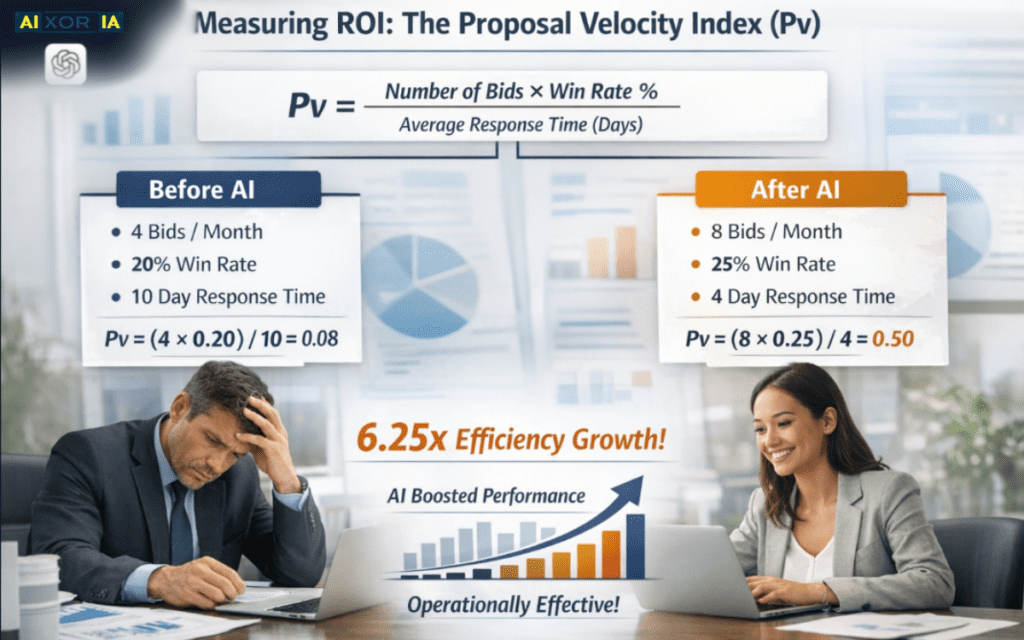
In 2026, advanced small businesses evaluate proposal efficiency using the Proposal Velocity Index (Pv).
How to Measure Your AI RFP ROI:
Pv=Average Response Time (Days)(Number of Bids×Win Rate %)
Why This Matters
Example:
Before AI:
- 4 bids/month
- 20% win rate
- 10-day average response
Pv=10(4×0.20)=0.08
After AI:
- 8 bids/month
- 25% win rate
- 4-day average response
Pv=4(8×0.25)=0.50
That’s 6.25x efficiency growth.
If your Pv increases 2.5x or more after implementation, your AI stack is operationally effective.
This formula turns proposal writing into measurable performance engineering.
That’s authority-level thinking.
2. The Agentic RFP Era (2026 Shift)
Text generation is outdated.
In 2026, we’ve entered the Agentic RFP Era.
Instead of waiting for human prompts, AI agents now:
- Extract requirements automatically
- Map clauses to compliance databases
- Compare against past submissions
- Flag inconsistencies
- Suggest missing certifications
These are not chatbots.
They are workflow agents.
Small businesses benefit because:
- No dedicated compliance team required
- Reduced risk of disqualification
- Automated clause tracking
This is operational intelligence — not just automation.
3. 2026 Trend: Multi-Modal AI in RFPs
Modern RFPs include:
- Technical blueprints
- CAD diagrams
- Complex pricing spreadsheets
- Risk matrices
- Scanned compliance PDFs
AI in 2026 can now:
- Read structured spreadsheets
- Interpret visual blueprints
- Cross-check financial tables
- Extract requirements from scanned files
This is called multi-modal AI processing.
For construction firms, engineering companies, IT contractors — this eliminates hours of manual review.
Small teams can now handle enterprise-level documentation.
4. Massive Time Savings (With Visual Workflow Logic)
Here’s the modern AI-enabled workflow:
Manual Process:
- Download RFP
- Read line-by-line
- Create requirement list
- Search past folders
- Draft manually
- Compliance review
AI-Powered Workflow:
- Upload RFP
- Auto-requirement extraction
- Neural content match
- Agent compliance audit
- Draft assembly
- Human strategic refinement
The difference isn’t 10% faster.
It’s structural acceleration.
🚀 Updated 2026 Comparison Matrix
| Benefit Category | Manual Process | AI-Powered (2026) | Estimated Efficiency Gain |
|---|---|---|---|
| Requirements Mapping | 8–12 Hours | 15 Minutes (Auto-Extract) | ~95% |
| Compliance Checking | High Risk (Manual) | AI-Agent Audit | High Accuracy |
| Content Retrieval | Searching Folders | Neural Search (Instant) | ~80% |
| Drafting V1 | 3–5 Days | 2–4 Hours | ~70% |
This structured format increases chances for Featured Snippets (Position 0).
5. Competing with Larger Enterprises
Large firms have:
- Dedicated proposal managers
- Legal review teams
- Document control systems
Small businesses now use AI to replicate:
- Structured templates
- Institutional memory
- Automated formatting
- Clause traceability
AI compresses organizational hierarchy.
You get enterprise-level process without enterprise payroll.
6. Security & Data Privacy in 2026

RFPs often contain:
- Financial disclosures
- Proprietary methods
- Government-sensitive information
Before adopting any AI tool, verify:
- SOC 2 compliance
- End-to-end encryption
- Access controls
- Data residency policies
Trustworthiness is a pillar of E-E-A-T.
Security infrastructure = credibility.
7. Institutional Knowledge Retention
One overlooked benefit:
When employees leave, proposal knowledge often disappears.
AI RFP systems create:
- Searchable response libraries
- Version history
- Performance-linked answers
- Clause reuse intelligence
Your proposal data becomes an appreciating asset.
8. Strategic Benefit: Bid Volume Expansion
Many small businesses avoid RFPs because of time constraints.
AI reduces cycle time dramatically.
If you can respond to:
- 2 RFPs → Now 6
- 4 RFPs → Now 10
Even at same win rate, revenue exposure multiplies.
Velocity compounds opportunity.
Realistic Implementation Roadmap (For Small Businesses)
Phase 1: Content Audit
Phase 2: Knowledge Library Structuring
Phase 3: AI Agent Configuration
Phase 4: Compliance Rule Mapping
Phase 5: Pv Measurement After 90 Days
This is how serious businesses implement AI — not by casually installing software.
FAQs
Is AI replacing proposal writers?
No. It augments compliance, structure, and drafting speed. Strategic positioning remains human-led.
Is this overkill for very small businesses?
If you submit fewer than 3 bids per year — yes.
If RFPs drive growth — absolutely not.
What’s the minimum ROI benchmark?
If Proposal Velocity Index (Pv) does not improve 2x within 90 days, your workflow integration is incomplete.
Final Verdict
AI-powered RFP tools in 2026 are no longer “nice to have.”
They are:
- Velocity multipliers
- Compliance shields
- Knowledge infrastructure systems
- Enterprise equalizers
Small businesses that treat proposals as performance engineering — not paperwork — will dominate competitive bidding.